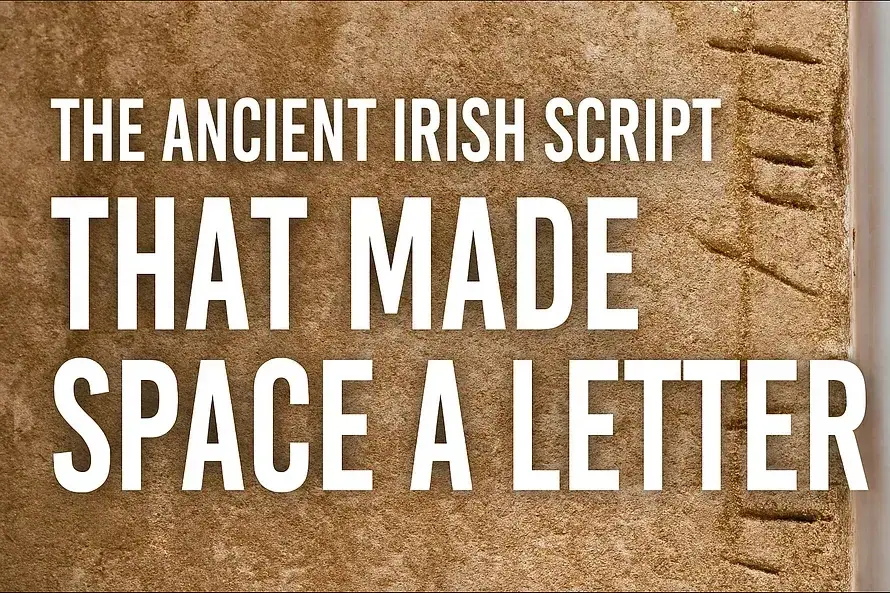
When you read a sentence in English, the spaces between words are invisible — blank gaps that tell your eye where one word ends and another begins. We don’t think of space as a character. It just is.
Ogham thought differently.
The Ogham Space Mark
In the Ogham writing system, the separator between words is not a blank gap but a visible symbol: the Ogham Space Mark, encoded in Unicode as U+1680. It looks like a short horizontal stroke crossing the central stem line — distinct from any of the 25 letter characters, but just as real.
In Unicode terms, the Ogham block runs from U+1680 to U+169F. The very first character in the block — U+1680 — is not a letter at all. It is a space. A visible, intentional mark that says: here is where one word ends and another begins.
Why Does This Matter?
Because Ogham was primarily a carved script — cut into stone edges and wooden posts — a blank space would have been meaningless. There is no “blank” in stone. If you want to separate two words, you need a physical mark.
The Ogham Space Mark is that mark. It is a word divider, but unlike the interpunct used in Latin inscriptions or the spacing conventions of Greek, it was standardised enough to be included as a distinct character in the Unicode standard over 1,500 years later.
Space as a Glyph
What makes this philosophically interesting is the implication: in Ogham, space is not the absence of something. It is a presence. A character with its own form, its own visual identity, its own Unicode code point.
Most writing systems evolved to hide the seams between words. Ogham wears them openly. Every word boundary in an Ogham inscription is marked — not by silence, but by a stroke.
Modern Implications
When digital systems handle Ogham text, U+1680 should be used for word separation rather than the standard ASCII space (U+0020). This distinction matters for accurate rendering and text processing of Ogham inscriptions in databases and digital archives. Our Ogham stone database uses proper Unicode encoding throughout.
It’s a small detail. But it’s a reminder that the way a script handles space tells you something deep about how its creators thought about language and writing.
See Ogham in action with our free Ogham translator — fully Unicode-compliant.