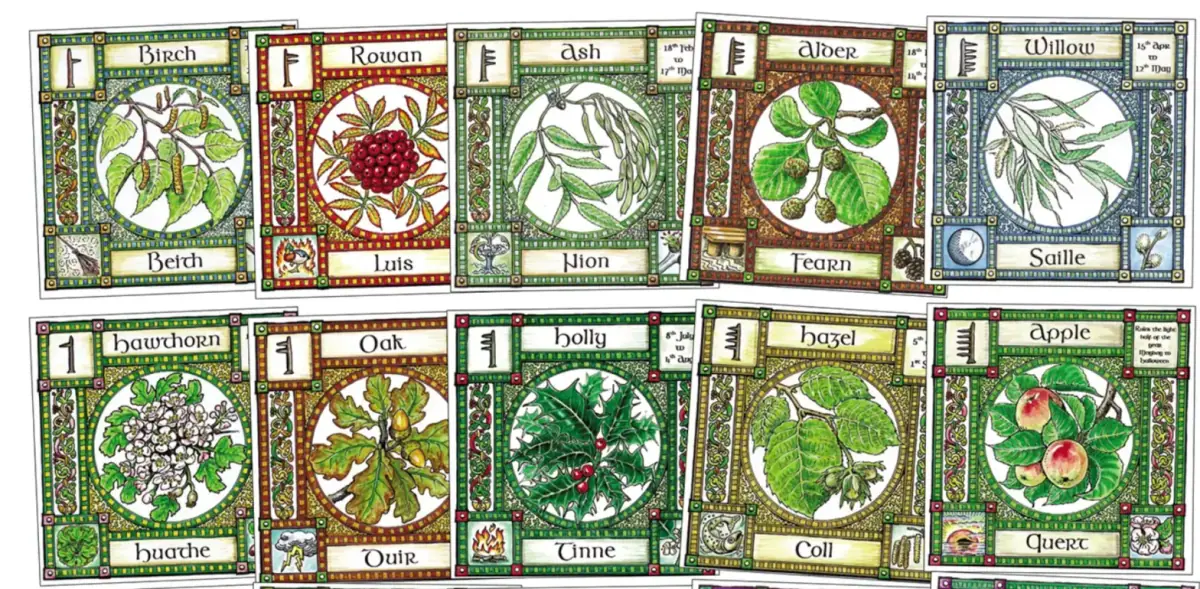
Ask most people what they know about Ogham and “the Celtic Tree Alphabet” comes up almost immediately. Websites, tattoo guides, and jewellery descriptions routinely describe each Ogham letter as standing for a specific tree. The association has become so embedded that it feels like basic historical fact.
The reality is more complicated, and more interesting.
The Letter Names
The standard Ogham alphabet has 20 letters arranged in four groups (aicmí), plus five additional characters called the forfeda. Each letter has a name:
B-aicme: Beith (B), Luis (L), Fern (F), Sail (S), Nion (N)
H-aicme: Huath (H), Dair (D), Tinne (T), Coll (C), Quert (Q)
M-aicme: Muin (M), Gort (G), Ngéadal (NG), Straif (STR), Ruis (R)
A-aicme: Ailm (A), Onn (O), Ur (U), Edad (E), Idad (I)
Some of these names are genuinely tree words in Old Irish. Beith is birch. Fern is alder. Sail is willow. Dair is oak. Coll is hazel. That’s five out of twenty, and a few more have loose plant associations. But the majority don’t, and some have no natural-world reference at all.
Tinne, usually translated as holly, more likely means “metal bar” or “bacon flitch” in Old Irish. Muin carries meanings of love, neck, or treachery, nothing to do with vine. Gort means field or territory. Luis is obscure, possibly connected to light or vegetation in a general sense. Ailm may even derive from the Greek alpha.
The tidy one-letter-one-tree system is a later construction, not a feature the script was born with.
Where the Tree Alphabet Idea Comes From
The main source for the tree associations is a medieval Irish text called the Auraicept na nÉces, sometimes translated as “The Scholars’ Primer”, compiled roughly between 900 and 1200 CE. That puts it several centuries after the earliest Ogham stones were carved.
Medieval Irish scholars were doing something genuinely ambitious. They wanted to show that the Irish language had its own grammatical tradition to set alongside Latin. To do that, they built a native Irish framework for talking about language, and they used trees as the organising metaphor.
The word fid, meaning tree, was repurposed to mean letter. The consonant was called táebomna, literally “the side of a tree bole”. The metaphor also worked visually. The Ogham stem line reads like a trunk, with strokes branching off it. When the script moved from stone into manuscript, the trunk became a drawn line. The tree is genuinely there in the structure of the writing.
To build out the system fully, the Auraicept scholars created etymological explanations linking each letter name to a specific tree, using a method borrowed from the encyclopaedist Isidore of Seville: breaking words apart to find hidden compound meanings. Many of these etymologies don’t hold up to modern linguistic analysis. They were creative scholarship in service of a bigger argument about the status of the Irish language, not straightforward description of what the letter names originally meant.
The modern “Celtic Tree Calendar”, which assigns a tree to each month and connects the whole system to ancient druidic practice, takes all of this considerably further. It was popularised by the poet Robert Graves in The White Goddess (1948) and has been widely repeated since. Academic research has found no historical evidence for this calendar as a pre-Christian system. It is a modern construction built on medieval scholarly elaboration.
So Are the Tree Associations Meaningless?
Not at all.
The connection between Ogham letters and trees is genuinely present in the medieval tradition. Real scholars cultivated it, it was embedded in real manuscripts, and it shaped how the script was understood and taught for centuries. The Auraicept na nÉces was a serious work of Irish learning. The fact that its tree etymologies are sometimes creative rather than strictly accurate doesn’t make them worthless. They tell us a great deal about how medieval Irish people thought about language, nature, and the relationship between the two.
The medieval Ogham Tract assigns each letter not just a tree name but a kenning, a poetic phrase that tries to capture the letter’s essence. These kennings draw on the natural world, seasons, animals, and human experience. The scholar Searles O’Dubhain has argued that these lists served a mnemonic and poetic function, giving practitioners a web of associations to guide composition and memory. Whether or not the trees are literally encoded in the letters, they became inseparable from how the letters were used and passed down.
The Forfeda: The Extra Five
Beyond the standard 20 letters, the Ogham tradition includes five additional characters called the forfeda (extra letters). These were developed later, largely for manuscript use rather than stone inscriptions, and their letter names tend to be more straightforward:
- Ór (gold)
- Uillenn (elbow)
- Iphin/Pín (borrowed from Latin pīnus, pine)
- Emancholl (twin hazel)
- Peith (a variant of beith, birch)
Even here the picture is mixed. Not all tree names, but trees still showing up throughout.
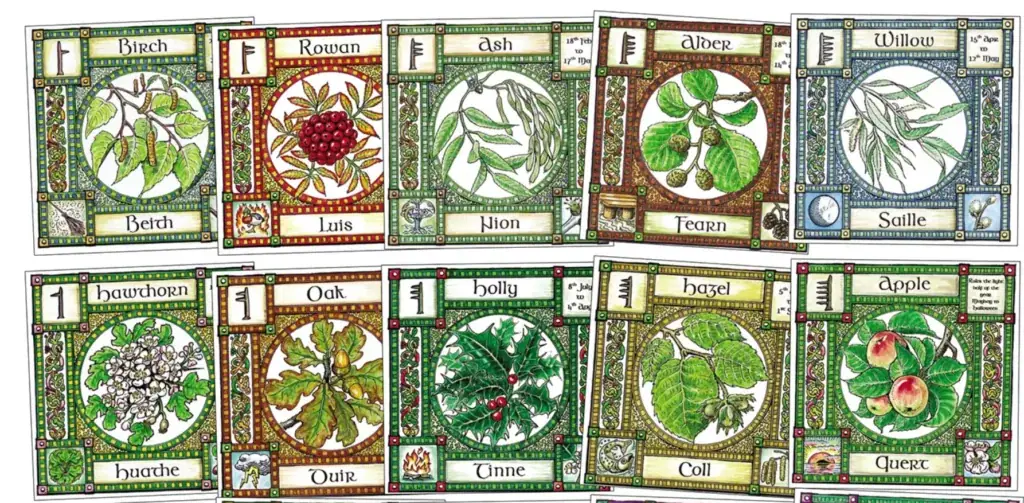 Ogham tree oracle cards (Hedingham Fair). The letter-to-tree associations shown here reflect the medieval and modern tradition.
Ogham and Divination
The tree associations are particularly alive in Ogham divination, the practice of working with the letters as a symbolic system for insight and reflection.
The kennings from the Ogham Tract and the tree associations from the Auraicept together provide a rich symbolic vocabulary. Birch for new beginnings. Oak for strength and endurance. Hazel for wisdom. Yew for death and transformation. Whether these meanings are ancient druidic lore or medieval scholarly invention, they have accumulated real weight over centuries of use.
For those who work with Ogham as a divinatory or meditative tool, the historical question of when a particular meaning attached to a particular letter matters less than the coherence and depth of the symbolic system as a whole. Knowing that the Celtic Tree Calendar as Graves described it was a 20th-century construction is useful context, but it doesn’t dissolve the meaning that practitioners have found in working with the letters. Ogham sits within a long tradition of alphabets used as symbolic systems: runes, tarot, the Hebrew Kabbalistic tradition. In all of these, historical origin and living practice are separate questions.
You can read more about how people work with the system today in our guide to Ogham divination.
Putting It Together
The Ogham alphabet is genuinely ancient, with inscriptions on Irish and British standing stones dating from the 4th to 7th centuries CE. Some letter names really do mean trees. The “Celtic Tree Alphabet” as a complete, systematic correspondence is largely a medieval elaboration, extended further in the modern period.
That history is worth knowing, not because it discredits the tradition, but because it shows how much has been built around these letters across the centuries. People have found meaning in the script at every stage of its history. The tree connection is part of that ongoing story, not separate from it.
Further Reading
- Calder, George. Auraicept na nÉces: The Scholars’ Primer. Edinburgh, 1917.
- McManus, Damian. A Guide to Ogam. Maynooth: An Sagart, 1997.
- McManus, Damian. “Irish letter-names and their kennings.” Ériu 39 (1988): 127–168.
- Moran, Pádraic. “Comparative linguistics in seventh-century Ireland.” Language & History 63/1 (2020): 3–23.
- Graves, Robert. The White Goddess: A Historical Grammar of Poetic Myth. London: Faber & Faber, 1948.