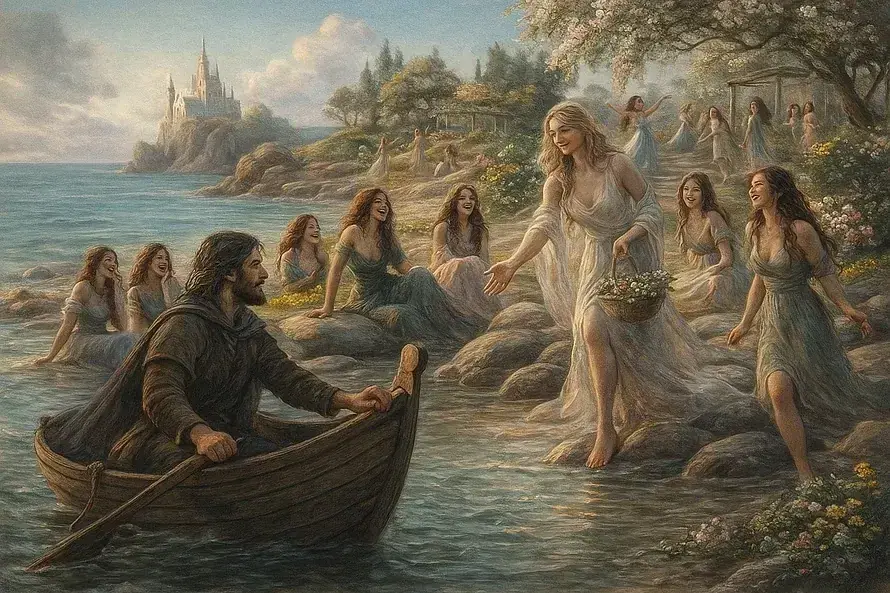
Immram Brain maic Febail — The Voyage of Bran, Son of Febal — is one of the oldest surviving pieces of Irish literature. Dating to around the 7th or 8th century CE, it tells the story of an Irish hero who receives a supernatural invitation to sail west to the Land of Women, a paradise beyond the edge of the known world.
The Silver Branch
The story begins when Bran is lured outside by mysterious music. He falls asleep and wakes to find a silver branch covered in white blossoms beside him. A woman from the Otherworld appears and sings fifty verses describing the land she comes from — a place of eternal youth, abundant food, and no sorrow.
The branch, in Irish mythology, is a token from the Otherworld. To carry it is to be invited; to give it back is to accept the invitation.
Ogham on the Tablets
Before setting sail with his company of 27 men, Bran does something that speaks to how central Ogham was to early Irish literate culture: he records the story on wooden tablets in Ogham script. The act of committing a tale to Ogham writing before a journey of no return carries enormous weight — it is the equivalent of leaving a last testament, a record that the voyage happened and what its purpose was.
The tablets are left behind. Bran and his men sail west.
The Otherworld
What follows is one of the strangest and most beautiful narratives in early Irish literature. The voyagers encounter the god Manannán mac Lir sailing over what appears to be the sea but is, to him, a blossoming plain. Time moves differently in the Otherworld — what feels like a year to the voyagers is many decades in Ireland.
When the crew eventually attempt to return home, one man leaps to shore in longing — and crumbles to ash upon landing, ancient before his feet touch Irish soil. Bran recites his story from the sea, carves it into Ogham, throws the tablets to shore, and sails away permanently.
Why It Matters
Immram Brain is not just mythology. It is the earliest surviving example of an immram — a voyage tale — in Irish literature, and it sets the template for later Christian voyage narratives like The Voyage of St Brendan. The presence of Ogham as the medium for recording Bran’s story tells us something important: by the time this text was written down, Ogham was already understood as ancient, authoritative, and connected to the pre-Christian world.
The tablets Bran leaves behind are a metaphor for literature itself. We read Immram Brain today because someone, like Bran, thought the story worth carving into whatever surface was available.
Explore more about Ogham’s role in Irish mythology or translate your name into Ogham.