If you’ve ever searched for your name in Ogham — maybe for a tattoo, a piece of jewellery, or just pure curiosity — you’ve probably noticed the results vary wildly depending on where you look. Some sites give you one version, some give you another, and none of them explain why.
This guide will tell you exactly how Ogham transliteration works, what the most common mistakes are, and where to find an accurate rendering of your own name.
What Is Ogham?
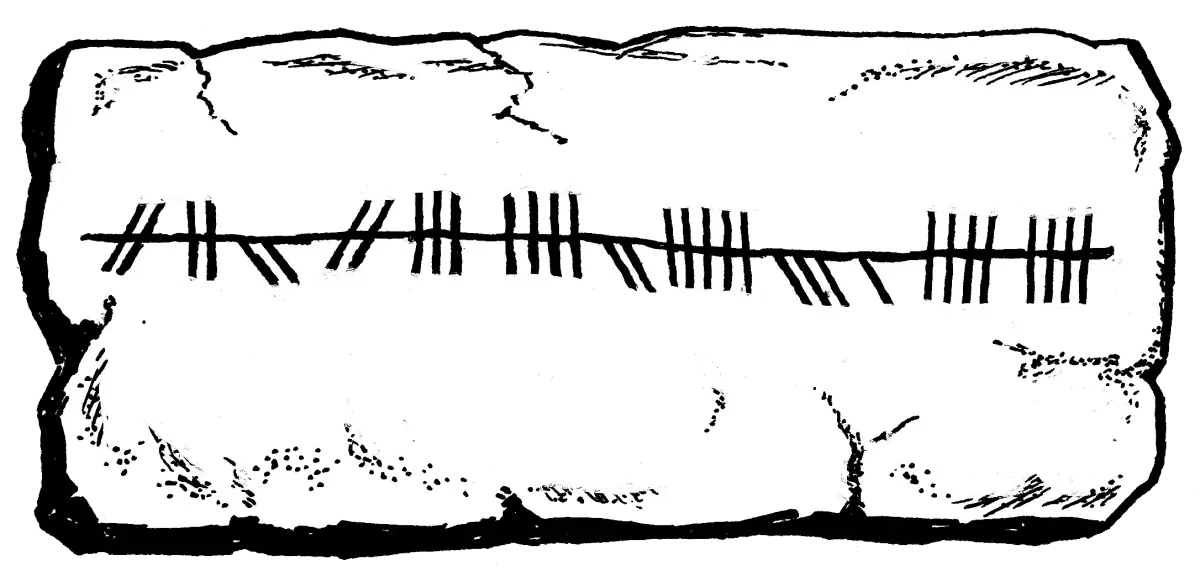
Ogham is an ancient script used primarily in Ireland from around the 4th to 7th centuries CE. It consists of a series of strokes and notches cut along a central stem line — traditionally the edge of a standing stone. Over 400 inscribed stones survive in Ireland, Wales, Scotland, and England.
The script was designed to write Old Irish, not modern English. That distinction matters enormously when you want to write your name in it.
How Ogham Transliteration Actually Works
Ogham is not a cipher that replaces Latin letters with symbols. It’s a phonetic alphabet designed for a specific set of sounds found in Old Irish. When we “write a name in Ogham” today, we’re doing transliteration — mapping the sounds of the name onto the closest matching Ogham characters.
This means:
- Each Ogham character (fid, plural feda) represents a sound, not a letter of the English alphabet
- Some English letters share a sound and use the same Ogham character (e.g. C and K are both rendered as coll)
- Some modern letters have no direct ancient equivalent and require approximation
For most common names, the transliteration is clean and unambiguous. The Ogham alphabet covers the sounds in names like Liam, Niamh, Conor, Aoife, Maeve, Siobhan, and Oisín without any problem.
Where it gets complicated is with letters like W, J, V, and X, which are rare or absent in Old Irish. Different sources handle these differently — which is why you’ll see inconsistencies across websites.
The Most Common Mistakes in Ogham Name Tattoos
Getting an Ogham name wrong in a tattoo is more common than you’d think. Here’s what goes wrong:
1. Using the wrong character for a sound
The most frequent error is treating Ogham as a direct letter-for-letter replacement for the English alphabet. For example, the letter Q in a name like “Quinn” is a /kw/ sound — in Ogham it should be rendered with quert (or approximated with coll + uath), not just whatever looks “closest” visually.
2. Getting the direction wrong
Traditional Ogham is written bottom to top on a vertical stem. On a horizontal surface (like a page or skin), it reads left to right. Many online generators produce it vertically but orient it incorrectly. If your tattoo artist copies from a bad source, the inscription could be written upside down.
3. Spacing and stem line omissions
Ogham characters must be read along a stem line. Without that central line, individual strokes become meaningless. Some designs remove the stem to make the tattoo “cleaner” — which makes it unreadable to anyone who knows Ogham.
4. Using forged or invented characters
A handful of characters in popular use today (particularly for sounds like ph, th, and ng) come from medieval manuscript traditions rather than the classical monumental inscriptions. These are legitimate extensions of the script, but some online generators invent characters with no historical basis at all. If a character doesn’t appear in any reference work, treat it with scepticism.
What Do the Letters in Your Name Actually Mean?
One of the most interesting things about Ogham is that each character has a name — and those names are tree names (or names of other plants and objects) from Old Irish.
Here are some of the most common Ogham characters and their traditional names:
| Ogham | Name | Traditional meaning |
|---|---|---|
| ᚁ | Beith | Birch tree |
| ᚂ | Luis | Rowan / Herb |
| ᚃ | Fearn | Alder tree |
| ᚄ | Sail | Willow tree |
| ᚅ | Nion | Ash tree |
| ᚆ | Huath | Hawthorn / Fear |
| ᚇ | Dair | Oak tree |
| ᚈ | Tinne | Holly / Iron bar |
| ᚉ | Coll | Hazel tree |
| ᚊ | Quert | Apple tree |
| ᚋ | Muin | Vine / Neck |
| ᚌ | Gort | Ivy / Field |
| ᚍ | Ngeadal | Reed / Broom |
| ᚎ | Straif | Blackthorn / Sulphur |
| ᚏ | Ruis | Elder tree |
| ᚐ | Ailm | Fir / Pine tree |
| ᚑ | Onn | Gorse / Ash |
| ᚒ | Ur | Heather / Earth |
| ᚓ | Edad | Aspen tree |
| ᚔ | Idad | Yew tree |
This tree association comes from the Ogham Tract, a medieval Irish manuscript that documented the script and attached meanings, kennings, and lore to each character. The connection between letters and trees is the origin of the phrase “the language of trees” — which you’ll sometimes see used to describe Ogham poetically.
Irish Names vs. English Names: A Note
If your name is of Irish origin — Aoife, Ciarán, Muireann, Tadhg, Siobhán — you may want to think carefully about which version you use. These names existed in Old Irish and the Ogham transliteration of the Irish spelling is often more historically authentic than transliterating the anglicised version.
For example: Siobhán is the Irish form; Shevawn is an anglicised phonetic spelling. The Ogham for Siobhán maps cleanly to the original Irish sounds. The Ogham for Shevawn treats it as an English word — not wrong, but further from the original.
If your name has Irish roots, it’s worth looking up the original Irish spelling first.
Find Your Name in Ogham
Ready to see your name? We have two tools that can help:
- Ogham Translator — convert any name or word instantly, with a clean visual output you can save or share
- Popular Names in Ogham — browse hundreds of names already rendered in Ogham, with individual pages for each one
Each name page shows the Ogham characters, the transliteration breakdown, and the traditional letter names — so you can understand what you’re looking at, not just copy a symbol you don’t recognise.
Ogham has survived for over 1,500 years on standing stones across Ireland and Britain. Getting your name right in the script is a small act of respect for one of the oldest written languages in western Europe — and it means a lot more when you understand what you’re actually writing.