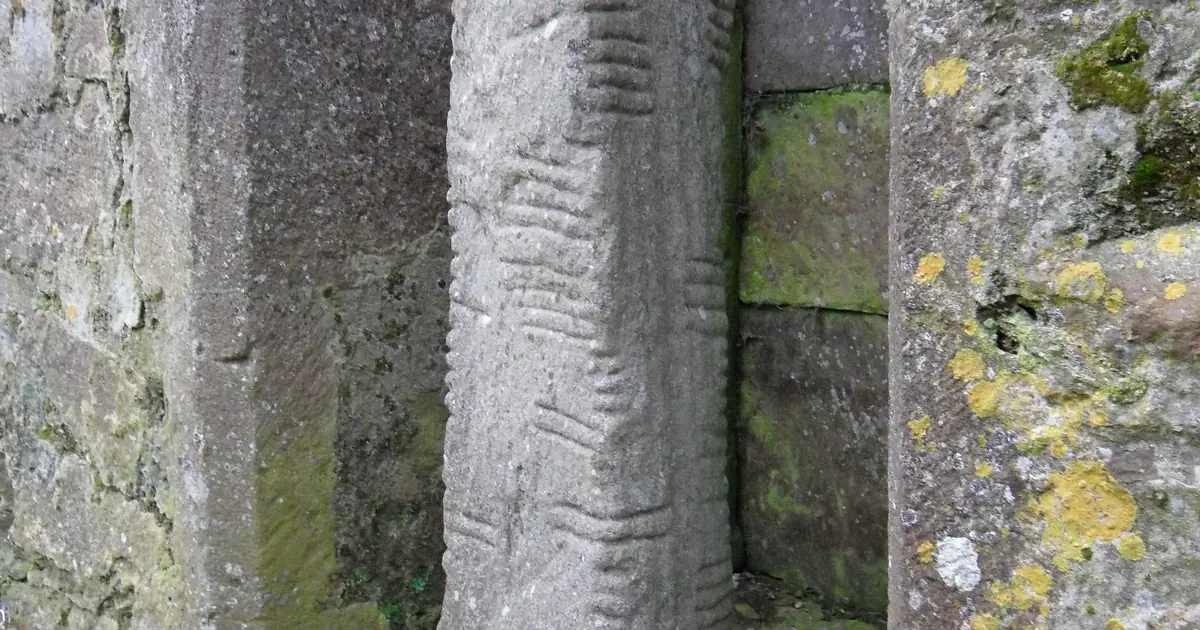
If you have ever tried to search for information about the ancient Irish script, you may have noticed something confusing: sometimes it is spelled ogham, sometimes ogam, and occasionally even ogum. Are these the same thing? Is one correct and the other wrong? And how exactly do you pronounce it?
The short answer is that both spellings are correct — but they reflect different periods of the Irish language, and the choice between them carries a quiet but meaningful signal about context and scholarly convention. Here is a clear breakdown of where both forms come from, how to say them, and when to use each.
What Does the Word Ogham Mean?
Before tackling the spelling, it is worth asking what the word actually means. The origin of ogham (or ogam) is genuinely uncertain, and the question has occupied Celtic scholars for well over a century.
The most widely discussed theory links the word to the name of the god Ogma — a figure in early Irish mythology who is credited in medieval sources as the inventor of the script. But this etymology is difficult to establish on purely linguistic grounds, and not all scholars accept it. The Old Irish form of the name and the word for the script do not align neatly enough to make the connection certain.
A separate proposal connects ogam to a Proto-Celtic root related to the idea of a pointed or incised mark, which would fit the visual character of the script — notches and strokes across a stem line. This interpretation focuses on what the script does rather than who invented it.
Whatever its ultimate origin, ogam appears in Old Irish texts as the name for both the individual letters and the script as a whole. It is one of the oldest native Irish words for a writing system.
Old Irish: Ogam
Ogam is the original spelling, and the correct form in Old Irish. Old Irish was spoken and written roughly between the 6th and 10th centuries CE — the same period in which most surviving Ogham stone inscriptions were composed.
In Old Irish, the word is a single syllable: something like OH-am. There is no ‘gh’ in the spelling because, at that stage of the language, the sound represented by ‘gh’ in modern Irish had not yet undergone the changes that would eventually lead to its insertion into the written word.
Scholars working on early Irish linguistics, medieval manuscripts, and the epigraphy of the inscribed stones themselves tend to use ogam (lowercase, one syllable) because it is the historically accurate form for the period they are discussing.
The major academic corpus of inscriptions — the OG(H)AM project at the University of Glasgow — uses ogam consistently in its Irish-language and Old Irish contexts, and the quirky parenthesised project title is itself a nod to this ongoing debate.
Modern Irish: Ogham
The spelling ogham reflects how the word evolved in Modern Irish — the form of the language spoken from roughly the 17th century onwards and standardised into the written Caighdeán Oifigiúil (Official Standard) used in Ireland today.
In Modern Irish, the word is still a single syllable but spelled with ‘gh’: ogham. The ‘gh’ here does not represent a sound that is actually pronounced; it is a fossil of a historical sound change. The modern Irish pronunciation is approximately OH-əm — the first syllable rhymes with ‘go’, and the second is a brief unstressed vowel, like the ‘a’ in ‘about’.
This is the spelling most commonly used in everyday English writing, in popular books about Celtic heritage, on tourist signage in Ireland, and on this site. It is also the form used by most professional tattoo artists and jewellery makers who work with the script.
English Usage: Both Are Acceptable
In English-language scholarly literature, both spellings appear, and neither is definitively wrong. You will find ogham in general-audience books, newspapers, and cultural heritage contexts. You will find ogam more often in academic journals, linguistic monographs, and epigraphy publications.
The practical convention, followed by most researchers and writers today, is broadly as follows:
- Ogham — when writing in English for a general audience, when discussing modern use of the script (tattoos, jewellery, transliteration), or when following Irish Tourism and cultural heritage conventions.
- Ogam — when working in an Old Irish or scholarly linguistic context, when quoting from medieval sources, or when following the conventions of Celtic studies journals and the Glasgow OG(H)AM project.
Neither is a mistake. The choice is one of register rather than correctness.
How to Pronounce Ogham
Regardless of which spelling you use, the pronunciation in English is the same: OH-əm (two syllables, stress on the first).
The ‘gh’ is silent. Do not pronounce it as in ‘ghost’ or ‘ghee’ — it is not a hard G sound. The word sounds like ‘OAK-um’ without the K, or like the first two syllables of ‘ocean’ cut short.
A common mispronunciation among non-Irish speakers is OG-ham (with a hard G and a separate H sound). This is understandable but wrong. The word follows the same pattern as the Irish word for river (abhainn, pronounced OW-in) or the common name Siobhán (pronounced shih-VAWN) — Irish spelling often looks opaque to English eyes.
For reference, a rough phonetic guide:
| Spelling | Language | Pronunciation |
|---|---|---|
| Ogam | Old Irish | OH-am |
| Ogham | Modern Irish | OH-əm |
| Ogham | English | OH-əm |
Should It Be Capitalised?
In English, Ogham is typically capitalised when used as the name of the script, in the same way that Latin or Greek are capitalised when referring to those writing systems. This is the standard convention in most English-language publications.
When used as an adjective in a general descriptive sense — ogham stone, ogham inscription — capitalisation is less consistent, and you will find both Ogham stone and ogham stone in reputable sources. The key is to be consistent within a single piece of writing.
In Irish, the word follows standard Irish capitalisation rules: lowercase unless beginning a sentence.
Why Does This Matter?
For most readers, the choice of spelling is a minor stylistic point. But it matters for a few reasons worth keeping in mind.
First, if you are researching the script seriously, understanding the difference between ogam (Old Irish) and ogham (Modern Irish / English) helps you navigate the scholarly literature more effectively. A paper that consistently uses ogam is likely operating in a technical linguistic register; one that uses ogham is likely more accessible.
Second, for Irish-language learners and heritage researchers, knowing that ogham is the Modern Irish form — and that its pronunciation is fixed and straightforward — removes a common source of confusion.
Third, for anyone planning an Ogham tattoo or using the script in a creative context: the spelling you choose in the text around your design sends a small but real signal. Both are appropriate; ogham is simply more widely recognised.
The Bottom Line
Ogam is the Old Irish original. Ogham is the Modern Irish and standard English form. Both are correct. Both refer to the same ancient Irish script of notches and strokes, one of the oldest written records of any Celtic language.
Whether you prefer the older scholarly spelling or the modern popular one, what matters most is the script itself: a remarkable system invented in early medieval Ireland that has survived 1,500 years and is still being carved, drawn, and debated today.
Want to try the script yourself? Use our free Ogham translator to convert any name or word into authentic Ogham characters — or read our complete guide to the Ogham alphabet to learn all 25 letters.