Provenance
Discovery: Found in 1841 by Zachariah Hawkes and John Windele in a souterrain (CO122-049002-) located in the northern half of a rath (CO122-049001-), one of six known raths in the townland, at least three of which contain souterrains. Two other ogham stones (I-COR-018 and I-COR-019) were also discovered in the souterrain. Counting from the entrance, this stone was the fourth out of the souterrain’s seven roofing slabs. All three stones were ‘taken out of the cave sometime toward the end of the nineteenth century, by the proprietor, the late Mr. R. Bence Jones, and placed on a rockery in his garden: but afterwards acquired from him by the Royal Irish Academy’ (Macalister 1945, 73).
Findspot: Ahalisky (Achadh Loiscthe), Co. Cork, Ireland (ITM Coordinates: 541423, 547985)
Current repository: Ireland National Museum of Ireland (inv. no. RIA 1927:2)
Last recorded location(s): Now in the National Museum of Ireland, where it was examined and recorded in 3D (using Artec Eva structured light scanner) by the Discovery Programme for the Ogham in 3D project in 2015.
Support
National Monuments Service SMR ID: CO122-049003-
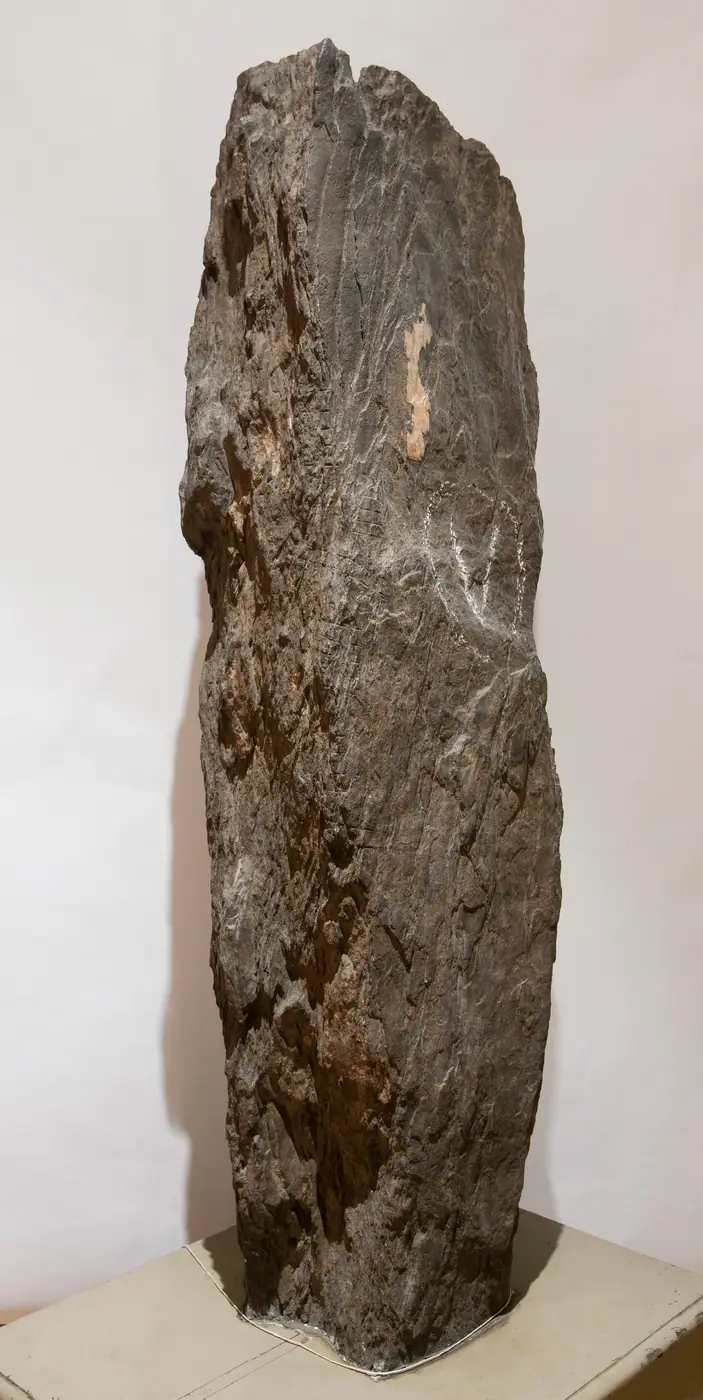
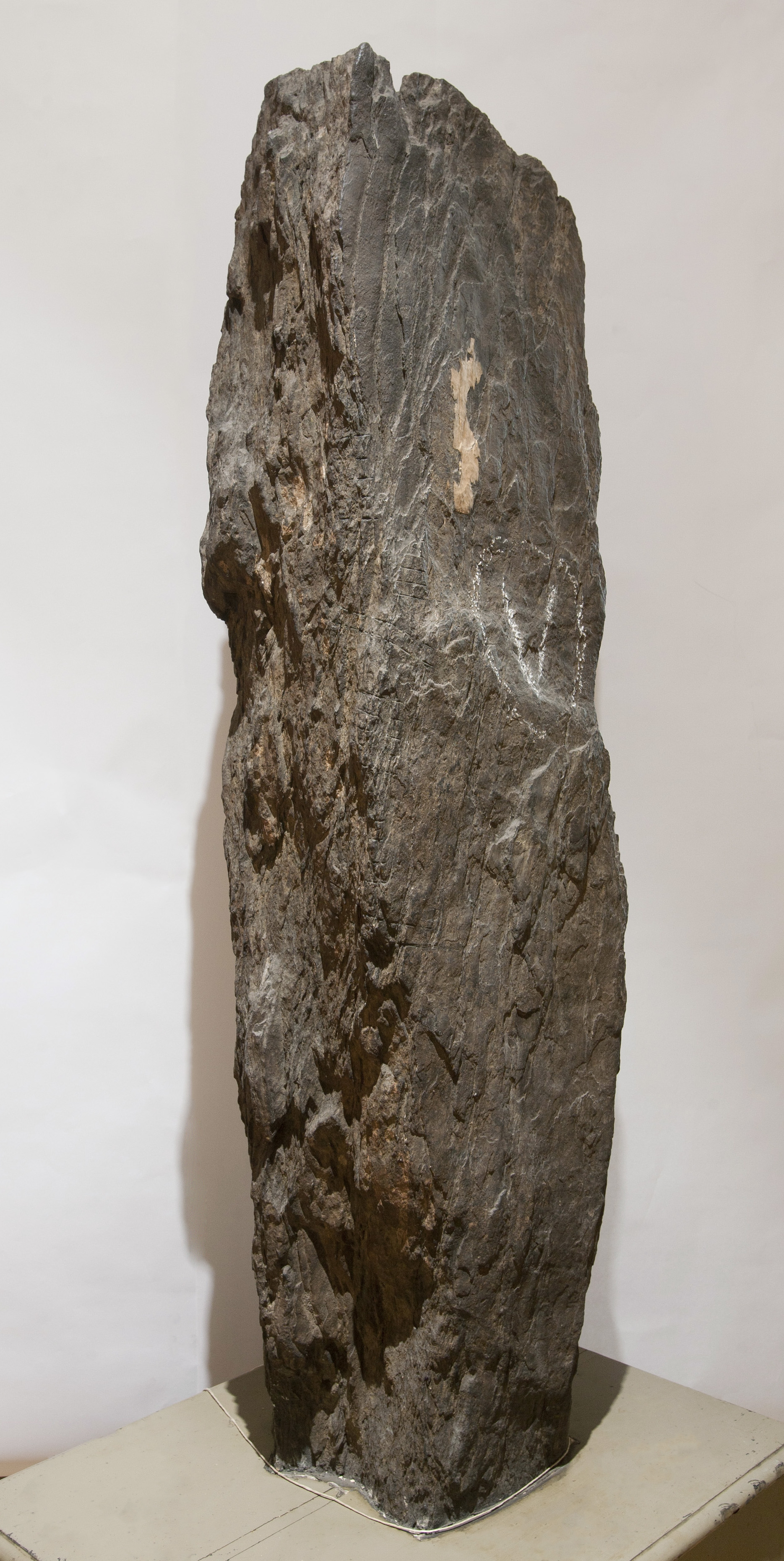
Object type: Pillar
Material: Siltstone
Dimensions: H 1.83 × W 0.36 × D 0.34 m
Condition: This pillar was reused as a lintel in the construction of a souterrain. The edges of the stone are very rough and uneven. Brash (1879, 145) recorded the height as 1.83m (6ft.). The current visible extent above the display stand is 1.35m (4ft. 5in.).
Inscription
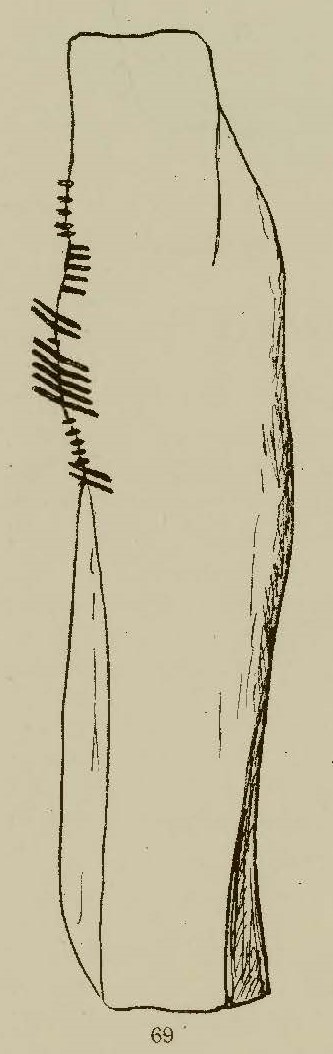
Text field: The inscription reads upwards on the dexter/left angle of one of the flat faces occupying roughly the middle third of that angle.
Letters: The ogham strokes in this inscription are so fine that they appear to have been knife-scored with breaks in the strokes where the stone surface is uneven. Macalister (1945, 73) remarked that ‘the notches of the final I are rather long, and misled early decipherers into reading the letter as Q. Brash makes the A into O, but there is only one notch’.
Date: Possibly fifth century (linguistic)
Edition
Ogham text: ᚌᚔᚏᚐᚌᚅᚔ
Transcription: GIRAGNI
Translation
of Gerrán (*Girragnas)
Commentary
McManus (1991: 107) and Ziegler (1994: 184) connect this name with the OIr. adjective gerr ‘short, small’, perhaps in the meaning ‘short-haired’; corresponding OIr. formations with -án are gerrán ‘castrated horse’ and the individual name Gerrán. While this comparison is formally possible, it cannot be squared with the received etymology of gerr < PIE *g̑ʰerso- (IEW 443; Stifter 2023: §§ 3.2., 11.3.1.), which leaves the I of GIRAGNI unaccounted for. Therefore, either GIRAGNI and gerr are not related, or the traditional etymology of the latter is wrong. The retention of all inherited sounds makes it possible that the inscription belongs to the 5th century.
References
- Brash 1879, 145-148
- Macalister 1945, 73, no. 69
- McManus 1991, 97, 107
- Power, Byrne, Egan, Lane, and Sleeman 1992, 124, no. 1028
- Ziegler 1994, 184