Provenance
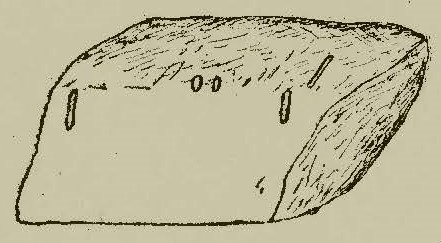
Discovery: Discovered during excavation in 1934, lying ‘lengthwise along the passage’ of a souterrain, ‘just under the surface soil, on top of the filling stones’ (Mongey 1935, 267). The exact location of the souterrain is now unknown. A fragment with ogham-like marks was also found and read by Macalister (1935, 149) as BHOH or BHOH. Macalister (1945, 278) dismissed it as ‘of no epigraphic importance’. It was reportedly sent to the museum with the larger stone but its current whereabouts is unknown.
Findspot: Fox’s Castle (An Baile Beag), Co. Waterford, Ireland (Precise location unknown)
Current repository: Ireland National Museum of Ireland (inv. no. 1934:413)
Last recorded location(s): National Museum of Ireland (seen and recorded in 3D in May 2016).
Support
National Monuments Service SMR ID: WA024-080002-
Object type: Fragment
Material: Tuff
Dimensions: H 1.45 × W 0.46 × D 0.20 m
Condition: The stone (volcanic tuff) is quite damaged and irregularly shaped, which may be the result of its reuse as a souterrain lintel.
Inscription
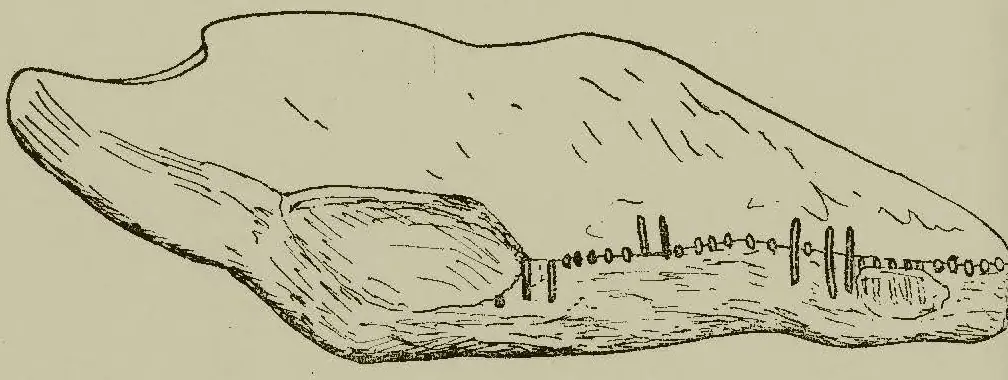
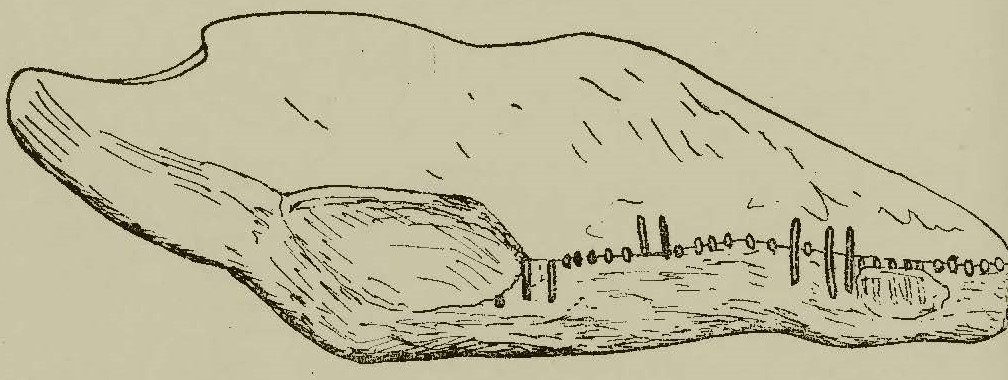
Text field: Only one angle has part of a damaged inscription surviving (left angle downwards or right upwards). The original orientation of the stone/inscription when it was upright is unclear.
Letters: The ogham inscription is both chiselled and pocked. The consonant strokes are pocked but vowel strokes appear to have been executed using a flat chisel and are wedge-shaped. With regard to spacing, there is no clear evidence of extra space between words or letters. The one exception is the extra space commonly used to distinguish between successive letters from the same aicme (here A and I). The spacing between individual strokes is in places uneven with, for example, more space between the strokes of the consonants (20-30mm) than between vowel strokes (15mm). This may, however, be due to roughness of the stone. The vowels strokes are short, approximately 10-15mm long and similarly wide. The few surviving consonant strokes are up to four times longer (40-50mm) and although many are damaged, they appear to be of average width (5mm). Macalister (1935, 150) notes that ‘some of the consonantal scores in this inscription give an impression that I have derived from other inscriptions that the engraver began by making a series of vowel-like notches upon the edge of the stone and then developed these into consonant scores as was required by the sense to be conveyed. There is a nick between the second and third scores of the V, which has no meaning - it may be a piece of faulty setting-out, stopped just after it had begun’.
Edition
Transcription: [---A]ṾỊ DAIMẠGṆI
Critical apparatus:
- The beginning of the inscription is lost. The first visible signs are two strokes of the B-aicme, probably the remains of a V (3 strokes) and part of the formula word AVI. Macalister (1945, 278; 1935, 150) recorded the ‘distal tip’ of a third stroke (preceeding the two) but this is not clear. Regarding the final I of a possible AVI, Macalister (1935, 150) describes it as ‘much worn, the first and third notches being effaced’. 2. Regarding DAIMAGNI, Macalister (1935, 150) notes that ‘DAI is quite clear. The B-half of the M (which is drawn at right angles to the edge, not sloped) is broken. The vowel following M looks at first sight like O, but the second notch, on careful examination with a strong electric lamp, is seen to be an accidental fracture and the first notch is centrally placed between the M and the G. The G is quite clear, but a spall has carried off all but the butts of the following N-scores, so that a careless reader might take the letter for I. The final I is quite clear’.
Translation
of the descendant of *Dáemán
Commentary
Since all other occurrences of AVI are preceded by an individual name and sometimes also by a patronym, it is very likely that this inscription must have originally also contained an individual name, which has been lost through damage to the stone.
DAIMAGNI appears to be a formation with the individualising and hypocoristic suffix *-agno- from a stem *dai̯mo- or *dai̯mmo-, a nominal stem that is otherwise unknown. Ziegler (1994, 163) compares the derivational basis of DAIMAGNI with that of the adjective daimech ‘with assent or consent; kind, friendly, affectionate’, for which she postulates the diphthong áe/aí on the basis of the comparison with the name. However, this adjective, which was included in the original print edition of DIL, was derived from Peter O’Connell’s dictionary of Modern Irish; it has since been removed from eDIL. The entry dáimeach in Dinneen’s dictionary rather suggests the long monophthong á, and an adjectival formation from the noun dám ‘company, relationship, affection’. It can therefore not be used to illuminate the present name. Neither can her other comparison with the word daim, for which she quotes the old definition ‘free will’, but which in fact is just a form of the word dom, dam ‘house’ (LEIA D-9 ). Finally, Ziegler’s rough equation with the OIr. names Daimén, Daiméne, Daimíne etc. has to be rejected, since they are doubtless productively formed hypocoristics of the noun dam ‘ox, stag’. Ultimately, the etymological analysis of DAIMAGNI must remain obscure. No population group of the name *Uí Dáemáin is known from the historic record.
The retained genitive ending -I and the preserved -G- of the suffix are conservative features, but either could be due to orthographic, not phonetic conservativism.
References
- Macalister 1935, 149-150
- Macalister 1945, 277-278
- Mongey 1934, 265-268
- Ziegler 1994, 107, 163