Provenance
Discovery: First published in 1916 by Macalister noting the discovery ‘several years’ previously by Sergeant Lyons of Athenry. Macalister (1945, 7-8) records that the stone had previously been a ‘kneeling-stone’ on a dwarf wall surrounding a well dedicated to St Mobhí [Tobar na Bachaille ‘the Well of the Crozier’], and that at some later date it was moved to its current site: ‘upright on a low altar-like structure north of the well’. Macalister (1945, 8) suggested that a fracture across the stone’s top, cutting off the inscription, was the result of deliberate action, ‘presumably by the masons who built the wall around the well’.
Findspot: Rusheens West (An Roisín Thiar), Kilmovee (Cill Moibhí ‘Church of Mobhí’, Co. Mayo, Ireland (ITM Coordinates: 555640, 794299)
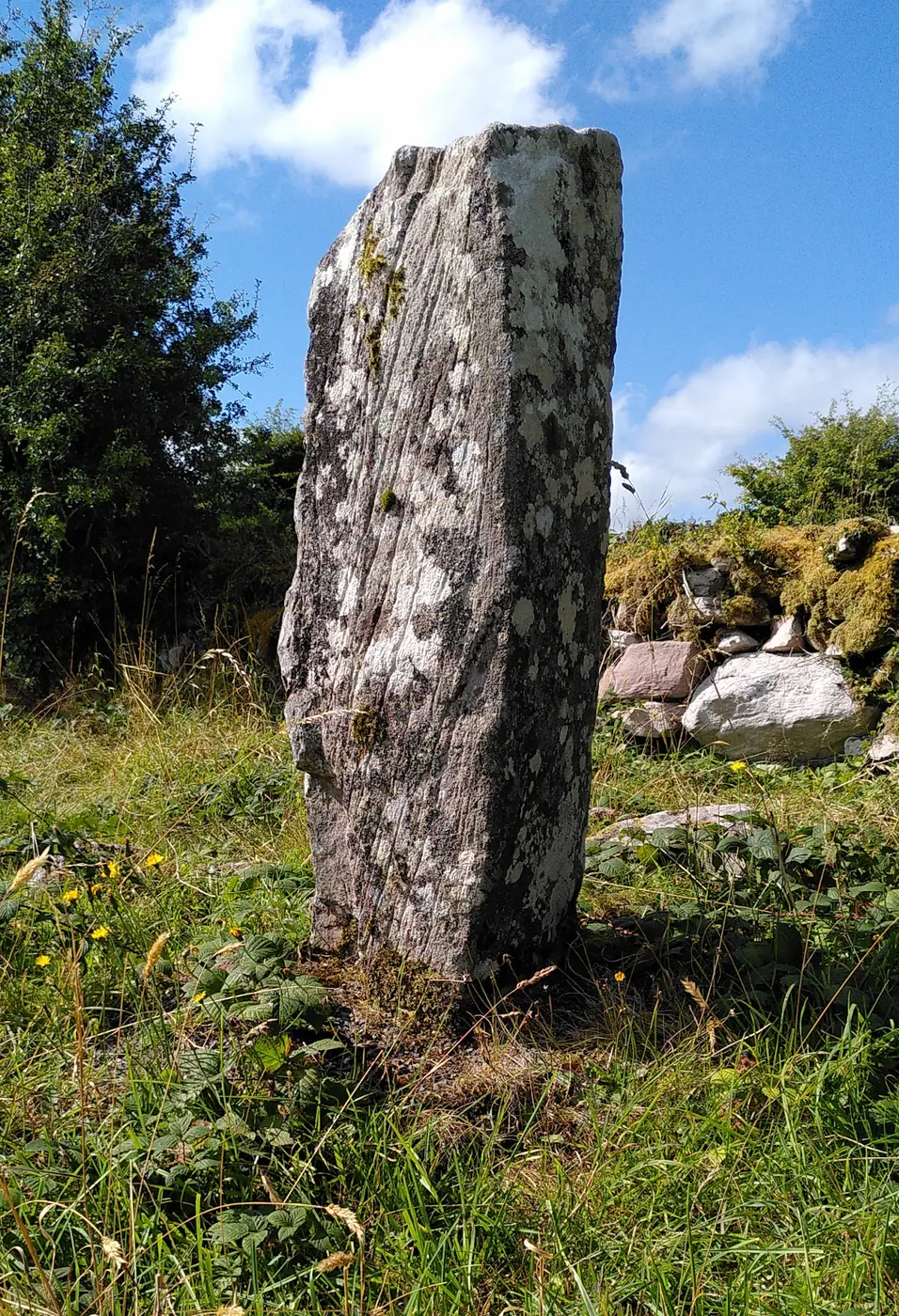
Last recorded location(s): Located ‘in the NE corner of a field of rough, damp, rush-grown pasture, on a low rise, 2m to N of a holy well (MA073-013----). A church (MA073-014001-) and graveyard (MA073-014002-) are located c. 250m to SE, and there is a possible ecclesiastical enclosure (MA073-011001-), named Killerrikeen [Cill Ericín], c. 240m to W… The stone is set upright in a bed of concrete on top of a circular stone-built platform (diam. 3.2m; H 0.45m at N, 1m at S). The perimeter of the platform is defined by a roughly coursed wall of boulders and large, horizontally-laid stones, rising slightly proud of the flat top of the platform. The platform is built up on the S side to compensate for a gentle fall of ground on that side. The top and sides are largely obscured by sod and moss’ (Archaeological Survey of Ireland, Field Report 2017). 3D recorded for the OG(H)AM project and as part of the Kilmovee Heritage Trail project supported by Mayo County Council Heritage Office in 2021.
Support
National Monuments Service Record Number: MA073-012----
Object type: Pillar
Material: Schist
Dimensions: H 1.28 × W 0.40 × D 0.40 m
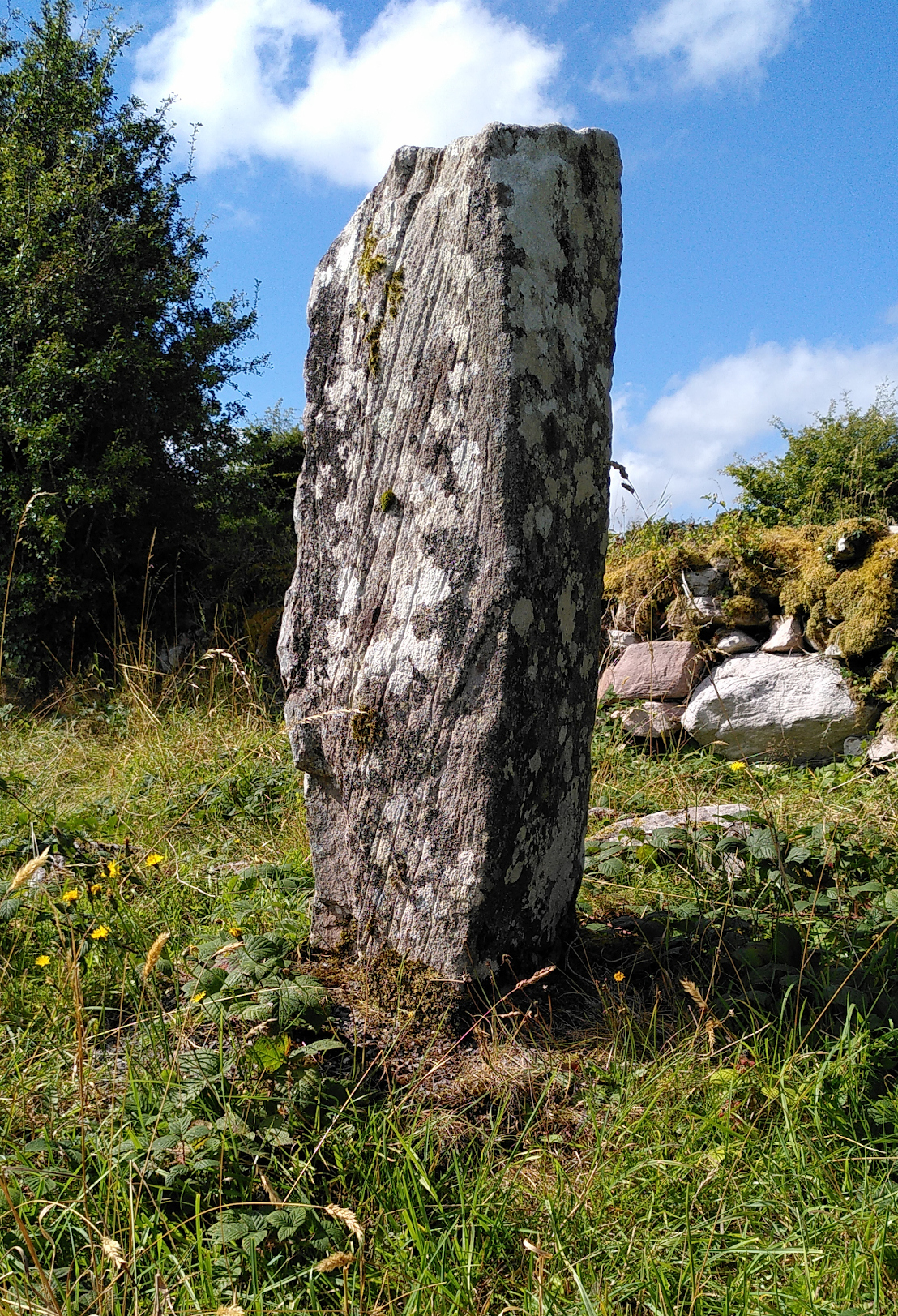
Condition: ‘The flattish top (0.4m E−W; 0.25m N−S) of the stone has a slight slope to S, and is corrugated on a roughly N−S axis by several natural fissures which continue as fine striations or cracks obliquely down the N and S faces of the stone. There is an angular indentation in the lower SW corner of the stone, giving the stone an irregular cross-section at ground level. All exposed surfaces of the stone are moderately blotched with lichens’ (Archaeological Survey of Ireland, Field Report 2017).
Inscription
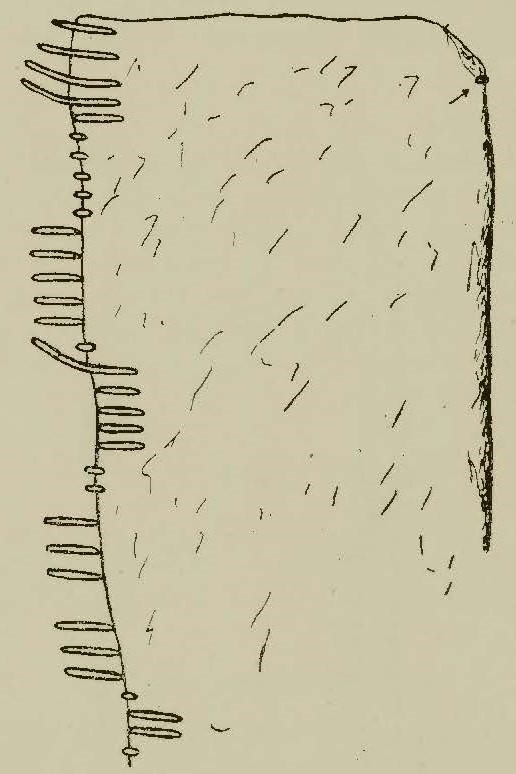
Text field: The stone is ‘square in cross-section and rectangular in shape, tapering slightly towards the top, bearing an ogham inscription on the NE angle’ (Archaeological Survey of Ireland, Field Report 2017). The inscription is on approximately the upper two thirds of the angle (reading up). Macalister (1945, 7) notes a possible single vowel notch towards the top of the opposite angle. He also notes the ‘deceptive score-like appearance’ of the natural fissures running down from the top.
Letters: The inscription is pocked and rubbed (Macalister 1945, 7). The scores and notches are generally fairly uniform and evenly spaced (although the S scores appear a little cramped) with only the two T’s separated by extra space.
Date: fifth century A.D. (linguistic)
Edition
Ogham text: ᚐᚂᚐ̣ᚈᚈᚑᚄ ᚋᚐᚊᚔ ᚁᚏ[---
Transcription: ALẠTTOS MAQI BR[---]
Translation
of Allaid son of Br…
Commentary
The personal name ALATTOS (gen. sg. of ALLATIS) appears to be a substantivised form (‘wild one’) of the old Irish adjective allaid ‘wild’. The name is also found in other ogham inscriptions with some variation in spelling with regard to L(L) and T(T): ALATTO Whitefield, Co. Kerry; ALLATO Corkaboy, Co. Kerry and ALOTTO Droumatouk, Co. Kerry. The example here is the only one displaying a pre-apocope ending -S, suggesting that it is the earliest and probably pre-6th century (McManus 1991, 103, 116). Only the first two letters of the father’s name (BR) survive. Although we cannot say what letters may have followed, two of the most common personal name elements found in ogham inscriptions which also start with BR are bran ‘raven’ and brocc ‘badger’.
References
- Macalister 1916, 92
- Macalister 1945, 7-8
- McManus 1991, 103, 116