Provenance
Discovery: First published in 1898 by John Rhys. The stone presumably once stood upright in the barrow but when first recorded it was already tilting to the W at an angle of 75 degrees, with ‘the apex at a height of five feet (1.5m) from the ground level’ (Cochrane 1898, 401; Archaeological Survey of Ireland Field report, 2017).
Findspot: Island (An tOileán), Co. Mayo, Ireland (ITM Coordinates: 547294, 780728)
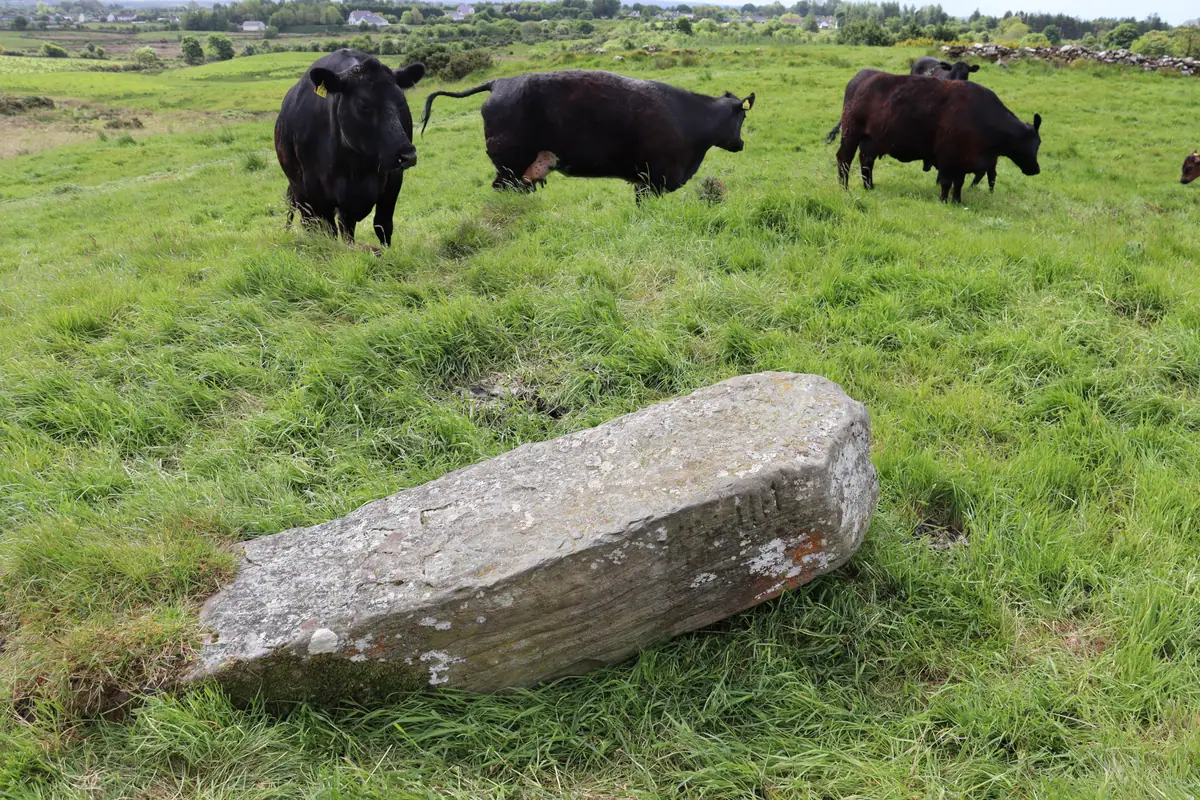
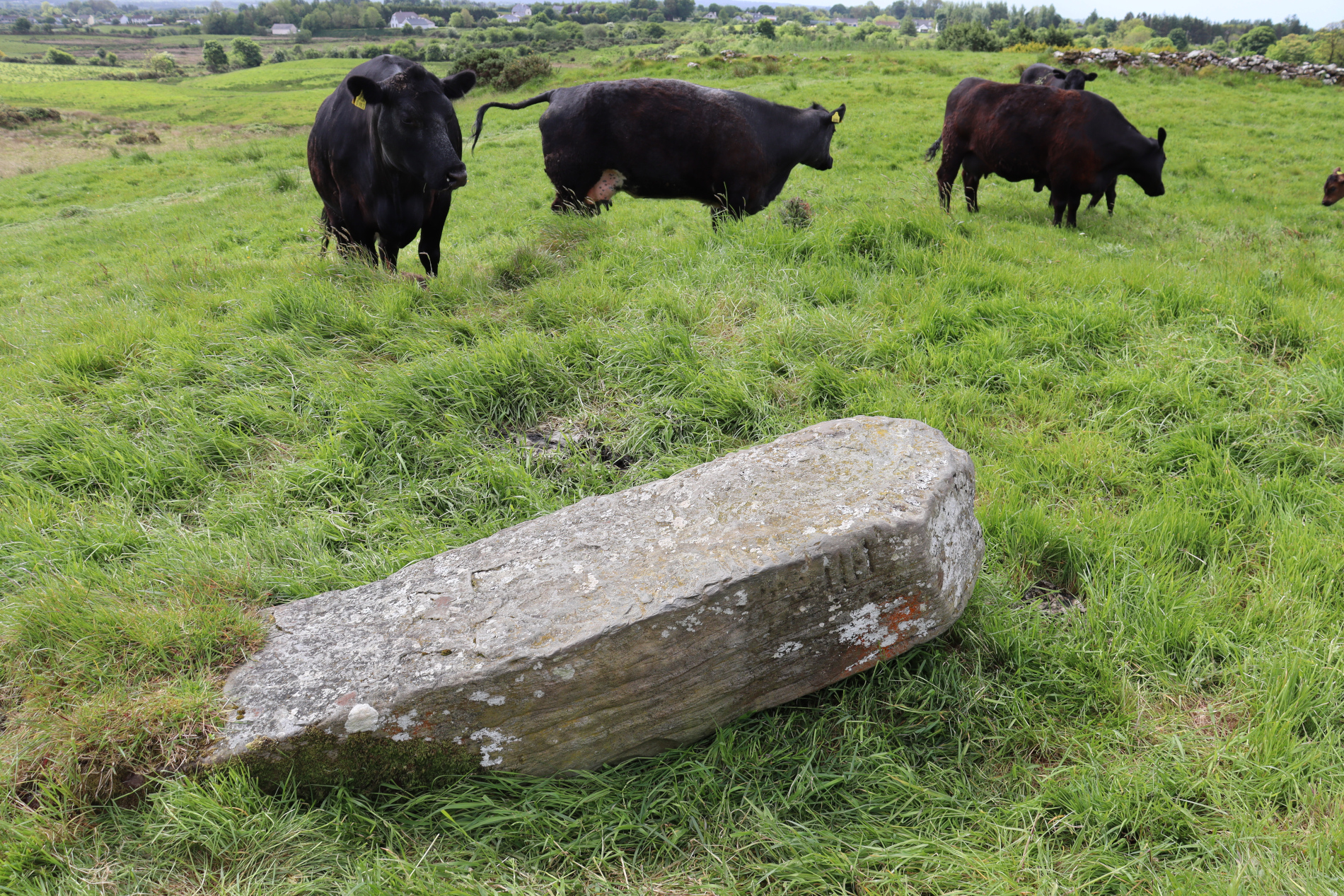
Last recorded location(s): Embedded in the top of a barrow (MA093-038002-) crowning the NE end of a steep-sided ridge. Incremental tilting to the W has continued since its discovery in 1898, to the extent that the stone is now almost prostrate; the base remains embedded in the top of the NE perimeter of the barrow, with apex/top now tilted to a height of 0.43m above the surface of the shallow, central hollow of the barrow (Archaeological Survey of Ireland, Field Report 2017). Visited and 3D recorded as part of the Mayo Ogham project 2022, funded by The Heritage Council and Mayo County Council.
Support
National Monuments Service Record Number: MA093-038001-
Object type: Pillar
Material: Sandstone
Dimensions: H 1.80 × W 0.60 × D 0.35 m
Condition: The ‘face of the stone has a rather rough and weathered surface, with several irregularities and areas of possible flaking or chipping, particularly toward the apex/west end of the stone. The surface is moderately blotched with lichen. The scores on the narrow N and S sides of the stones appear somewhat better preserved than some of those on the more weathered broad face’ (Macalister 1945, 5). The inscription is legible despite being damaged in parts.
Inscription
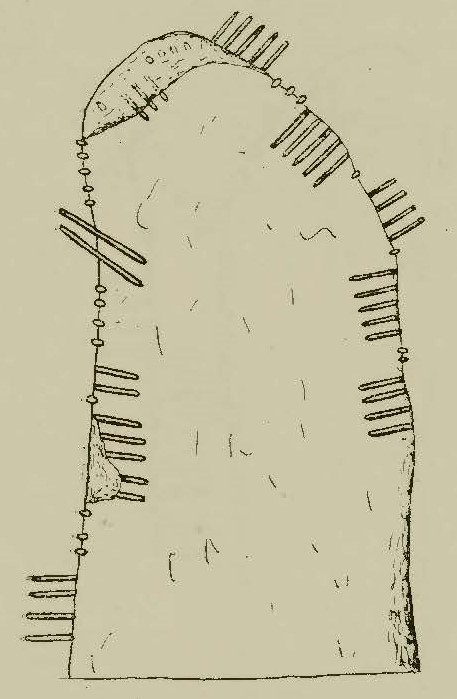
Text field: The stone is rectangular in cross-section with ‘straight sides which taper at the top to form an asymmetrical triangular peak and an ogham inscription on the angles of the top and both sides of the E (or uppermost) face’. However, as the stone is currently leaning to an almost horizontal position, ‘the ogham inscription is, therefore, on what now presents as the uppermost surface of the stone, formerly the E face when the stone was vertical’ (Archaeological Survey of Ireland, Field Report).
Letters: The inscription is pocked and rubbed. The lines and notches are, in general, sharply delineated, up to 1cm in width, with the lines measuring up to 10-12cm in length, but some variation is evident in the thickness and spacing of the scores (Archaeological Survey of Ireland, Field Report).
Date: fifth century A.D. (linguistic)
Edition
Ogham text: ᚉᚒ̣ᚅ̣ᚐᚂᚓᚌᚔ̣ vac.
Transcription: CỤṆALEGỊ vac. AṾ[I] ⸢C⸣UNACANOS
Critical apparatus:
- Macalister (1945, 5) noted that ‘AVI (except the A notch and distal ends of the V) and parts of some other scores are chipped away : a flake about 2-in. (5.1cm) wide (measured at right angles to the arris) has here been broken off. The space available does not confirm Rhys’s contention that the second word should be AVE, not AVI’. Some letters in the first name are also damaged. Only one clear notch of the U remains, one damaged and three full strokes to the right follow before the A notch. However, the space allows for a more likely UN reading. The last name is remarkably clear and undamaged. 2. CUNALEGI: CUNALEGEA (an alternative reading of the first name)
Translation
of Conlang, grandson/descendant of Conchaín
Commentary
Macalister (1945, 5) noted that although this inscription is ‘injured by wear and chipping’, the reading is ‘certain’. However, there are a couple of uncertainties with regard to interpretation. In the first name (CUNALEGI), the five vowel notches at the top left of the stone are equally spaced suggested an I, but we would rather expect (and perhaps should read this as) a gen. sg. ending -EA (of ā-stem, nom. sg. CUNALENGA) which would also be five notches but usually grouped 4 (for E) + 1 (for A). There is, however, a definite space between this and the A of the following word, AVI. What may be the same name appears in later genealogies as Conlang and is made up of the elements cú ‘hound’ and probably a form of lingid ‘leaps’. In the ancestor’s name (QUNACANOS), initial Q is either a hypercorrection (suggesting a later date) or an error for C. CUNACANOS, gen. sg. of i-stem CUNACANIS?, which doesn’t appear to be attested later (*Conchaín?), again has the element cú ‘hound’, this time probably with caín ‘good/beautiful’.
References
- Macalister 1945, 5
- McManus 1991, 95, 113
- Rhys 1898, 396–398