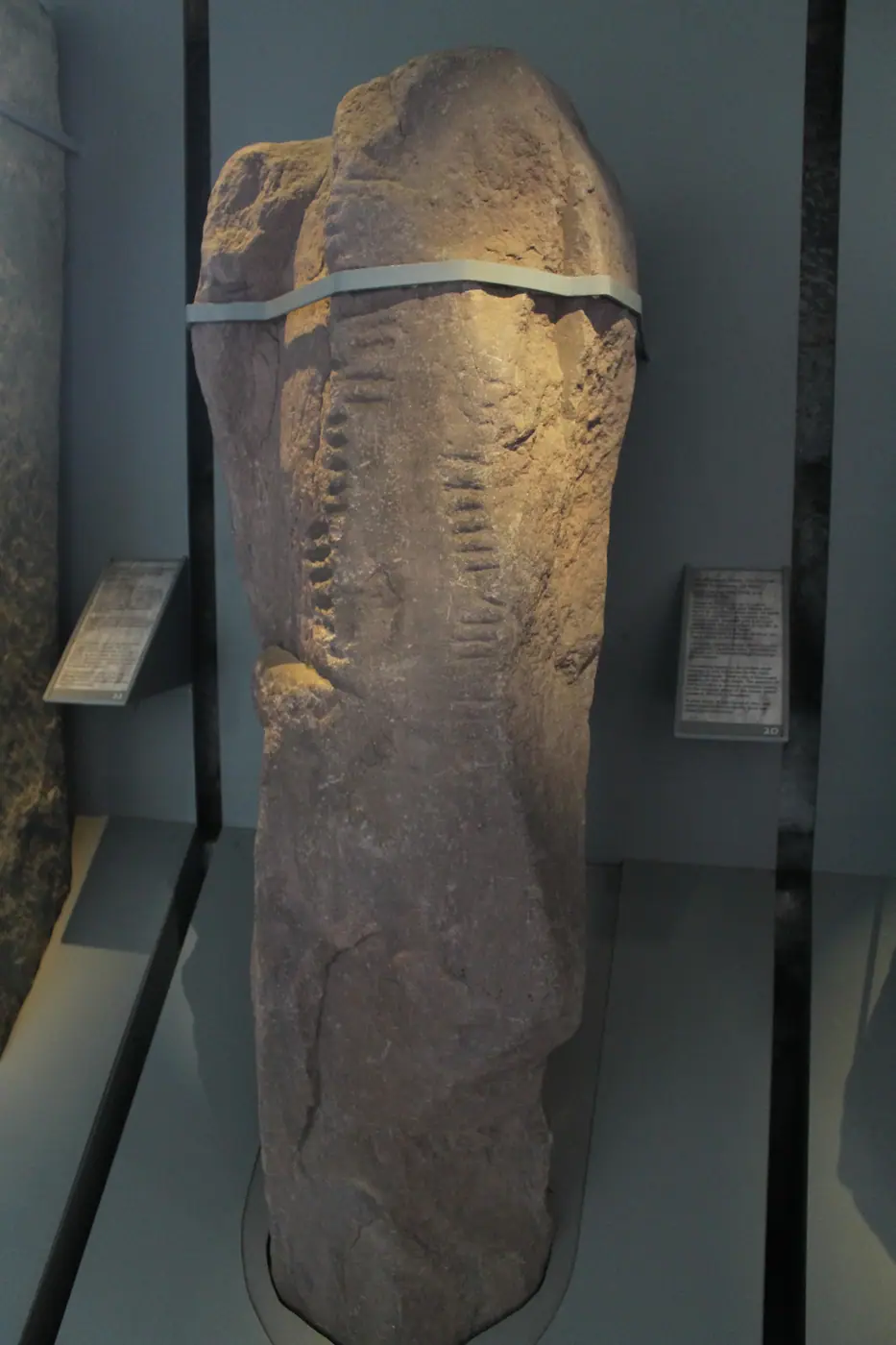
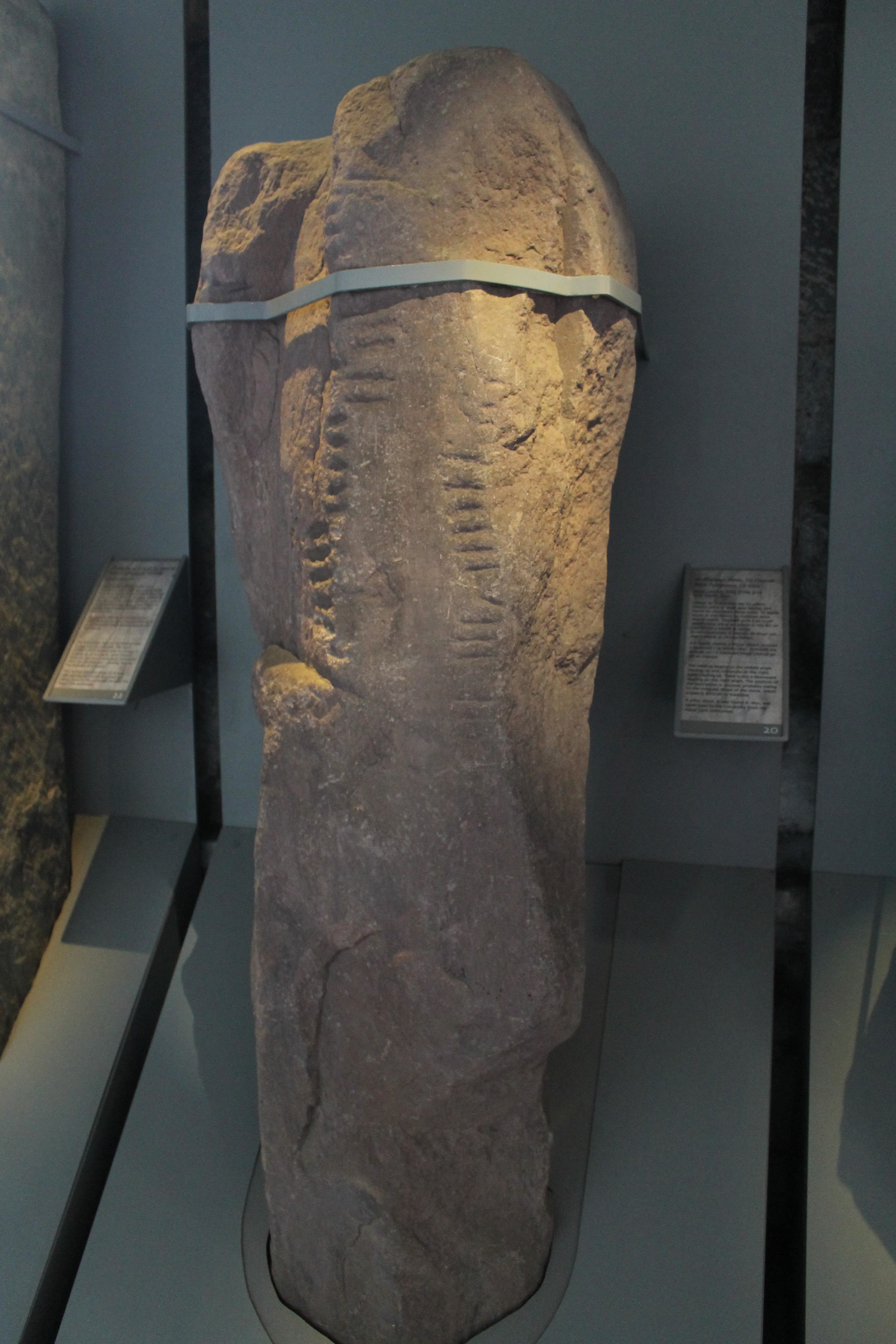
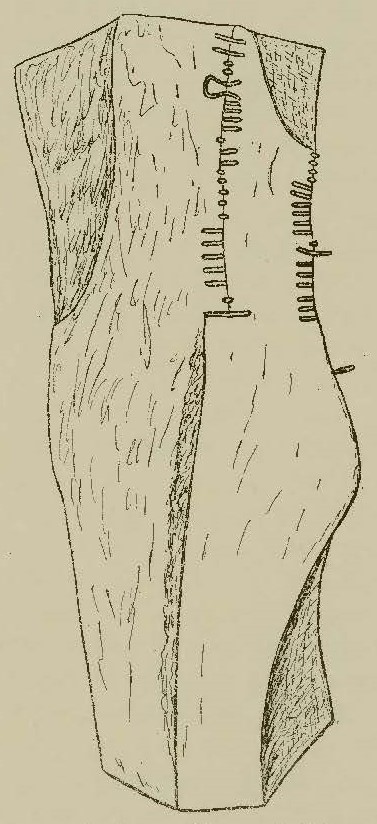
Provenance
Discovery: Found by Mr. E. Hawkesworth and transferred to the Royal Cork Institution (Macalister 1945, 124).
Findspot: Tullig More (An Tulaigh Mhór), Co. Cork, Ireland (Coordinates approximate to townland)
Current repository: Ireland University College Cork (inv. no. 20)
Last recorded location(s): Now on permanent display in the Stone Corridor (‘Rúin na gCloch / Stories in Stone’ exhibition), University College Cork, where it was examined for the OG(H)AM project in May 2024.
Support
National Monuments Service SMR ID: CO061-182----
Object type: Pillar
Material: Sandstone
Dimensions: H 1.57 × W 0.54 × D 0.47 m
Condition: Of extremely irregular shape, Macalister (1945, 124) noted that the stone bears ‘unmistakable evidence of the attacks of a sledge-hammer or of some similar tool’. He also suggested (1945, 126) that ‘there has unquestionably been an earlier inscription on the stone, and the severe battering which has left evident marks has completely destroyed it’. Macalister (1945, 84) recorded the height of the stone as 1.57m (5 ft. 2 in.) but only 1.52m are currently accessible. All of the ogham stones in the UCC collection underwent conservation in 2006. The stones are currently in display cases and held in position by brackets.
Inscription
Text field: The inscription is comprised of two lines reading up on both the dexter and sinister angles of the stone.
Letters: The inscription is coarsely pocked. Macalister (1945, 125) remarked that the ‘scores in the dexter line are more coarsely pocked than those in the sinister’. The strokes are quite large, even some of the vowel strokes, although they are still distinctively shorter than the consonant strokes.
Edition
Ogham text: ᚋᚐᚊᚔ ᚂᚐᚄ.
Transcription: MAQI LAS.OG Ḅ[.]TTM[A]CDE
Critical apparatus:
- McManus (2004, 20) read: MAQI LAS?OG B/M[ ]TTM[ ]Cge ; 1. Macalister (1945, 124) read: MAQILASPOG B TTMACDE 2. The character following the S in the first name is unclear and is obscured by the supporting bracket. Macalister (1945, 125) suggested taking this as an error for the epigrpahic I-forfid (an X shape to the right of the stemline) and suggested the interpretation MAQIL ASPOG BENEDICAT MAC DE (Translation: May the son of God bless Bishop Maqil), which is very doubtful. McManus tentatively favoured Macalister’s initial reading of this character as a disjoined X-forfid. It is also noteworthy that Brash (1869, 129) read: ᚋᚐᚊᚔᚂᚐᚄᚓᚌ (MAQILASEG).
References
- Brash 1869, 129-130
- Macalister 1945, 124-126, no. 127
- McManus 2004, 20, no. 20
- Oldham 1844, 515-516
- Power, Byrne, Egan, Lane, and Sleeman 1997, no. 7990