Provenance
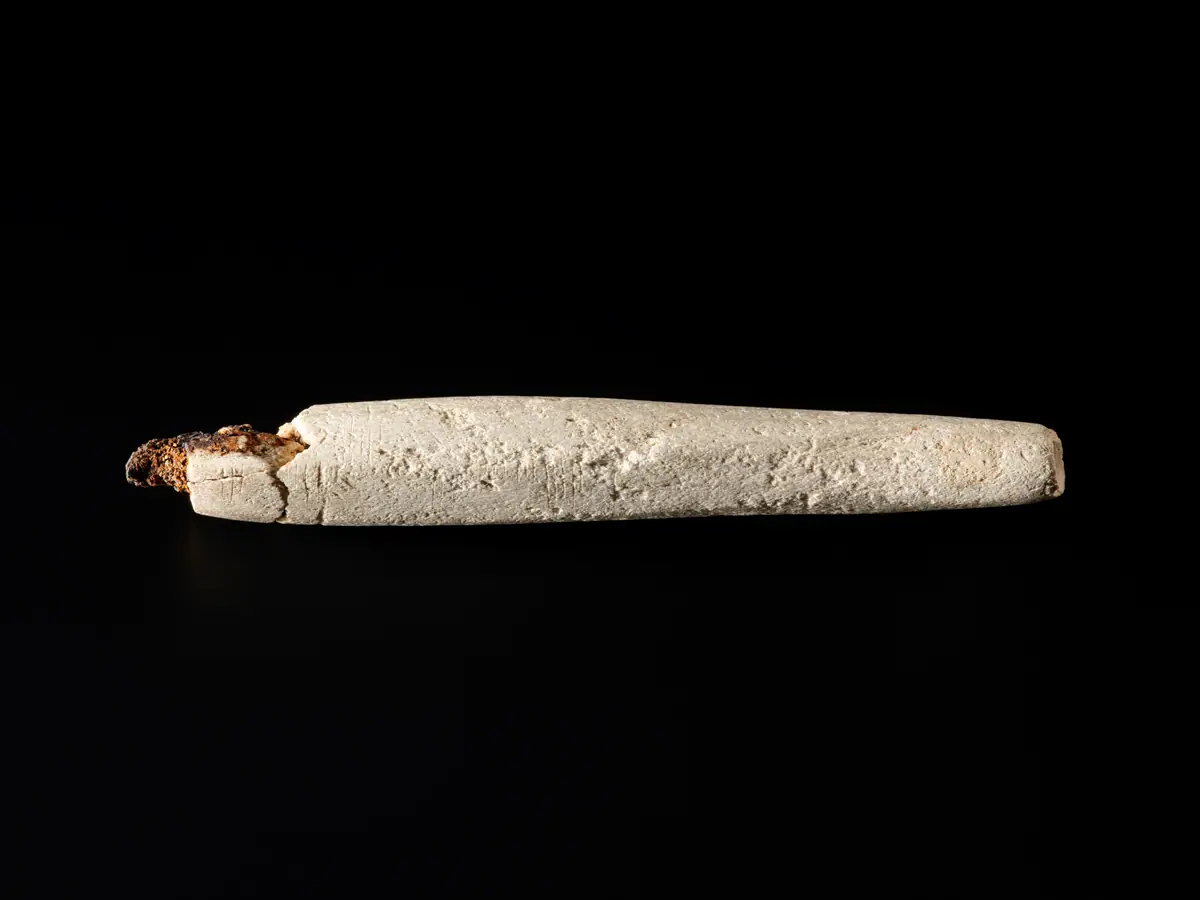
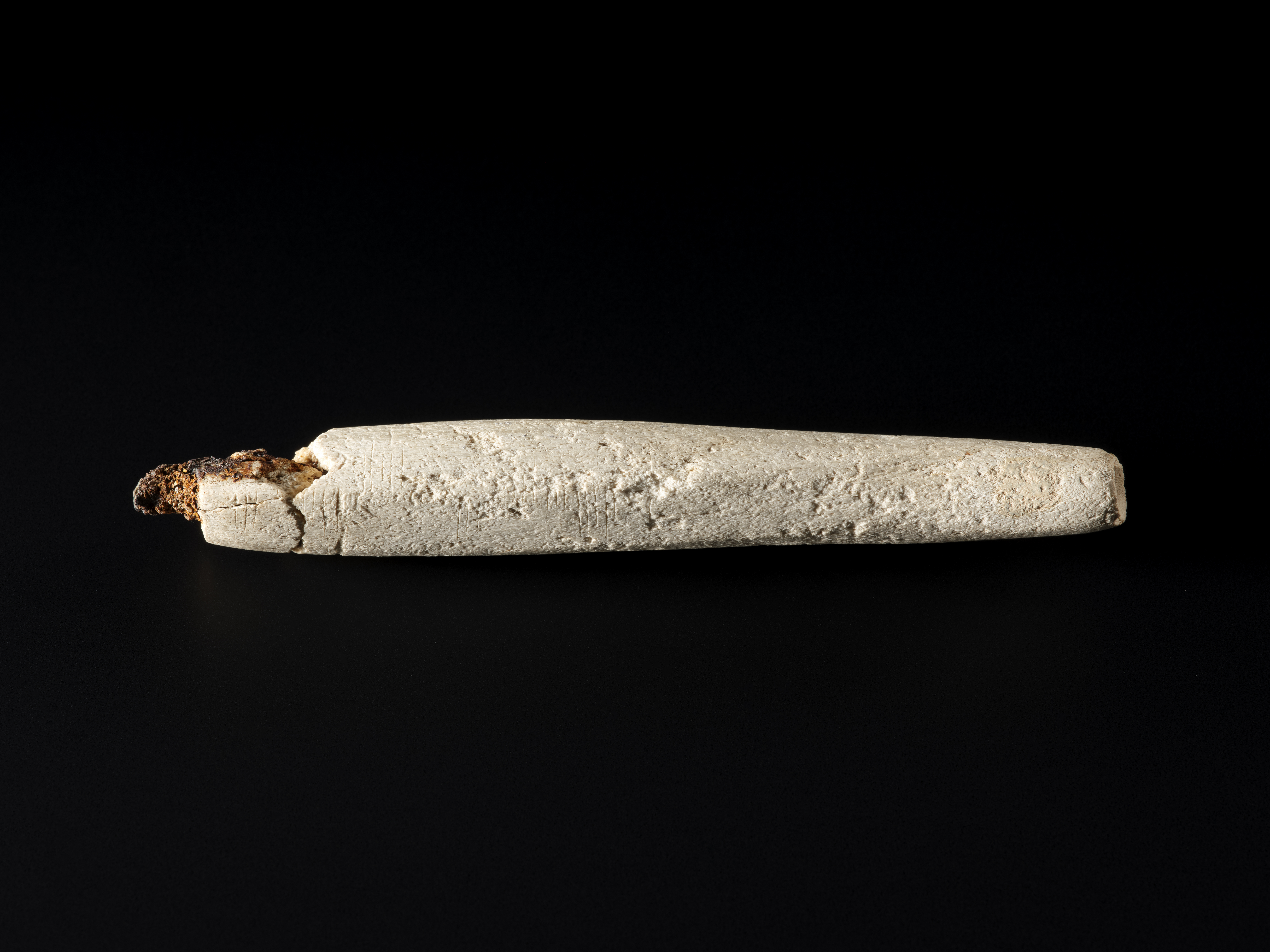
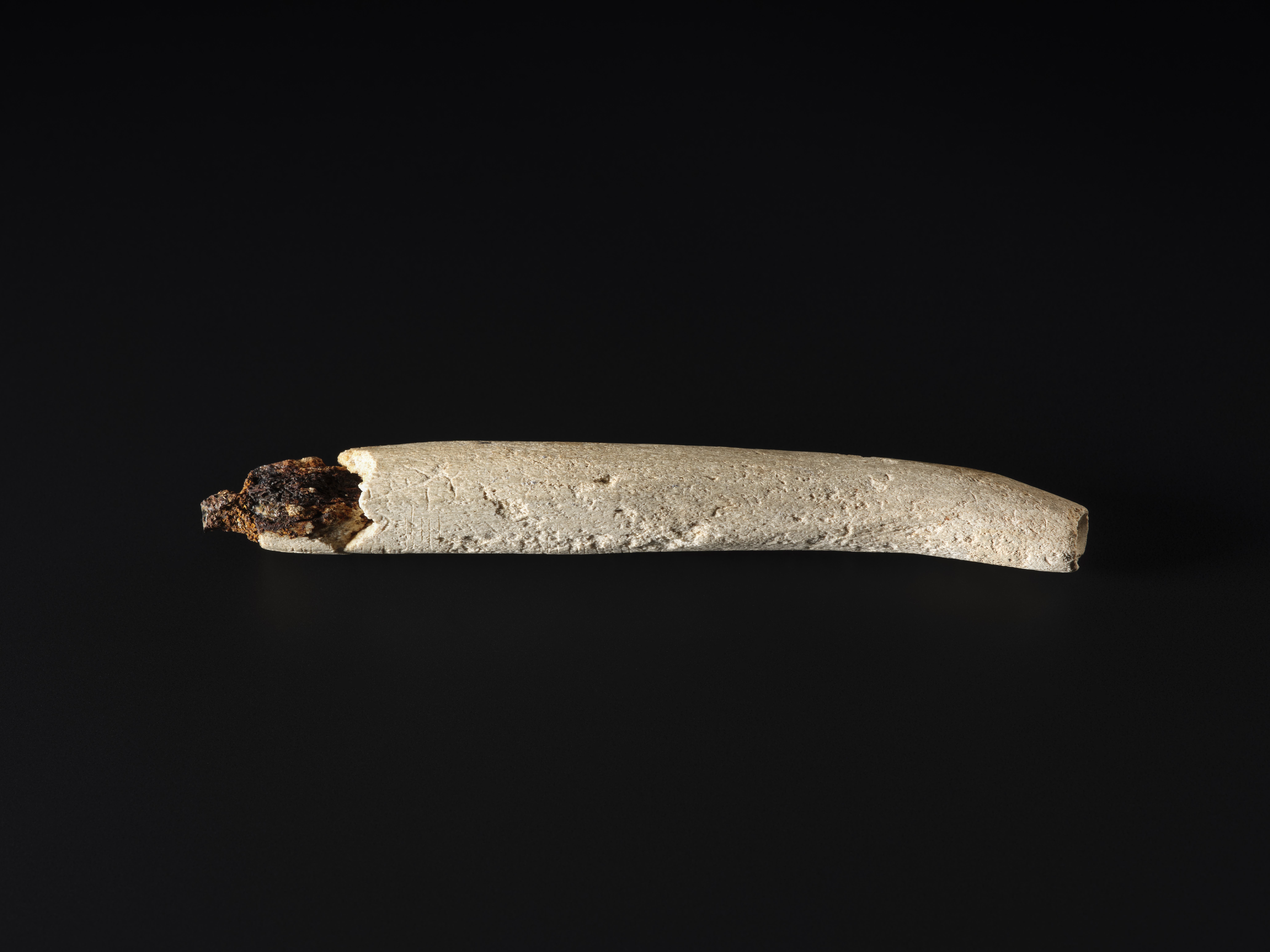
Discovery: Discovered in 1919 during Erskine Beveridge’s excavation of a wheelhouse on the tidal islet of Vallay, North Uist (Forsyth 1996, 55). The ogham-inscribed knife-handle was accessioned in December 1921.
Findspot: North Uist, Inverness-shire, Scotland (National Grid Reference: NF 7694 7619)
Current repository: Scotland National Museums of Scotland (inv. no. GNB134)
Last recorded location(s): Recorded in the National Museum of Scotland on May 6th 2022.
Support
Canmore 10054
Object type: Knife-handle
Material: Cetacean bone
Dimensions: H 10.8 × diam. 1.6 cm
Condition: The knife-handle retains only the rusted tang of an iron blade. The bone is well preserved apart from a fracture near the blade-end (Forsyth 1996, 58). The ogham inscription is generally clear and appears complete. Parts of the inscription have been worn or chipped and vowel-notches have been lost, however, Forsyth (1996, 59) notes that ‘the available space may be used to determine what is missing’.
Inscription
Text field: There is no stem-line. Instead, the ‘bone has been planed to produce a slight ridge for one line of ogham lettering’ (Forsyth 1996, 58). ‘The inscription begins about half-way along the handle and continues for approximately 50mm, almost to the handle’s end’ (Forsyth 1966, 59). The individual strokes appear to have been closely yet evenly spaced and there is clear differentiation between vowels and consonants.
Letters: The inscription is comprised of ‘thin consonant-strokes and very short vowel-strokes’ (Forsyth 1996, 61). The lines are fine and appear to have been knife-scored with a sharp blade. Forsyth (1996, 59-60) remarks that ‘each stroke is cut with a single slash, there has been no re-cutting, which perhaps implies that the carving was done with skill and some confidence’. The longest consonant strokes are c.0.6cm long (Forsyth 1996, 59).
Date: Fifth to eighth century
Edition
Ogham text: ᚋᚑ̣ᚊᚒ ᚅᚈᚓᚅᚉᚐ̣ᚈ
Transcription: MỌQU NTENCẠT
Critical apparatus:
- The use of RTI and photogrammetry conducted by Megan Kasten has confirmed the reading provided as the most feasible. The measurements taken from the 3D model enabled a more precise estimation of the average spacing between individual letters and therefore suggest that the second letter is most likely to be an O (two strokes). Similarly, given the space between the third to last and the last letter, and considering what is left of the damaged surface, the second to last character is most likely to have been an A or a B with A being linguistically more probable (Kasten 2023). 2. Forsyth (1996, 61) highlights two features of the inscription that are worth mentioning: ‘the initial letter, M, is upright, not oblique’ and there are no double letters in the inscription.
Translation
There is no obvious interpretation of this inscription and several segmentations and readings could be suggested.
Commentary
Forsyth (1996, 66) maintains that, generally, ‘the text appears to be a single male personal name and as such probably records the identity of the owner or maker (or donor if it was given as a gift)’.
Regarding the language of the inscription, although previous commentators have interpreted the Bac Mhic Connain ogham as Pictish, Forsyth (1996, 66) maintains that the letters are most naturally read as Irish.
Forsyth (1996, 65) highlights that ‘the Bac Mhic Connain knife-handle is one of a very small group of ogham-inscribed household objects, and as such provides important evidence for the non-monumental use of the script’, signifying ‘ogham literacy at a non-church-site, on the part of people of middling social standing’.
References
- Forsyth 1996, 55-68
- Kasten 2023-04-28,