Provenance
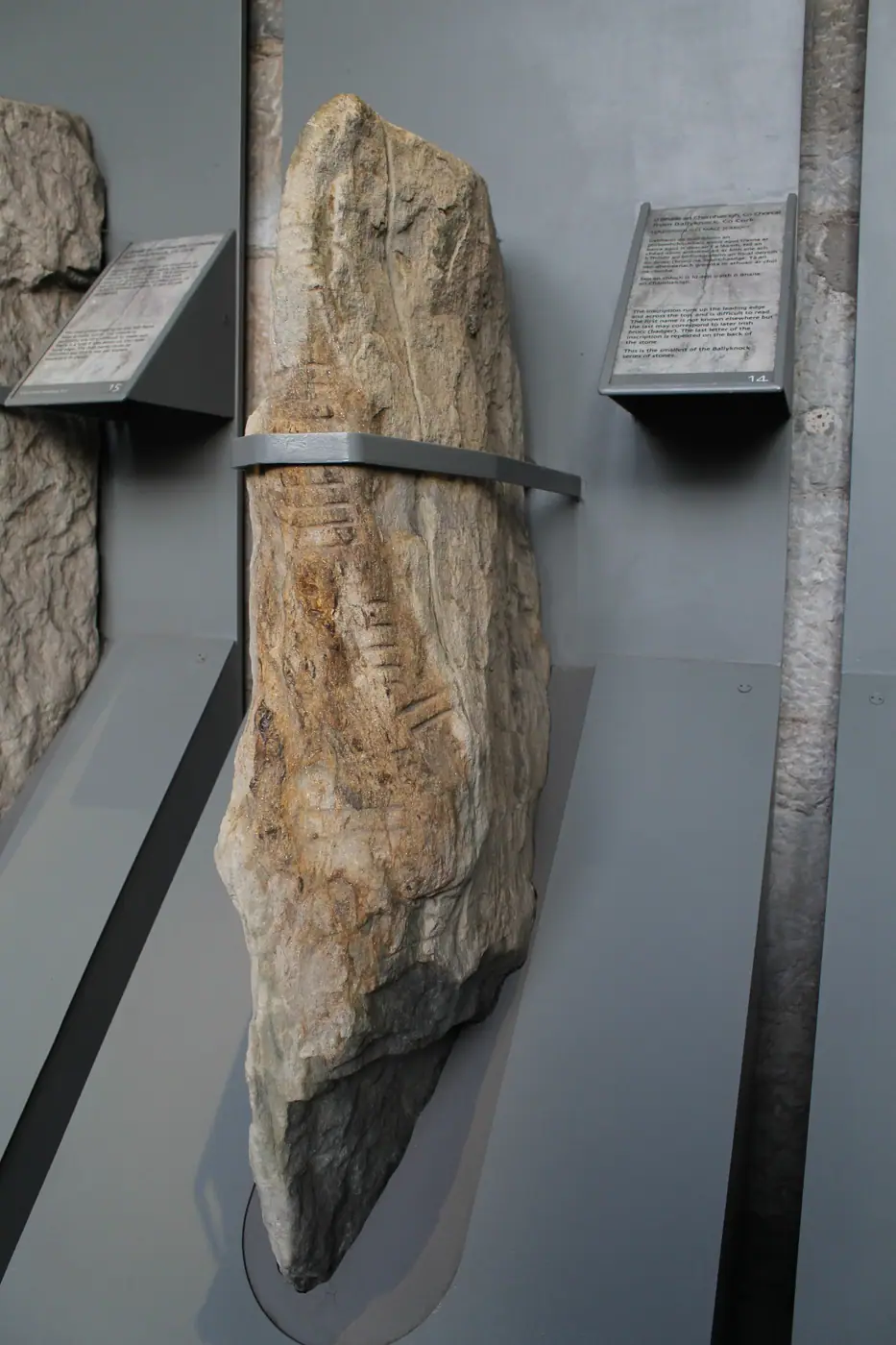
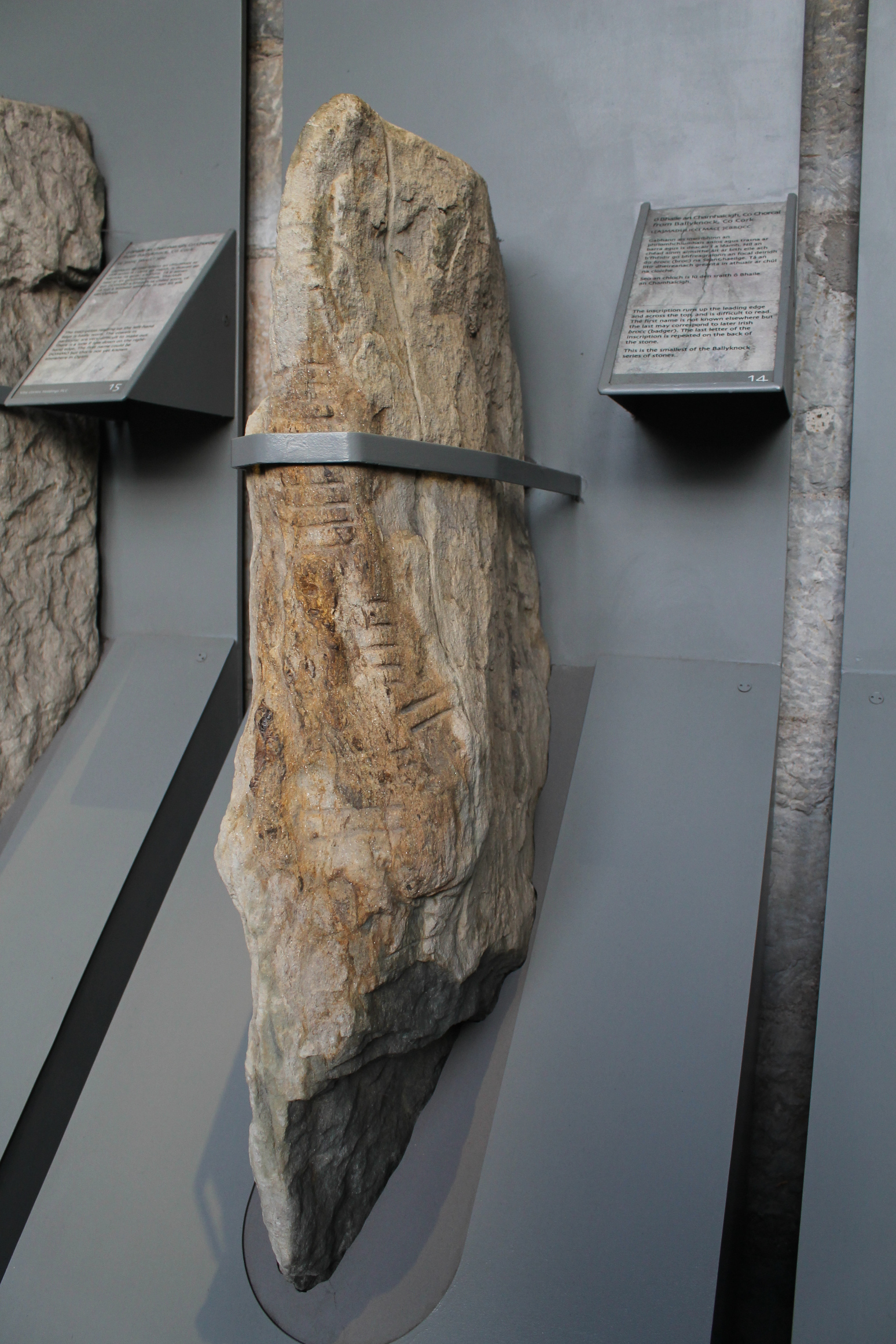
Discovery: Discovered in the NW quadrant of a large rath or ringfort (CO055-007001-) at Castle farm (also site of Ballyknock castle CO055-007004-). According to Barry (1891, 519), this is the top part of ‘a roofing flag that fell in at the north-east end of the cave’ (souterrain CO055-007003-) where fourteen other ogham stones were also found (I-COR-031 - I-COR-045), all but one (I-COR-031) acting as lintels. A high percentage of ogham stones in Ireland are found reused in souterrains, particularly in Co. Cork but this is the highest number from a single souterrain.
Findspot: Ballyknock North (Baile an Chamhaicigh Thuaidh), Co. Cork, Ireland (ITM Coordinates: 594327, 586954)
Current repository: Ireland University College Cork (inv. no. 14)
Last recorded location(s): The stone is currently on permanent display in the Stone Corridor (‘Rúin na gCloch / Stories in Stone’ exhibition) at University College Cork, where it was examined and photographed for the OG(H)AM project in May 2024.
Support
National Monuments Service SMR ID: CO055-007005-
Object type: Pillar
Material: Sandstone
Dimensions: H 0.96 × W 0.46 × D 0.15 m
Condition: Reused as building material in a souterrain and now the broken top of a once larger stone. Barry (1891, 519) noted the stone’s original ‘dimensions were 50 in. x 18 in. x 6 in. (1.27 x 0.46 x 0.15m); but now it is in two overlapping pieces; the inscribed one being 38 in. (0.96cm) long’. Some flaking is evident on one side of the stone but much of this was before the inscription was added. A natural vertical line/vein runs the length of the stone, parrallel to and roughly 10cm from the inscribed edge. All of the ogham stones in the UCC collection underwent conservation in 2006. The stones are currently in display cases and held in position by brackets. The current visible extent above the display case is 0.87m.
Inscription
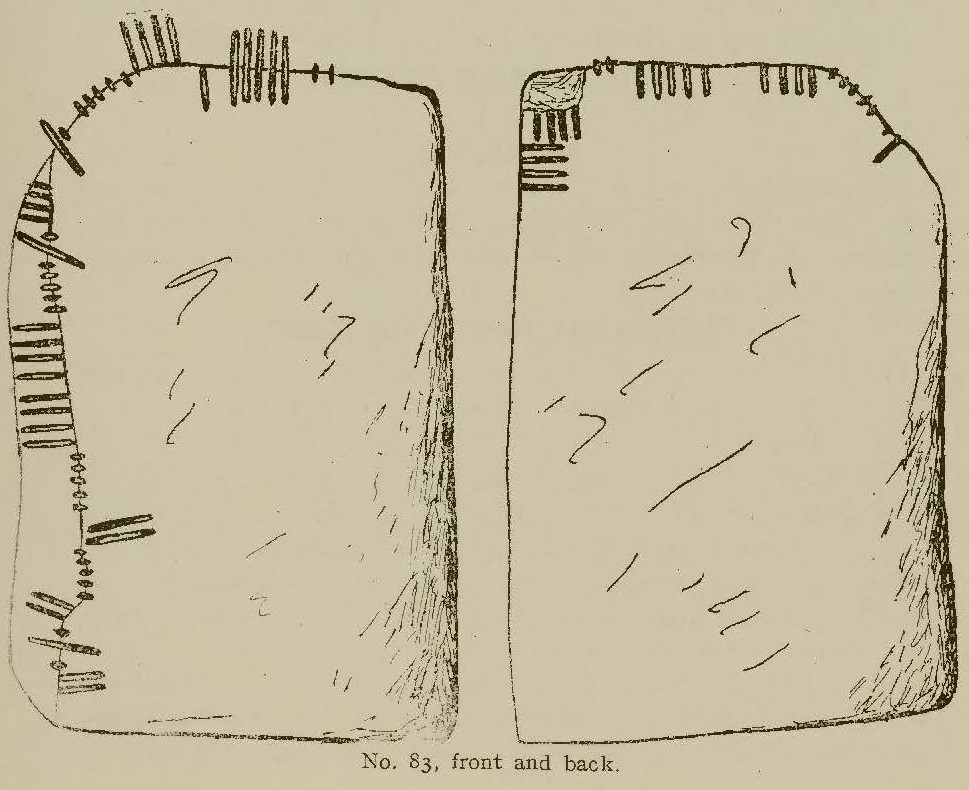
Text field: The inscription runs up the left edge and across the (back of) top of the stone.
Letters: Macalister (1945, 86) described the inscription as chiselled. The consonant strokes are narrow and tapering and the vowel strkes are quite long, especially the first I, though still distinctive.
Edition
Ogham text: ᚂ̣ᚐ
Transcription: ḶAMADULICCI MAC MAIC BROC̣C
Critical apparatus:
- Macalister’s earlier (1907) reading: [A]NM DULICCI MACI EBR[A]S[I] 2. Macalister’s (1945, 86) revised reading: LAMADILICCI MAC MAIC BROCC 3. Prior to conservation, McManus (2004, 18) and, similarly, Gippert (1997) both read: L[A]MaDILICCi MAC[ ]CBROC 4. Considering the break in the stone at the commencement of the inscription, as also noted by Rhys (Barry 1891, 533), the inital L could be the remains of a V, S or N. A possible initial ANM, as in Macalister’s initial reading, cannot be ruled out. The As before and after the M are quite uncertain, although there is sufficient space.
Translation
of ? son of Mac-Bruicc
Commentary
Ziegler (1994, 174), following Macalister’s earlier interpretation of [A]NM DULICCI, suggests that DULICCI may be the Old Irish adjective dúilech ‘greedy’. The alternative interpretation, LAMADULICCI, suggests an inital word element LAMA- (lám ‘hand’) (Ziegler 1994, 192).
As noted by McManus (2004, 18), ‘the last name may correspond to later Irish brocc “badger”, attested elsewhere in the ogham corpus in the forms BROCI and BROCAGNI (later Brocc and Broccán), though one would have expected *BRUCC (corresponding to later gen. Bruicc) if the inscription post-dates the loss of -I’ (see Mac-Bruicc in genealogies (CGH S. 681); Ziegler 1994, 141-142). The genitive form MAIC looks particularly late and is very rare in ogham inscriptions.
References
- Barry 1891, 514-535
- Macalister 1945, 85-86, no. 83
- Power and et al. 1994, no. 4215
- Ziegler 1994, 174, 192
- McManus 2004, 18, no. 14