Provenance
Discovery: Discovered in the NW quadrant of a large rath or ringfort (CO055-007001-) at Castle farm (also site of Ballyknock castle CO055-007004-). According to Barry (1891, 521), this roofing flag was ‘next to No. 3’ (I-COR-033) in the souterrain (CO055-007003-) where fourteen other ogham stones were also found (I-COR-031 - I-COR-045), all but one (I-COR-031) acting as lintels. A high percentage of ogham stones in Ireland are found reused in souterrains, particularly in Co. Cork but this is the highest number from a single souterrain.
Findspot: Ballyknock North (Baile an Chamhaicigh Thuaidh), Co. Cork, Ireland (ITM Coordinates: 594327, 586954)
Current repository: Ireland University College Cork (inv. no. 9)
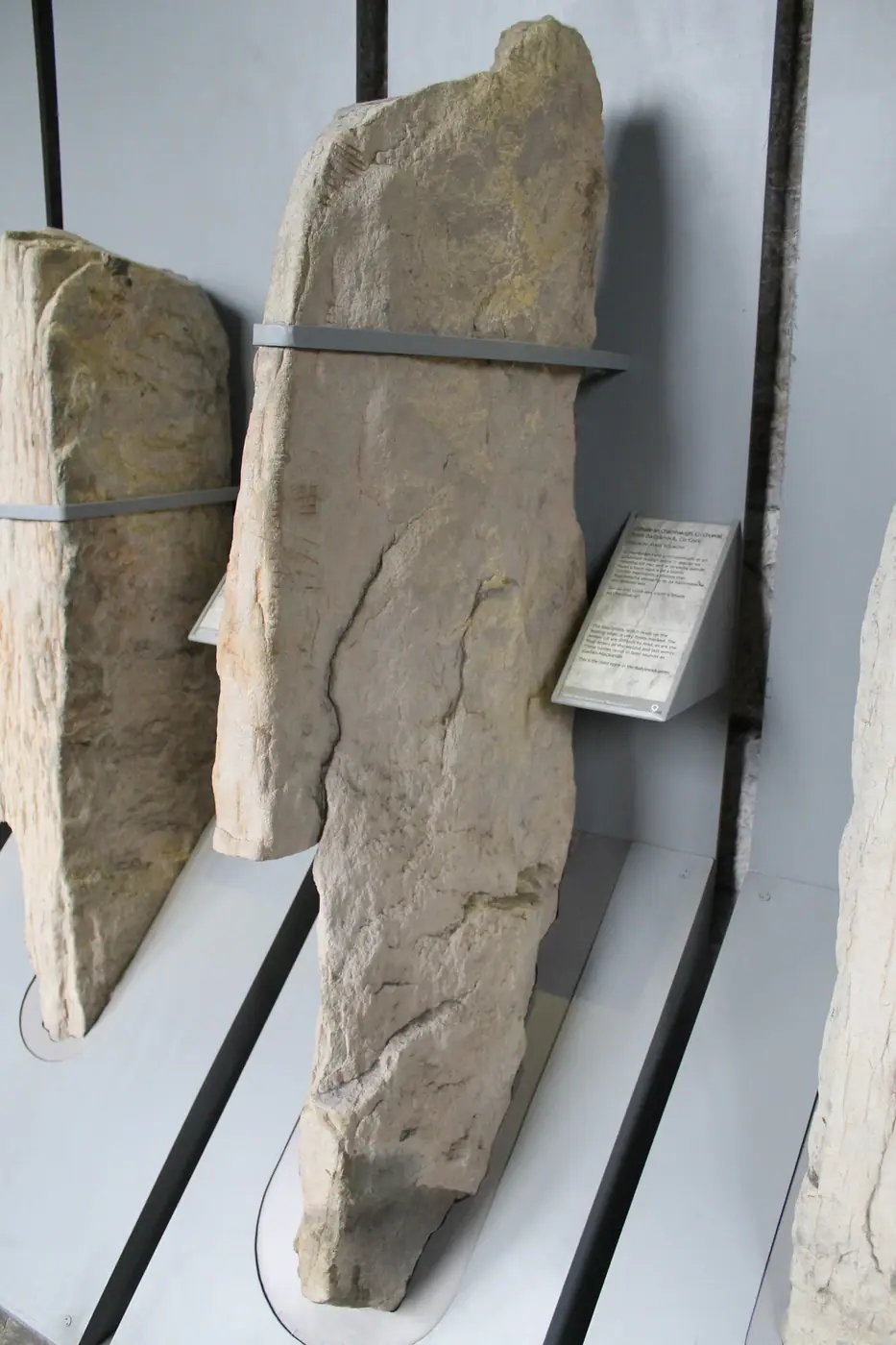
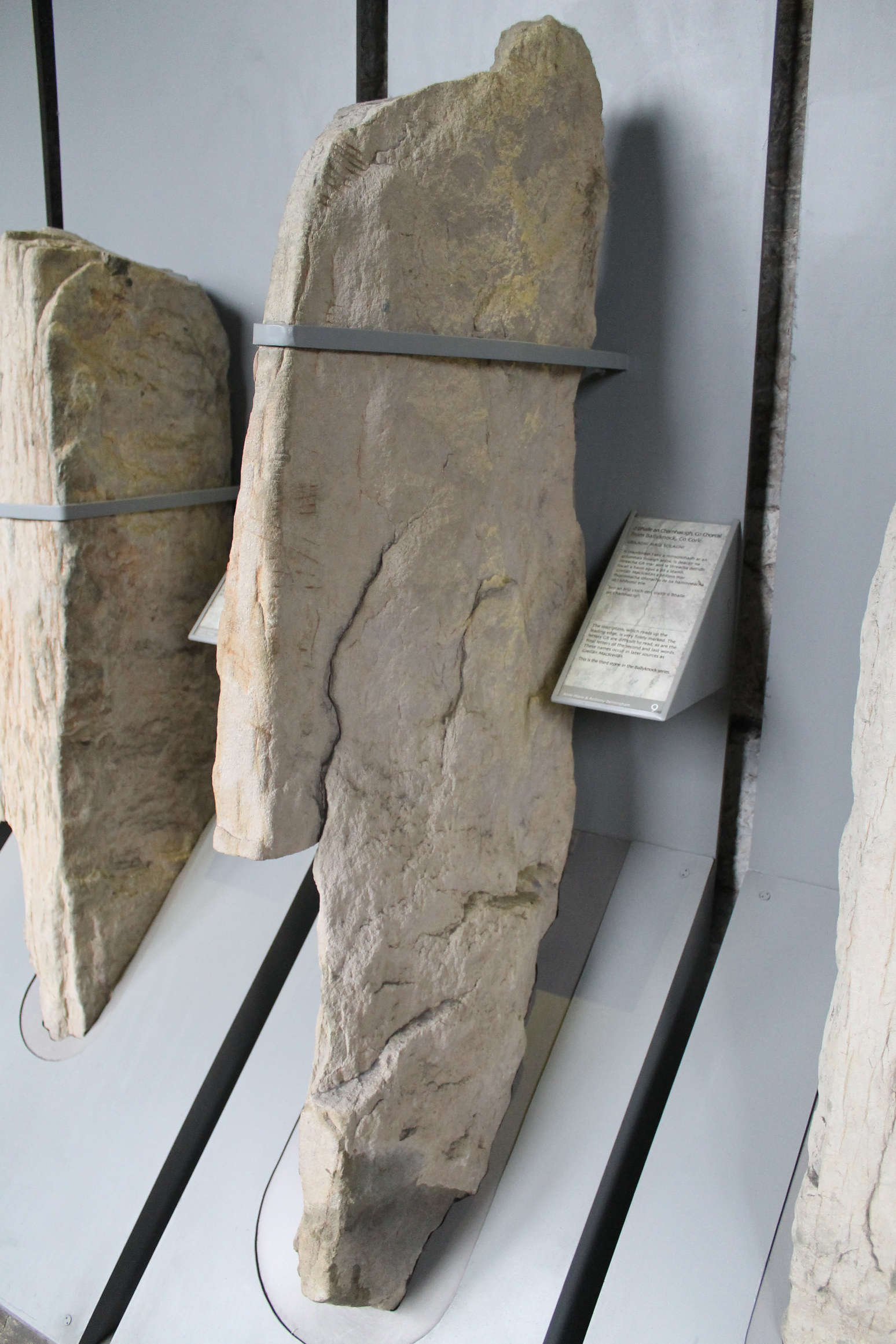
Last recorded location(s): The stone is currently on permanent display in the Stone Corridor (‘Rúin na gCloch / Stories in Stone’ exhibition) at University College Cork, where it was examined and photographed for the OG(H)AM project in May 2024.
Support
National Monuments Service SMR ID: CO055-007007-
Object type: Pillar
Material: Sandstone
Dimensions: H 1.60 × W 0.57 × D 0.13 m
Condition: Reused in a souterrain and in poor condition. Barry (1891, 521) noted the stone was originally 63 in. (1.60m) in height. All of the ogham stones in the UCC collection underwent conservation in 2006. The stones are currently in display cases and held in position by brackets. The current visible extent above the display case is 1.46m.
Inscription
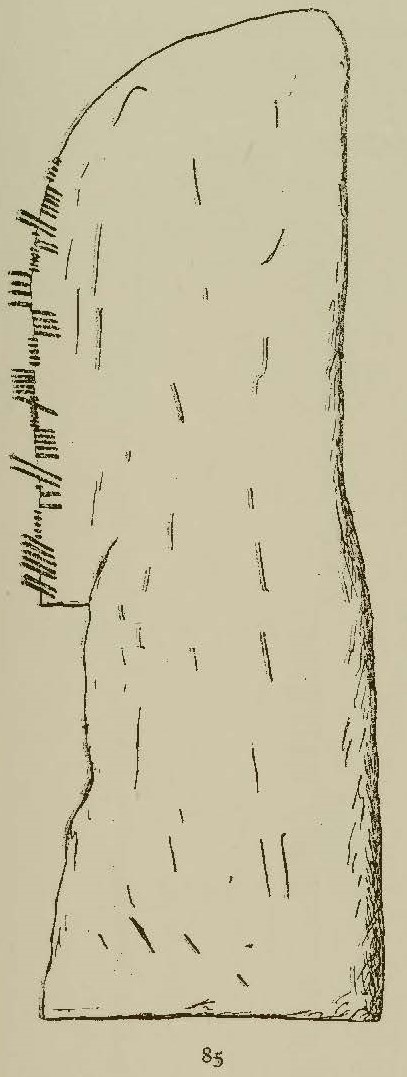
Text field: The inscription is on the dexter angle, commencing 0.76m ‘(30 in.) from the bottom and extending to the beginning of the slanted top of the stone’ (Barry 1891, 521).
Letters: The ogham strokes are very finely scored and tightly spaced.
Edition
Ogham text: ᚌ̣ᚏ̣ᚔᚂᚐᚌᚅᚔ ᚋᚐᚊᚔ ᚄᚉᚔᚂᚐ̣ᚌᚅᚔ
Transcription: G̣ṚILAGNI MAQI SCILẠGNI
Critical apparatus:
- Macalister (1945, 86) doesn’t give any details regarding the legibility of the inscription but Barry (1891, 521 noted that ‘only a trace like a pinscrape remains of the third A, the notches of the last I are very small; the R is worn in parts’. McManus (2004, 17), likewise Gippert (1997), also noted the difficulty with initial GR and final I.
Translation
of Grellán son of Scellán
Commentary
As noted by McManus (2004, 17), both names have the diminutive suffix (-AGNI, later -án) and both names occur in later manuscript sources as Grellán (cf. npr m. Grellán mac Lugbae, Rawl. 128a26) and Scellán ‘pip, seed, stone of a fruit; student’ (As n.pr.: Sgeallán Caol ó Chill cromglaisi, Mart. Don. Apr. 11 . Scellan, Gorm. Apr. 11.).
References
- Barry 1891, 514-535
- Macalister 1945, 86, no. 85
- Power and et al. 1994, no. 4218
- Ziegler 1994, 186, 230
- Gippert 1997, no. 85
- McManus 2004, 16-17, no. 9