Provenance
Discovery: Discovered in the NW quadrant of a large rath or ringfort (CO055-007001-) at Castle farm (also site of Ballyknock castle CO055-007004-). According to Barry (1891, 523), this roofing flag was ‘next to No. 5’ in the souterrain (CO055-007003-) where fourteen other ogham stones were also found (I-COR-031 - I-COR-045), all but one (I-COR-031) acting as lintels. A high percentage of ogham stones in Ireland are found reused in souterrains, particularly in Co. Cork but this is the highest number from a single souterrain.
Findspot: Ballyknock North (Baile an Chamhaicigh Thuaidh), Co. Cork, Ireland (ITM Coordinates: 594327, 586954)
Current repository: Ireland University College Cork (inv. no. 11)
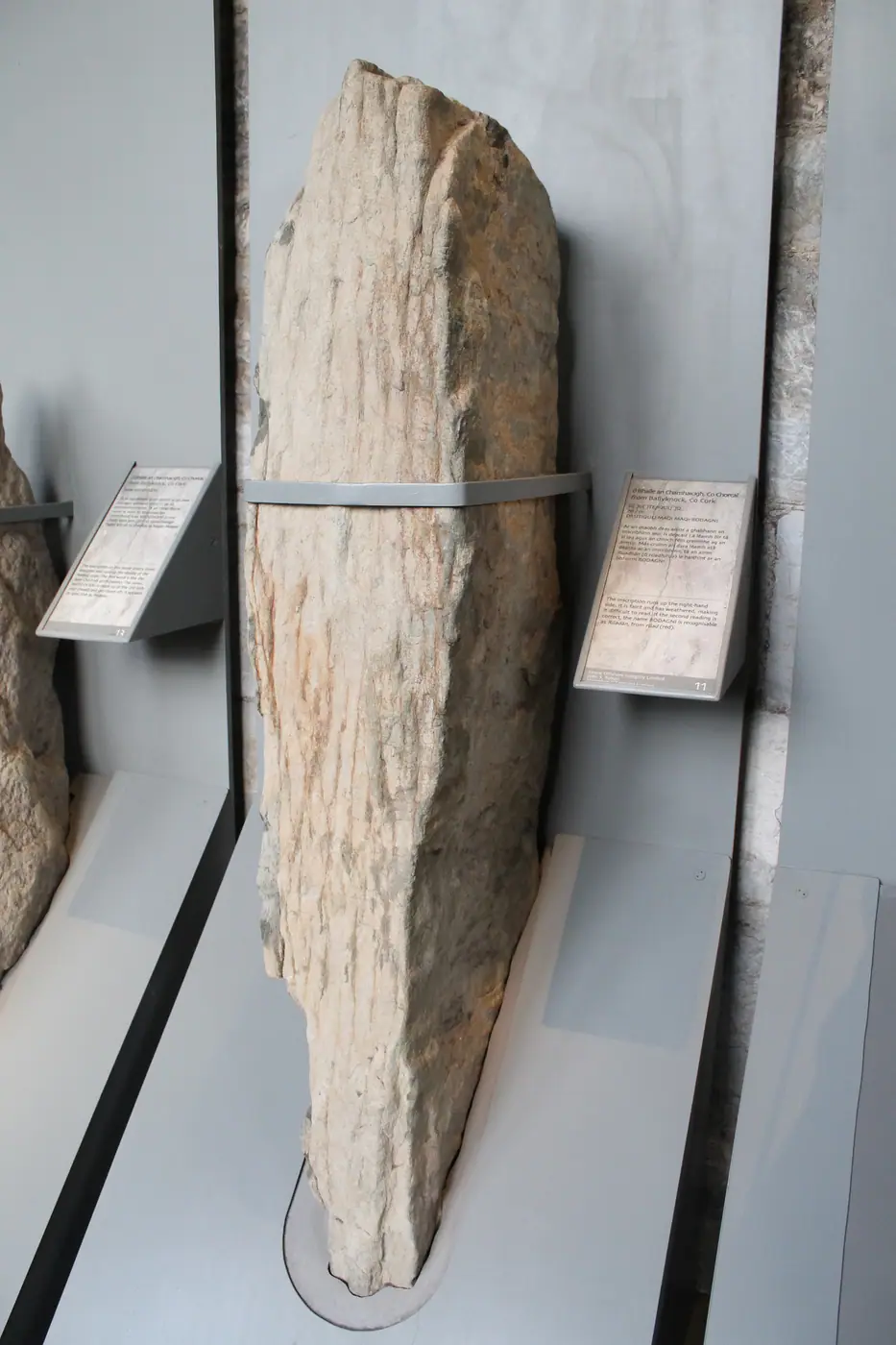
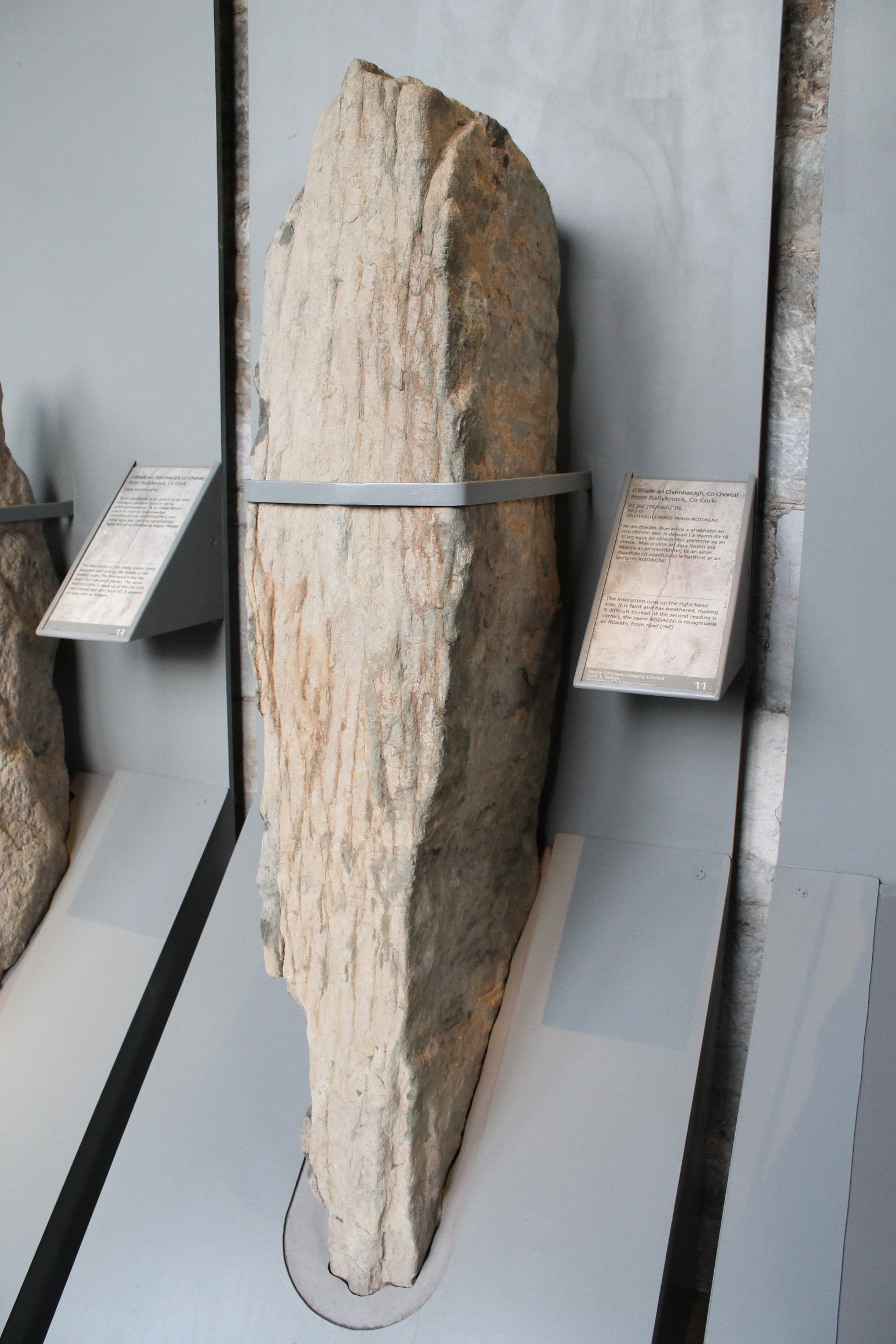
Last recorded location(s): The stone is currently on permanent display in the Stone Corridor (‘Rúin na gCloch / Stories in Stone’ exhibition), University College Cork, where it was examined and photographed for the OG(H)AM project in May 2024.
Support
National Monuments Service SMR ID: CO055-007009-
Object type: Pillar
Material: Sandstone
Dimensions: H 1.42 × W 0.35 × D 0.22 m
Condition: The stone is quite weathered and the inscription is difficult to decipher. Barry (1891, 523) noted that the stone was 1.42m (58in.) in height. All of the ogham stones in the UCC collection underwent conservation in 2006. The stones are currently in display cases and held in position by brackets. The current visible extent above the display case is 1.20m (3ft. 11in.).
Inscription
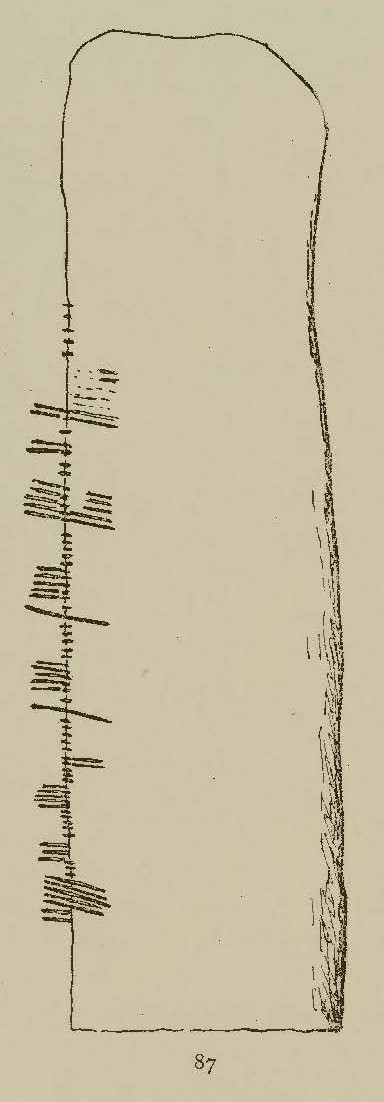
Text field: Up on one arris, the inscription begins 0.66m (26in.) from the bottom and ending 0.13m (5in.) from the top (Barry 1891, 523).
Letters: The inscription is very lightly scored in what Macalister (1945, 86) described as ‘the barest pinscrapes’. However, he added that ‘the scribe carefully blocked out the inscription first, scratching the number of nicks appropriate for each letter upon the edge of the stone; and afterwards developed these into scores by prolonging them across the adjacent surfaces’. The R-strokes appear more straight than sloped.
Edition
Ogham text: ᚇᚏ̣ᚒ
Transcription: DṚUTỊQULI MAQI ṂẠQ̣Ị ṚṚODAG̣ṆỊ
Critical apparatus:
- In the first name, only 2 or 3 R-strokes are clear (the final I is also very faint and only 4 strokes of the first I are evident). The M of the first MAQI is only barely visible on the B-side. The second MAQI is quite unclear with just 2 possible Q strokes and 2 vowel strokes surviving. Any remaining vowel strokes are obscured by the support bracket. The last name is very unclear. Barry (1891, 523) read RRRODAGNI and Macalister (1945, 87-88) read RODAGNI. There appears to be enough space for 2 initial Rs and there are traces of more than 5 strokes here (2 groups of 3 possible R-stokes). The D is very doubtful but there are tiny nicks on the stemline, which could be vowels and/or Macalister’s guide marks for the letters. Further up there are traces of strokes on the B-aicme, which could be the remains of GN and finally, there are 3 or 4 very short vowel strokes at the end but a fifth could easily be lost.
Commentary
If the reading is correct, the first name appears to contain the word drúth ‘jester, idiot’ (McManus 2004, 17; Ziegler 1994, 172-173). The second element (QULI) could perhaps be the same word (QOLI) found in I-KER-137 (Gearha South, Co. Kerry): MAQI-QOLI. The initial Q could be taken as a hypercorrection of C (due to the falling together of these formerly distinct sounds) and therefore representing COLI, gen. of later coll ‘hazel’ (also, of course, the name of the ogham character ᚉ) and attested in manuscript sources as Mac-cuill (Ziegler 1994, 222-223).
Although the reading is even more uncertain, the last name may be a MAQI- compound (MAQI-RODAGNI). This type of compound is quite common (e.g. MAQI-TRENI in I-COR-035). However, although the name RODAGNI is attested later as Rúadán ‘little red(-haired) one’, if correct, this appears to be a unique example of this particular compound (McManus 2004, 17; Ziegler 1994, 227).
References
- Barry 1891, 514-535
- Macalister 1945, 86-87, no. 87
- Power and et al. 1994, no. 4220
- Ziegler 1994, 172-173, 222-223, 227
- McManus 2004, 17, no. 11