Provenance
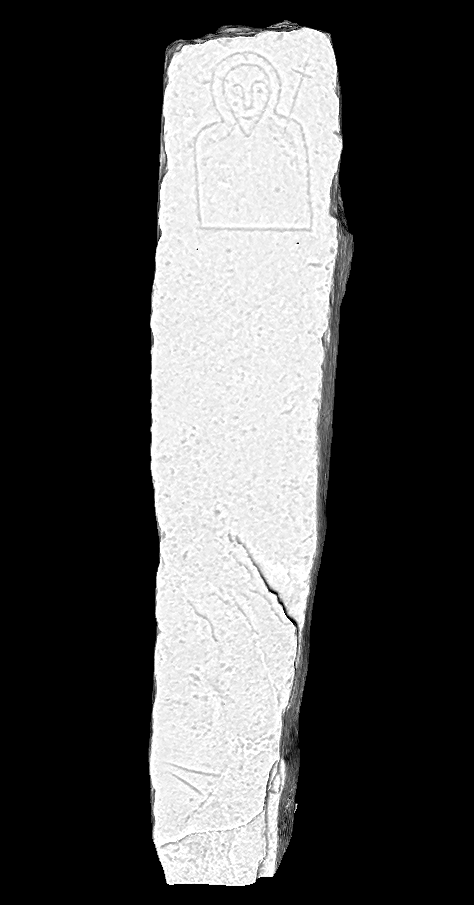
Discovery: Discovered just inside the gate of the graveyard at Cillín Chormaic (beside the figure-carved pillar described below) by Rev. John F. Shearman in 1860 and reported to members of the Royal Irish Academy in 1865 (Shearman 1864-1866, 253-260). Seven ogham stones (or fragments) in total were found at this site, one of which (I-KID-002 Colbinstown 2) seems to have been broken up and at least one fragment re-used in the repair of the surrounding wall in the late 19th century (FitzGerald 1895, 380-2). This is the largest collection of ogham stones found at a single site in Leinster. Four complete ogham stones and two fragments survive today. A geophysical survey carried out in the surrounding fields in 2012 revealed traces of a trivallate enclosure (max. diam. 205m) surrounding the burial ground, which occupies the centre of a much more extensive early medieval ecclesiastical site (Greene 2013, 37-40). In addition to the ogham stones, a number of other notable monuments (some of granite) have also been discovered at the site, including numerous (uninscribed) pillar stones and three probable cross slabs (Greene 2013, 33-36; Macalister and Praeger 1928-9, 253-61). One of the pillar stones (KD032-044016-), a slender earthfast stone (H 1.3m; L 0.35m N-S; Wth 0.25m), which this ogham stone was found standing beside, has a lightly carved bust on the upper N face: a head, with a very pointed chin, is shown with a possible hooded-cloak and the figure carries a cross over its left shoulder (see image).
Findspot: Killeencormack (Cillín Chormaic), Colbinstown (Baile Choilbín , Co. Kildare, Ireland (ITM Coordinates: 683115, 698259)
Current repository: Ireland National Museum of Ireland (inv. no. RIA1917:79)
Last recorded location(s): On display in the Treasury of the National Museum of Ireland, Dublin. The stone was recorded in 3D (using an Artec Leo structured light scanner) in collaboration with the Discovery Programme in February 2022 as part of the OG(H)AM project.
Support
Object type: Pillar
Material: Greywacke
Dimensions: H 1.54 × W 0.28 × D 0.29 m
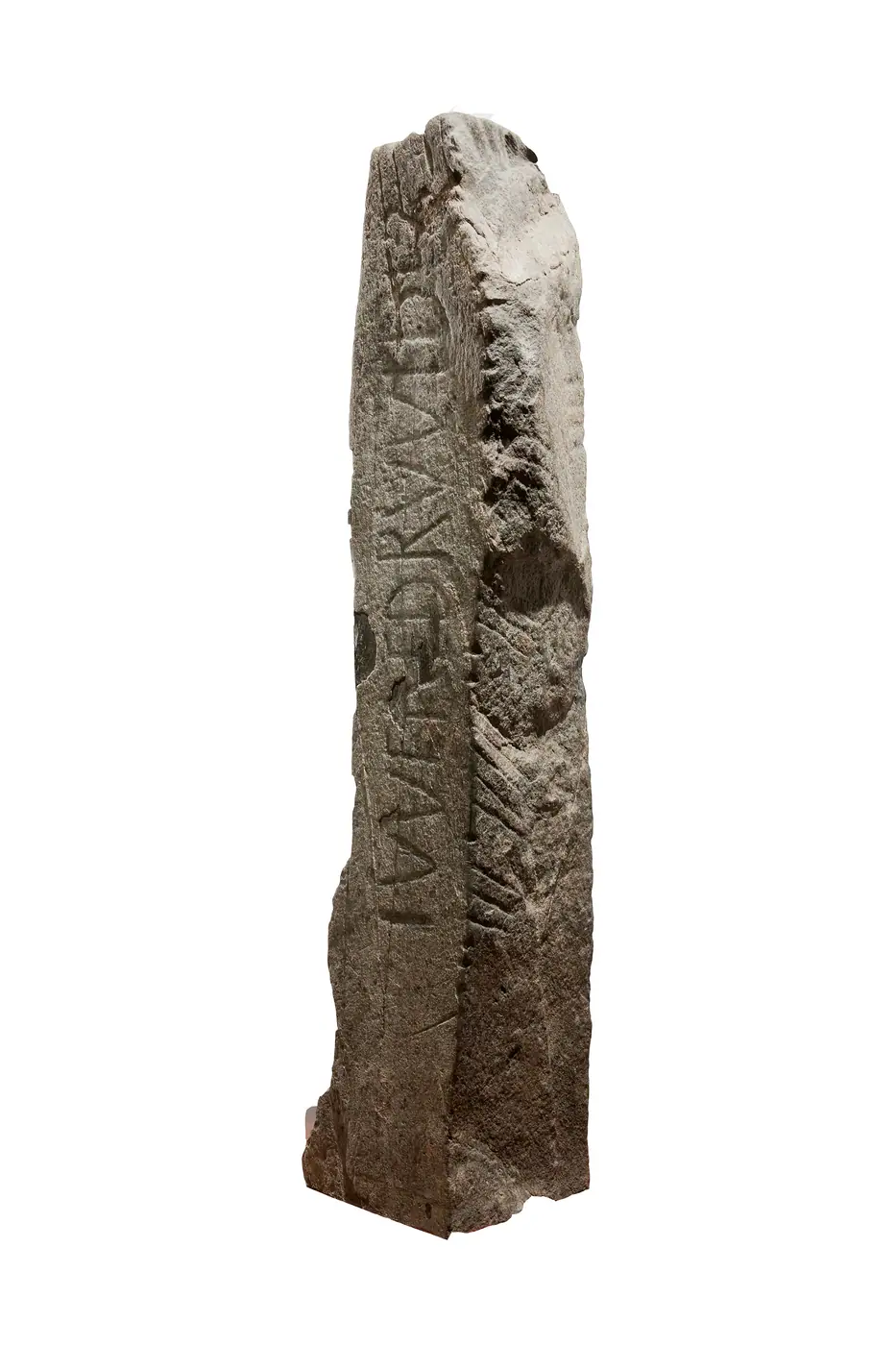
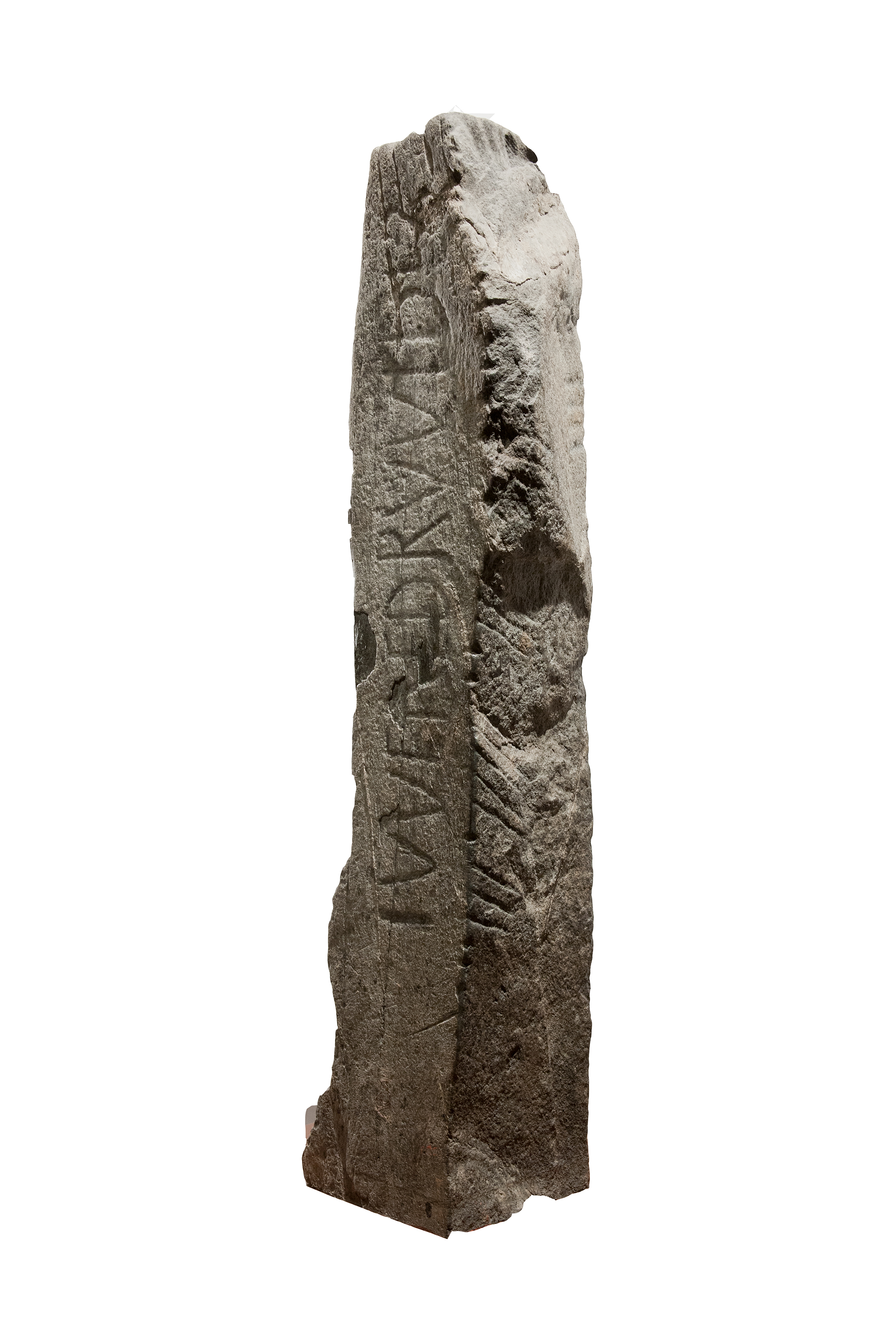
Condition: This rough, rectangular pillar (greywacke, with quartz veining) is somewhat battered and weathered, including some damage to the roman-letter inscription on one of the faces. The ogham, though weathered, is mostly legible. There is also modern graffiti in the form of initials (JM) scratched onto the face to the right of the third V of the roman-letter inscription. The height initially recorded by Shearman (1864, 254) was 6 feet 4 inches (1.90m) but only 1.54m are currently accessible above the display case.
Inscription
Text field: The ogham inscription begins at roughly a third of the way up the left edge of one of the flat faces of the stone, continues upwards, across the top and down the other side. This is the most common layout for ogham inscriptions.The roman-letter inscription starts just a few centimetres above the ogham on the face to the left and also runs upwards (facing right) to near the top of the stone. This is highly unusual as vertical inscriptions in roman capitals in Britain generally read downwards (facing left).
Letters: Both inscriptions are pocked. However, as noted in a number of other ogham inscriptions, the distinctive vowels appear to be wedge-shaped (with flat sides) and may have been cut using a flat chisel. The ogham strokes in this inscription are well spaced out except for the final S of the first name where the strokes are slightly closer together to avoid a ridge on the stone. The extra space this -S and the following AVI, which could be interpreted as an early example of word division, is more likely to also be due to this uneven surface. The consonant strokes are quite long, for example the N and S of the first name (up to 132mm in length), which are also quite slanted and more slender (c. 5mm) than, for instance, the final S (83mm long and 10mm wide). The wedge-shaped vowels are approximately 15 x 10mm. Although there are many examples of inscriptions in roman letters in Ireland, most are later and in insular half-uncial (even the early, c.6th-century, Inchagoill pillar). Only this one is entirely in roman capitals and so has more in common with British examples. Noteworthy features include the upward reading layout (typically downwards in British examples), the reversed S and possibly ligatured NE.
Date: First half of early second half of the fifth century A.D. (linguistic)
Edition
Ogham text: ᚑᚃᚐᚅᚑᚄ ᚐᚃᚔ ᚔᚃᚐᚉᚐᚈᚈᚑᚄ
Transcription: OVANOS AVI IVACATTOS
Critical apparatus:
- Both inscriptions are, for the most part, quite clear and unambiguous with regarding to reading. The only doubt is where there is damage to this fifth letter of IVVENE in the Latin inscription, making it difficult to be certain of the reading, either ligatured NE, or less likey R. Macalister (1945, 23-24) suggested that it is a G derived from Greek gamma, but his explanation and interpretation are not very credible.
Translation
Ogham: ‘of *Oän (? *Jovanis?) descendant of Éochad (*Ivacatus)’
Roman: ‘the druids (erected this) for (i̯)ou̯anis’?
Commentary
The analysis of ogham OVANOS has remained obscure so far, except for the ending -OS which is the genitive of a u- or an i-stem. Several explanations have been suggested for OVAN- (OIr. omun, ómun ‘fear’ and úaine ‘green’, but none of them can convince formally. A new suggestion (by David Stifter) is that OVANOS can be the genitive of Proto-Celtic *i̯ou̯ani-, which would continue an Indo-European formation *h₂i̯u-h₁n̥-i- ‘young person’. This could be an i-stem by-form of Proto-Celtic *i̯ou̯anko-, the normal adjective ‘young’, and would be comparable to Latin iuuenis ‘young person’. This proposed explanation presupposes that the initial *i̯- of earlier *i̭oṷanoṷs had already been lost in OVANOS. A serendipitous side result of this solution is that this name, which was otherwise lost in Irish, finds a possible cognate in the common Welsh name Ieuan. This has been traditionally explained as a loan from Biblical Iohanes, but it can just as easily be derived from inherited Celtic *i̭oṷanis ‘young person’.
IVACATTOS is a compound of PC *iṷo- ‘yew’ and PC *katu- ‘battle, war’ (Bergin 1932: 142–143), the meaning being ‘having battles with yews, yew-battler’. Pace Ziegler (1994: 190), it does probably not correspond to later Old Irish Éochaid, gen. Éochado (with transition to the i-stems).
IVVENE has been understood as a faulty spelling for iuuenes druides ‘the young druids’. However, an alternative interpretation is possible. The Latin word iuuenis is formally, semantically and etymologically the exact parallel to the new Celtic explanation for OVANOS. IVVENE could theoretically be not a faulty spelling for iuuenes, but the correct spelling for the i-stem dative singular of the semi-Latinised Primitive Irish name (i̯)ou̯anis, in which case the Latin text would mean “the druids (erected this) for (i̯)ou̯anis”. In that case, the inscription would in actual fact be a bilingual, with at least a similar text in the two languages, not two completely unrelated texts. The question still remains why one text had to be written in Latin in the first place.
The preservation of all endings and the lack of vowel affection suggests that this inscription is very early (5th century).
References
- Greene 2013, 26-47
- Macalister and Praeger 1928, 247-261
- Macalister 1945, 23-24
- Shearman 1864, 253-260
- Shearman 1873, 544-560