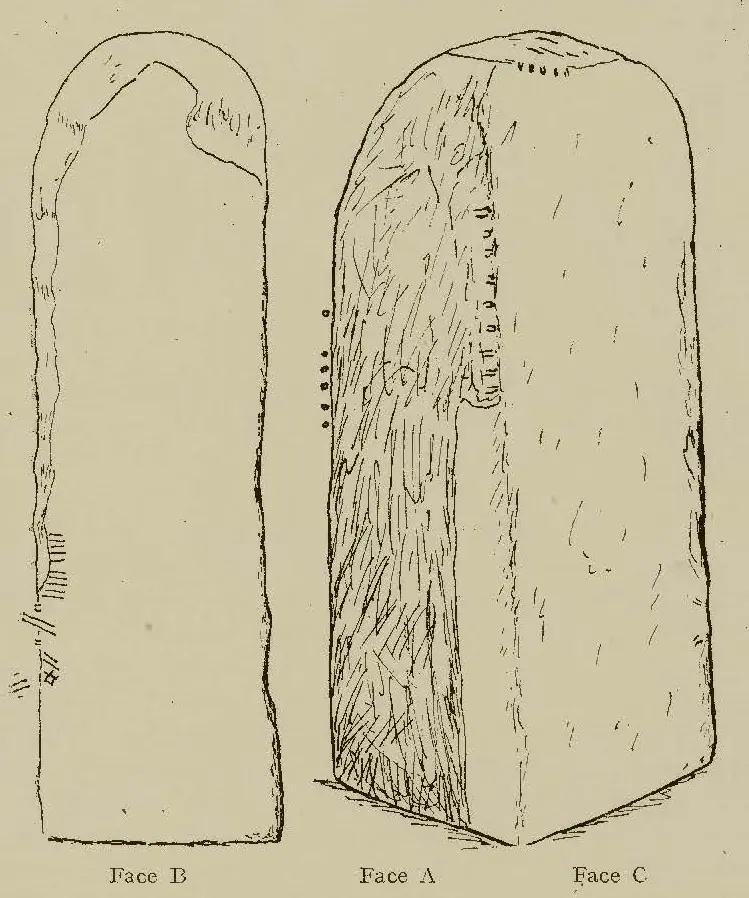
Provenance
Discovery: Discovered in 1846 by Cork antiquarians Windele, Abell, and Hawkes in a souterrain (CO085-067002-) in the SW quadrant of a ringfort (CO085-067001-), with five other ogham stones: I-COR-046, I-COR-047, I-COR-048, I-COR-049 and I-COR-050. In 1849 Windele removed five of the stones, including this one, to his own residence (Blair’s Castle, Cork) but they were later moved to the museum of the Royal Irish Academy (Brash 1879, 140; Macalister 1945, 92-93).
Findspot: Ballyhank (Baile Sheanc), Co. Cork, Ireland (ITM Coordinates: 557971, 564534)
Current repository: Ireland National Museum of Ireland (inv. no. 1872.23)
Last recorded location(s): All six stones from Ballyhank are now in the collection of the National Museum of Ireland. This stone was recorded in 3D in 2010 as part of the Ogham in 3D project in collaboration with the Irish Inscribed Stones Project.
Support
National Monuments Service SMR ID: CO085-067008-
Object type: Pillar
Material: Sandstone
Dimensions: H 1.09 × W 0.27 × D 0.30 m
Condition: A very smooth pillar, triangular in horizontal section, reused as a lintel in a souterrain. Macalister (1945, 100-101) describes it as a palimpsest, saying that the original inscription is almost entirely erased. There is certainly damage to the edges of this stone and while it is possible that an earlier inscription has been destroyed, no clear evidence of survives.
Inscription
Text field: Up on the dexter angle of one of the faces (Macalister’s face B), which occupies the space between 0.20m and 0.40m (7.8in. and 15.7in.) above the stand.
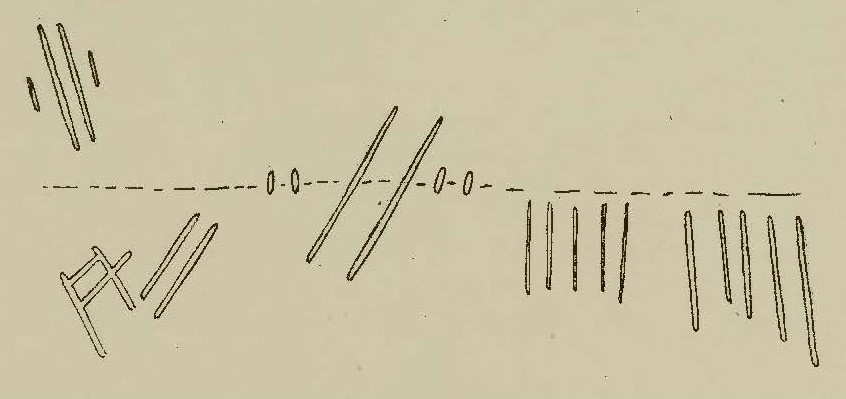
Letters: The surviving ogham stokes on this stone are finely scored and described by Macalister (1945, 101) as ‘a mere graffito’ and ‘roughly scratched’. One of the characters was read by Macalister as a rare I-forfid, but this is unclear. He also noted what he describes as an older inscription (cut in ‘bold, well-spaced’ strokes) on the sinister angle of one of the faces (up-top-down). However, there is no apparent evidence for this.
Edition
Ogham text: ᚇᚘ
Transcription: DILOGONN
Critical apparatus:
- As acknowledged by Macalister (1945, 102), there is much uncertainty with regard to the reading of this inscription, particularly the possible example of the rare I-forfid, which is not at all clear in this case.
Translation
of *Dílug (?)
Commentary
The personal name (DILOGOON), if correctly interpreted, does not appear to be attested later but may be something like *Dílug (intensive prefix dí and mythological/deity name Lug?).
References
- Macalister 1945, 100-102
- McManus 1991, 65
- Power, Byrne, Egan, Lane, and Sleeman 1997, no. 7953