Provenance
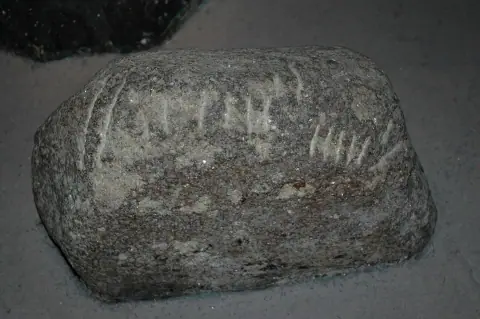
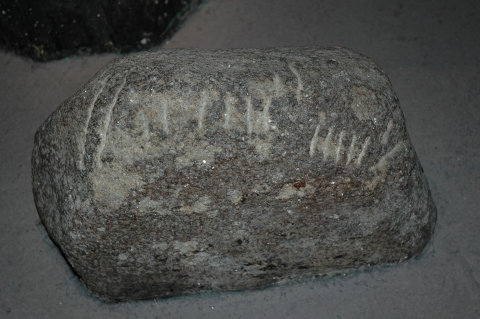
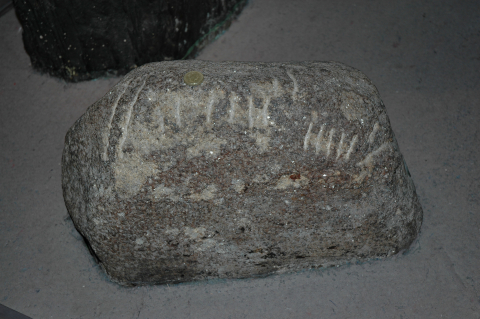
Discovery: Discovered around the same time as Bimaken Friary 1 (M-IOM-003), it was found in 1893 in the parish of Kirk Arbory, in the southern part of the island. This rounded granite boulder was found at Bemaken Friary, but its precise findspot is unknown. According to local tradition, it was found in a field bank on the boundary between the Friary farm and the neighbouring farm of Ballaclague (NGR SC 2490 7040) lying to the north-west.
Findspot: Kirk Arbory, Rushen, Isle of Man (National Grid Reference: SC 2490 7040)
Current repository: Isle of Man Manx Museum (inv. no. Category: MM 4)
Last recorded location(s): Now in Manx Museum.
Support
Isle of Man Historic Environment Record (IOMHER): 0011.40
Object type: Boulder
Material: Granite
Dimensions: H 0.47 × W 0.2 × D 0.39 m
Condition: The ogham inscription is incomplete with portions missing from both the beginning and the end.
Inscription
Text field: The ogham inscription is found on the stone’s arching upper angle. It starts on the left edge and reads upwards.
Letters: The ogham letters are well-spaced and neatly carved. The inscription apears to have been pocked.
Date: Seventh century
Edition
Transcription: [---]MAQ LEOG[---]
Critical apparatus:
- The spelling G is typical in ogham for word internal /g/, where the Old Irish (i.e. manuscript) spelling would be c, just as word-internal /b/ and /d/ are written B D in ogham, but p t in Old Irish. 2. The inscription appears to start on the right edge based on the angle from which the stone was photographed.
Translation
Mac-Liäc: son-of-stone
Commentary
Lía (genitive: liäc, later líac) means ‘stone’, especially an upright stone or pillar. It is the word most commonly used for an ogham-inscribed pillar.
While not a common name, Mac-Liäc does crop up now and again in the historical sources. There’s even a saint called Mac-Líac (from Drumglass, Co. Tyrone). The most famous bearer of the name was Mac-Líac (Muirchertach, son of Cú Chertaig), chief poet of Ireland, whose death is recorded in the Irish annals in 1015.
The name’s use on the Isle of Man gave rise to the Manx surname MacCluag, or Clague. A branch of this family occupied (and gave their name to) the farm Ballaclague (equivalent to Irish Baile (mhi)c-Líag) where this stone was found. Their presence there is recorded since at least the sixteenth century. Remarkably, this stone appears to commemorate their eponymous ancestor a millennium earlier.
According to Forsyth (2022), the lack of word-endings indicates this inscription is not older than the mid-sixth century as it post-dates the sound-change apocope which happened around this time, and is perhaps more likely to date to the seventh century.
References
- Broderick 2021, 102-104
- Forsyth October 2022
- Macalister 1945,