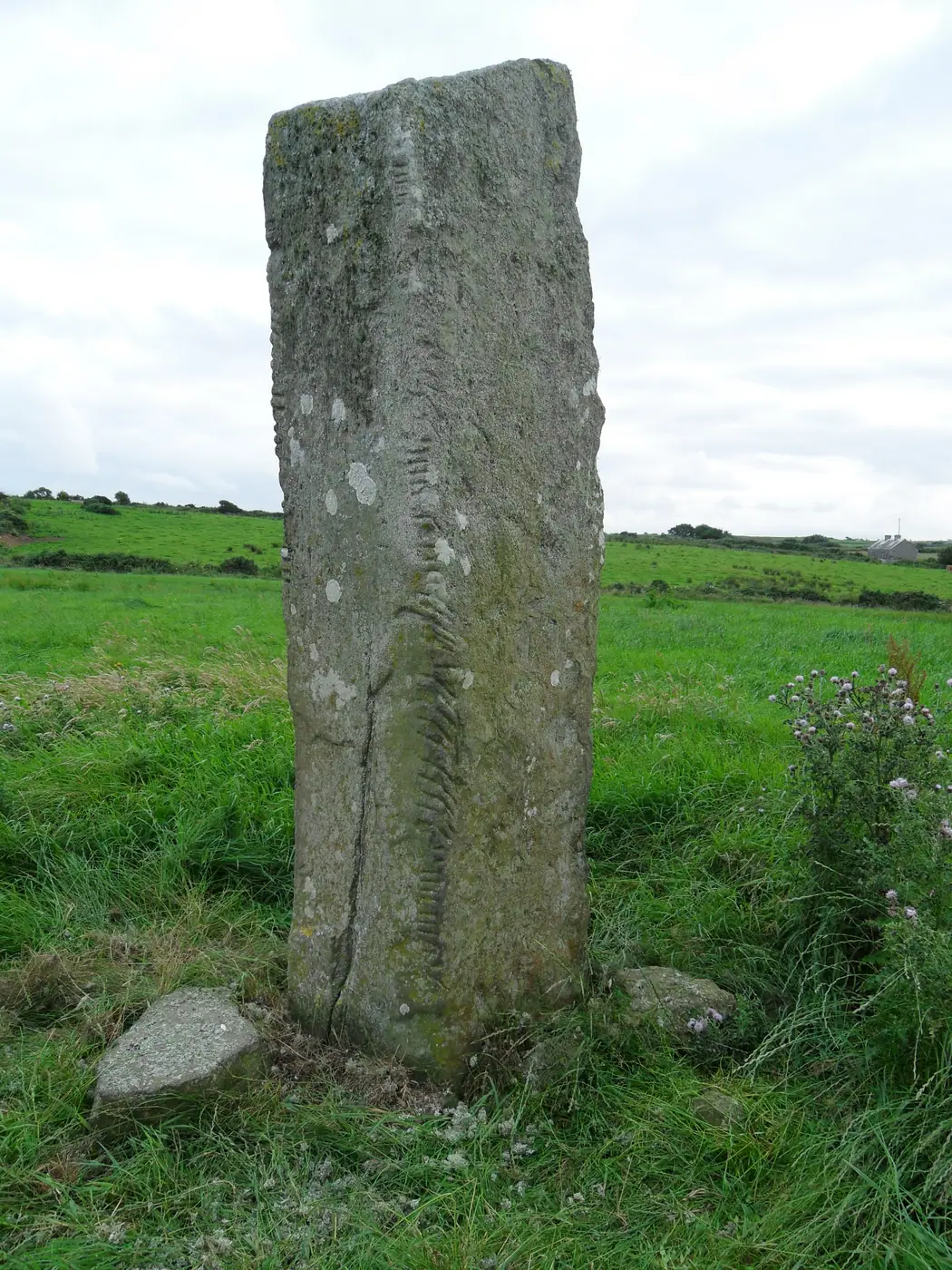
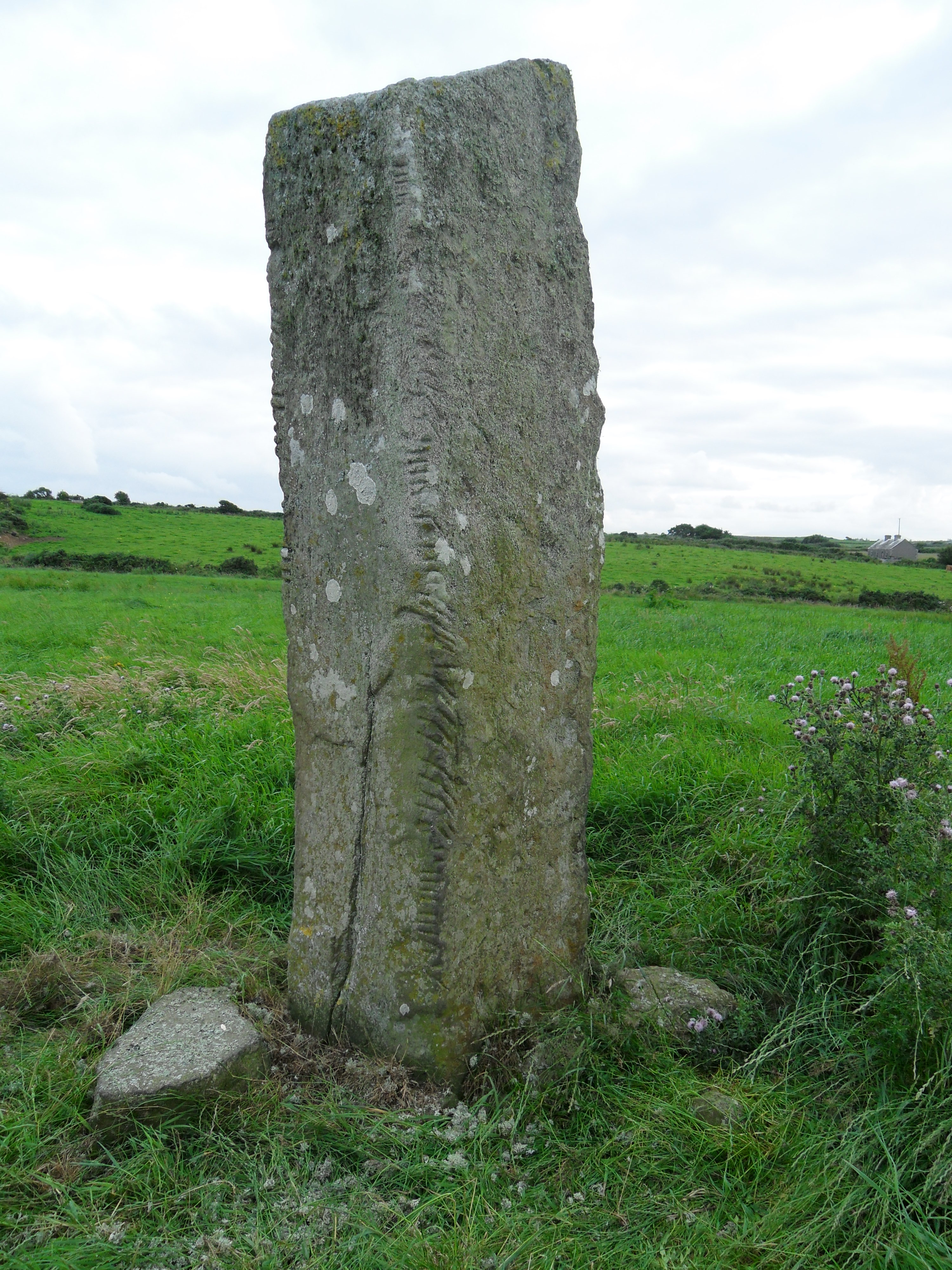
Provenance
Discovery: Discovered lying (total length 3.6m) in a field in the townland in 1874 by an English tourist and brought to the attention of antiquarian Samuel Ferguson. It appeared to overlie a possible grave, a cavity at the south end of which was identified as the socket in which the stone once stood (Ferguson, 1870-9, 201-206).
Findspot: Breastagh (Bréisteach), Co. Mayo, Ireland (ITM Coordinates: 518294, 833798)
Last recorded location(s): Re-erected after discovery in its current position. Visited and 3d scanned as part of the Ogham in 3D project in August 2014.
Support
National Monuments Service SMR ID: MA015-018001-
Object type: Pillar
Material: Stone type unknown
Dimensions: H 2.75 × W 0.98 × D 0.58 m
Condition: Sections of the inscription have been eroded and damaged by spalling. This ogham stone is a national monument (no. 415) in state guardianship.
Inscription
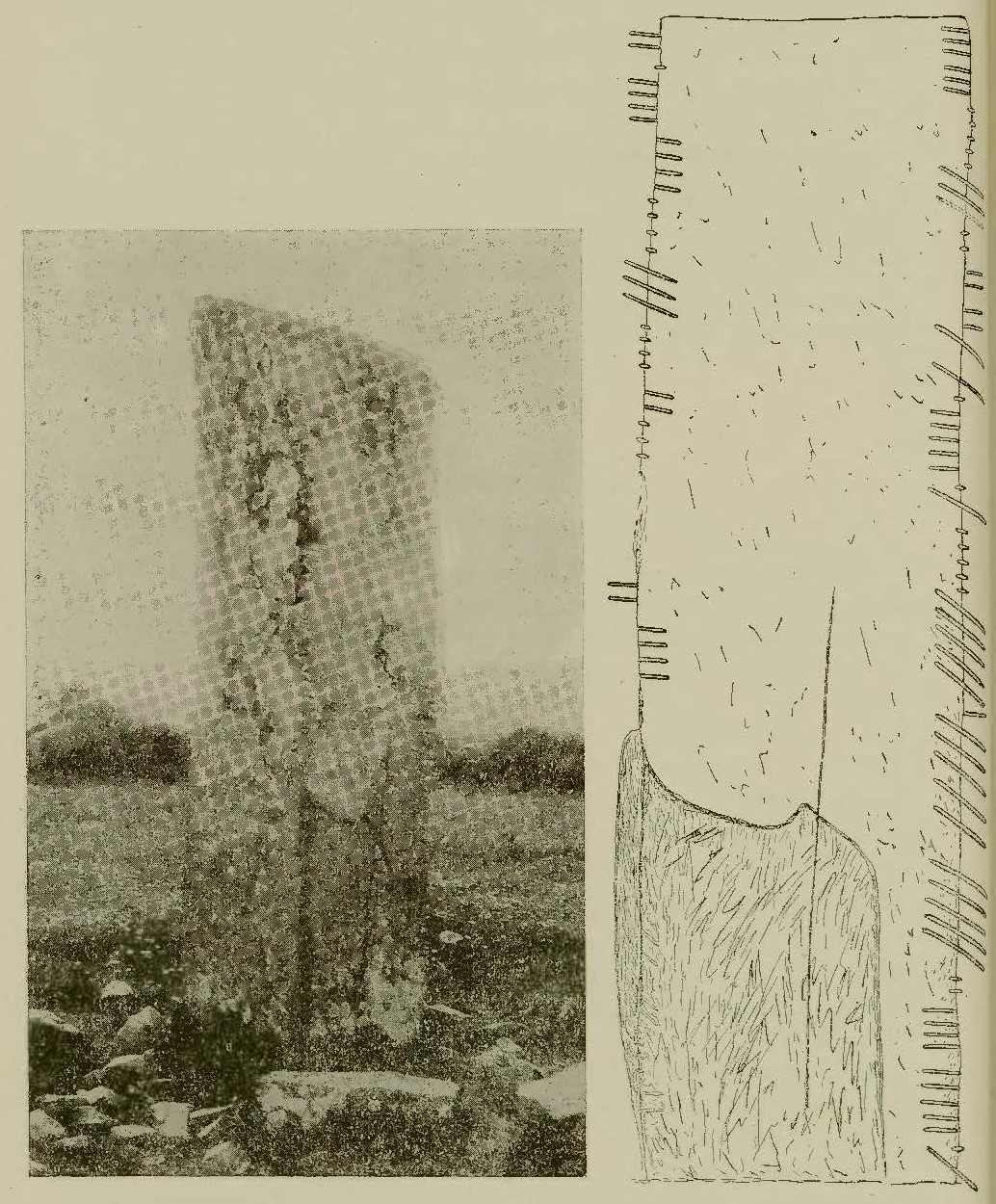
Text field: There are ogham inscriptions on the NE and SE angles. The inscription extends upwards the entire length of the NE angle (line 2); it is partly obscured by lichen. On the SE angle (line 1), the inscription begins 1.2m above ground level and continues upwards (Archaeological Survey of Ireland, Field Report 2017).
Letters: The ogham strokes appear to have been pocked and rubbed. Spacing is irregular, especially the Rs.
Edition
Ogham text: ᚂᚓ̣ᚌ̣ᚌ̣[.. ? ..
Transcription: LẸG̣G̣[.. ? ..]SDULEGʷẸṢC̣ẠD MAQ CORRBṚI MAQ AMMLḶỌG̣[I]ṬT
Critical apparatus:
- This inscriptions appears to contain one of the original 20 characters rarely attested in epigraphy, ᚍ transliterated as Gʷ (Macalister (1945, 13) transliterates this as ŋ following the manuscript tradition), where it is the last clearly legible letter on the left angle (line 1). Macalister (1945, 13) also reads this character on the opposite angle but what survives today looks more like a G (i.e. just 2 strokes).
Translation
… of the son of Coirpre son of Amalgaid?
Commentary
Little can be said about the unintelligible reading of the first (SE) angle. With regard to the second (NE) angle, the father’s name (possibly Amalgaid, or the like) was previously identified by Macalister (1945, 15) and others with a king of Connacht who died between 440 and 450 AD but the linguistic forms in the inscription rather suggest a late sixth or even early seventh century date. However, since Amalgaid could be the grandfather of the commemorated person, a 6th-century date isn’t beyond possibility.
References
- Ferguson 1874, 201-206
- Macalister 1919, 402
- Macalister 1945, 13-15