Provenance
Discovery: Discovered by Rev. W. P. (afterwards Dean) Carmody, then rector of Connor, in the year 1898. One of two inscribed stones, used in roofing a souterrain c. 8m (26ft. 6in.) long, where they were last but one at each end of nine roofing stones in total (Macalister 1945, 297; Buick 1900, 266). The other ogham stone (I-ANT-001) remains where it was found, and, as the souterrain is now closed, is inaccessible. There are no visible remains of this souterrain above ground.
Findspot: Carncome (Carn Coim), Co. Antrim, Northern Ireland (approximate. National Grid Reference: J1604096680)
Current repository: Ireland National Museum of Ireland (inv. no. RIA 1906:206)
Last recorded location(s): Now in the National Museum of Ireland collection. Examined and recorded using 3d structured light scanning in April 2017 in collaboration with the Discovery Programme as part of the Ogham in 3D project.
Support
Northern Ireland Sites and Monuments Record Number: ANT038:032
Object type: Pillar
Material: Basalt
Dimensions: H 0.92 × W 0.26 × D 0.28 m
Condition: One of two ogham-inscribed pillars (see also I-ANT-001) reused as lintels in a souterrain.
Inscription
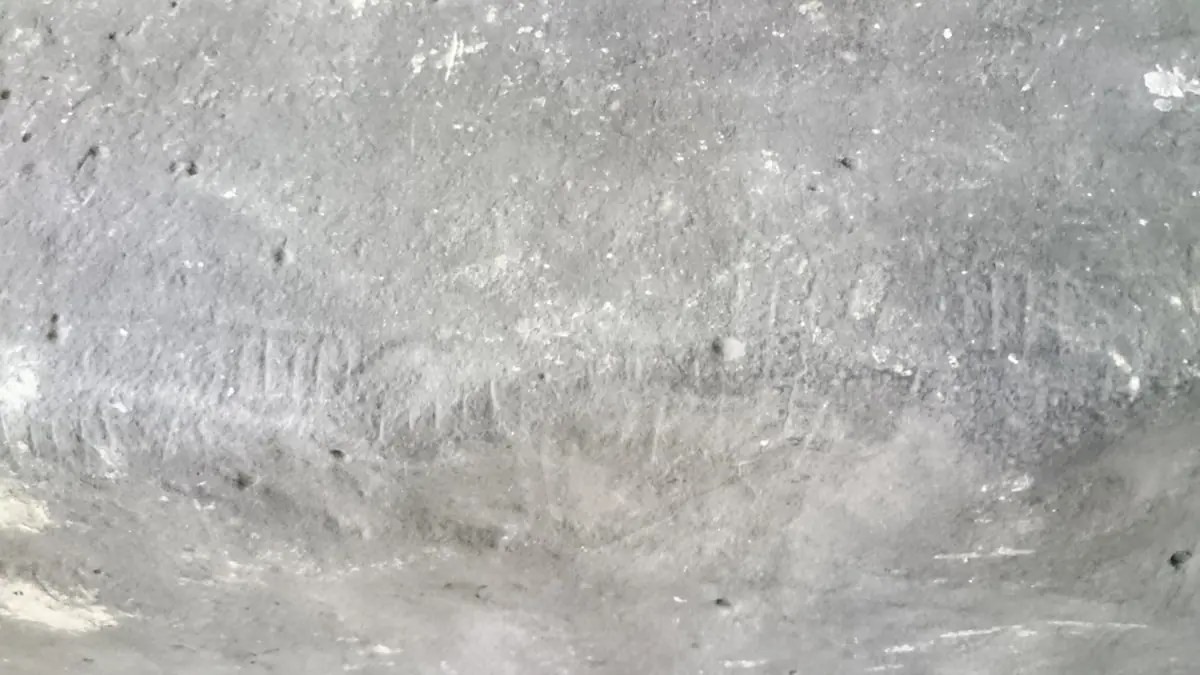
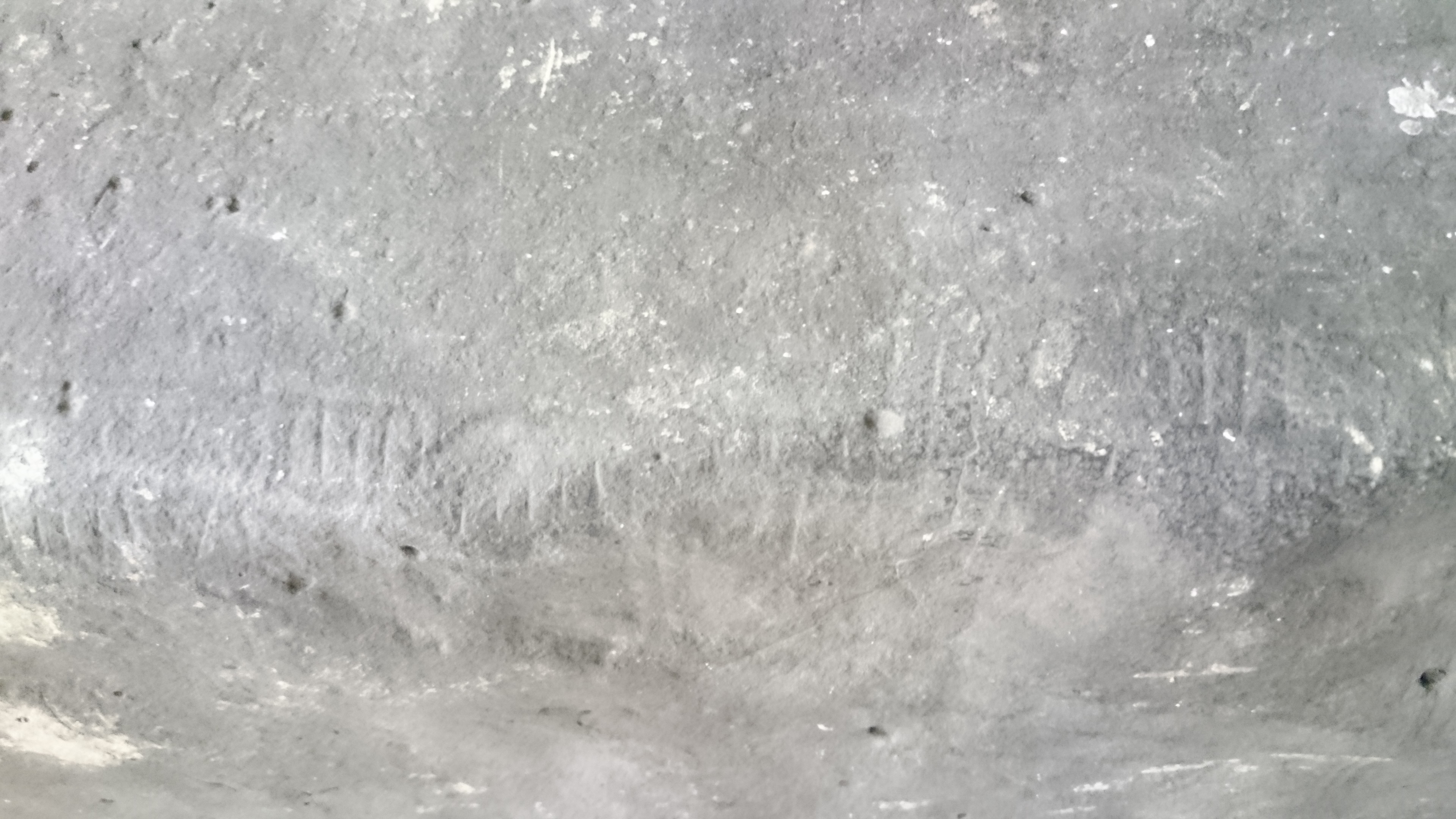
Text field: The inscription runs along one edge for ”14 inches” or approximately 35cm (Buick 1900, 266).
Letters: The ogham strokes in this inscription (also its companion (I-ANT-001) are particularly lightly scored, described by Macalister (1945, 297) as ‘little more than pin-scrapes’. Buick (1900, 266) noted that ‘the average length of most of the consonants is three-fourths of an inch (c. 1.9cm). Others, however, run up to an inch (2.5cm), and a few, such as Rs and Ms, to a couple of inches (c. 5cm). All of them look as if they had been scored in with a nail’.
Edition
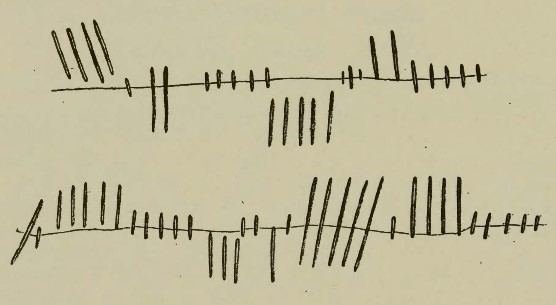
Ogham text: ᚉᚐᚌ̣ᚔᚅᚐ̣ᚇ̣ᚔ̣ ᚋᚐᚊᚔ ᚃᚑᚁᚐᚏᚐᚉᚔ
Transcription: CAG̣INẠḌỊ MAQI VOBARACI
Critical apparatus:
- The strokes are very faint and the identification of the letters, especially in the first word, is very difficult. 2. CAGINADI: CALINADI (alternative reading of the first name). Macalister (1945: 297) noted that the third letter is ‘docked rather short on the H-side’, which could mean that an L was intended.
Translation
of *Caigned (? *Caginadas?) *Fobrach (*Vobarrācas)
Commentary
This inscription consists of an individual name, the formula word ‘son’ and a patronym. The first name CAGINADI has no parallel in OIr. and its analysis is obscure. The ogam corpus contains several examples of a formally reminiscent name, even though the ambiguities of the script impede the determination of their exact relationship with CAGINADI. One approximate parallel is the simplex name CAGG[I] (I-COR-052 = CIIC 103; Barachaurin, Co. Cork) and perhaps CAGI (S-ARL-001 = CIIC 506; Gigha, Argyllshire; very uncertain reading). The same name appears as the second element of the binomial name NETA-CAGI (I-WIC-001 = CIIC 47; Castletimon, Co. Wicklow). CAGI can be analysed as the genitive of an o- or a i̭o-stem. These names appear to contain the same root element as CAGINADI, but its interpretation is unclear. The sequence -AG- most likely represents PrimIr. *-ag-. This sequence cannot continue older pre-Goidelic *-ank- since that would have resulted in PrimIr. *-ēgg-, which would be reflected in ogam as *-EG- or *-EGG-; cf. the treatment of the sequence *-ant- > *-ēdd- for example in DECCEDDAS < *dekantos (I-COR-014 = CIIC 66; Faunkill and the Woods, Co. Cork). Ziegler (1994: 144) compares CAGINADI with *kag̑o-/kog̑o- (IEW 517–518) in words for ‘goat’ in Germanic and Slavic, especially in words for ‘kid, young goat’ in Germanic languages (OE hēcen, MLG hōken). Motta (1983: 302–304) tentatively compares these names with the Old British name Cogidubnus and with OIr. coig, coic, which he glosses “consiglio” (‘advice’). This word is included in eDIL under ²coic (dil.ie/10032) where it is glossed ‘secret’. The dictionary points out that it occurs chiefly in glossaries and in Bérla na Filed poetry. Aside from the mismatch in the vocalism, the glossatorial nature of the word raises doubts about its suitability to explain the ogam personal names. Another possible connection is with Gaul. cagiíon, caio in Endlicher’s Glossary, W cae, Corn. ke, Bret. kae ‘hedge’ < *kagi̭o- (cf. Germ. Hag, Engl. hedge). However, any of these etymological attempts leaves the suffix -NADI of CAGINADI unexplained. In the absence of a simple noun of an appropriate shape in OIr., CAGINADI is hardly to be analysed as a compound name, unless *nad is the root found in nascaid ‘to bind’ < *nad-ske/o- and naidm ‘binding’ < *nadman. Other proposed readings of the name (CALINADI, TAGINADI) have no parallels. The OIr. rendition of the name above, *Caigned, is purely mechanical.
The most straightforward analysis of VOBARACI is as *u̯o-barr-āko-, a prepositional governing compound ‘he who is underneath (*u̯o-) the top (*barro-)’. The corresponding OIr. name *Fobrach is unattested. The connection with OIr. Foibrech/Fabrech < *u̯o-ber-āko- or Fobrecc < *u̯o-brikk-, proposed by Ziegler (1994: 249), is unlikely since in an early inscription like this, those names would be expected to appear as *VOBERACI or *VOBRICCI. The retention of all endings, if correct, points to an early date in the 5th or early 6th century.
References
- Buick 1900-1902, 265-271
- Macalister 1945, 297-298
- Ziegler 1994, 144, 249