Provenance
Discovery: The runic inscription was first identified by Macalister (1917, 493-498) on the fragment then built into the precinct wall in front of the cathedral. When it was removed from the wall, sometime before 1929, the ogham inscription was discovered (Macalister 1945, 58-59).
Findspot: Shantraud (An tSeantsráid), Killaloe (Cill Dalua), Co. Clare, Ireland (ITM coordinates: 570383, 672893)
Last recorded location(s): On display inside St. Flannan’s Cathedral, Killaloe, where it was examined and recorded for the OG(H)AM project by Gary Dempsey (Atlantic Technological University) in July 2022.
Support
National Monuments Service SMR ID: CL045-033010-
Object type: High cross shaft
Dimensions: H 0.68 × W 0.47 × D 0.22 m
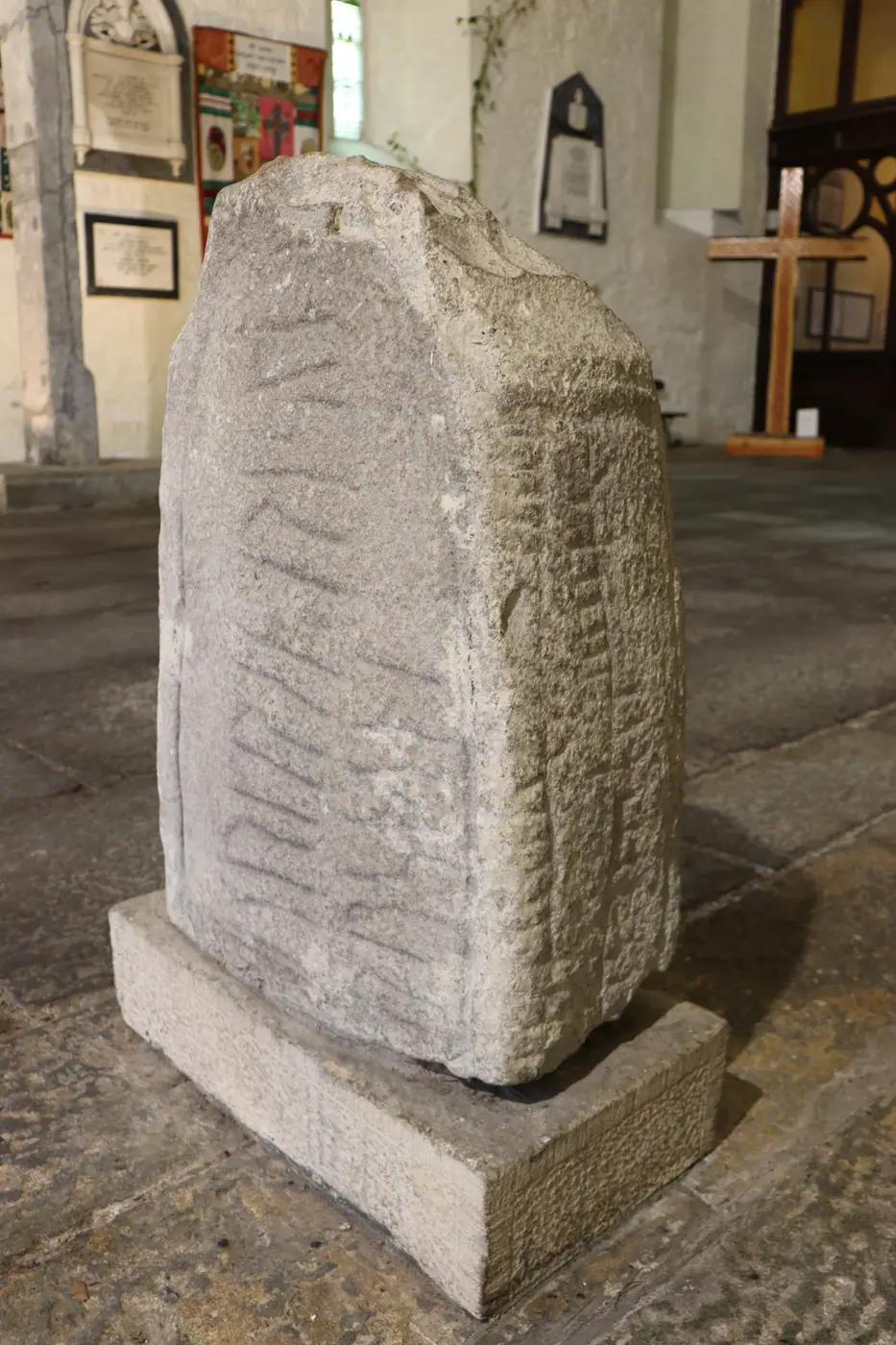
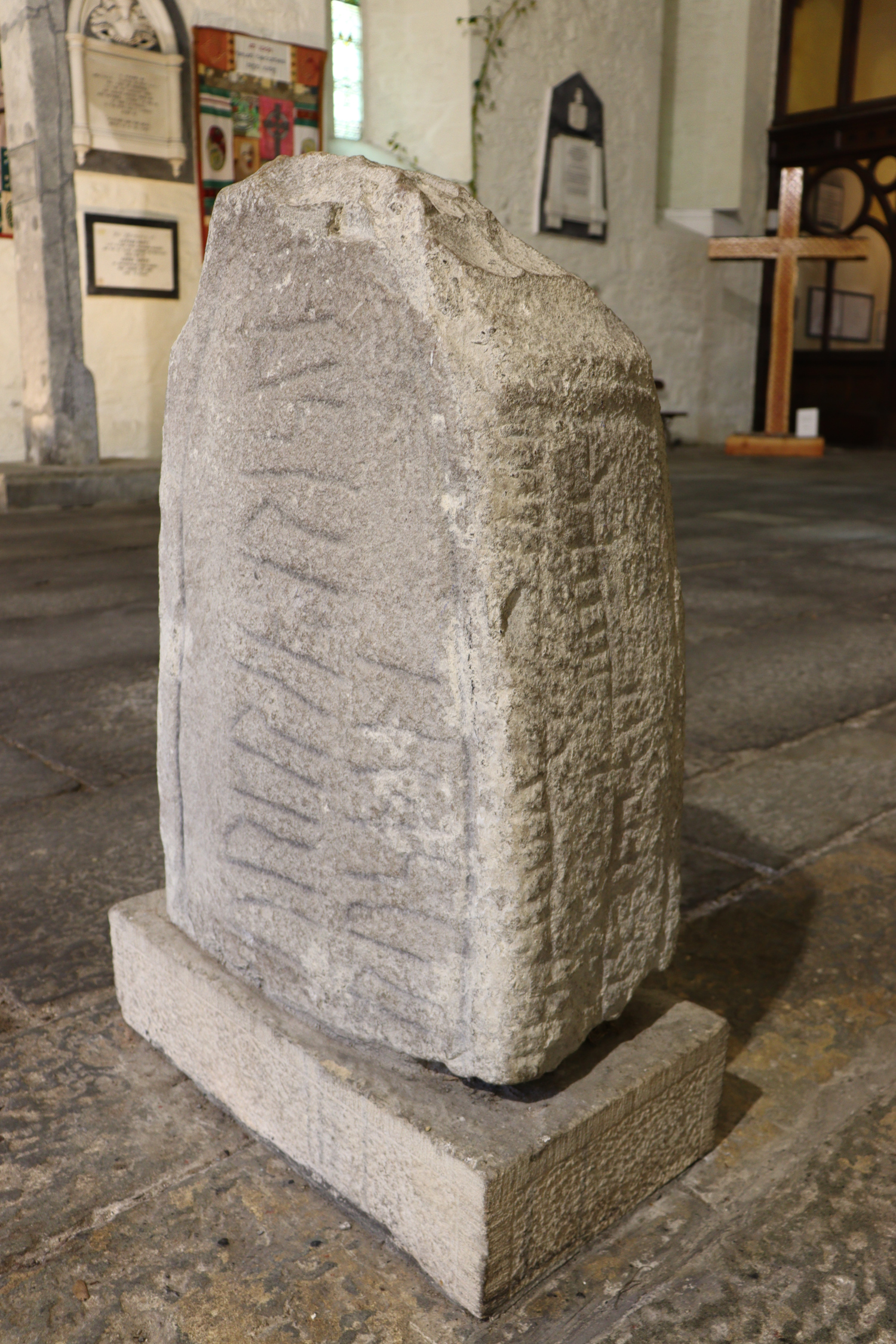
Decoration: In addition to an ogham and runic inscription, there is what appears to be a crucifixion scene on one of the broad faces surrounded by a frame or cartouche.
Condition: This is a fragment from the upper shaft, just below the head, of a free-standing cross (Murray 2019, 237). What survives is in good condition.
Inscription
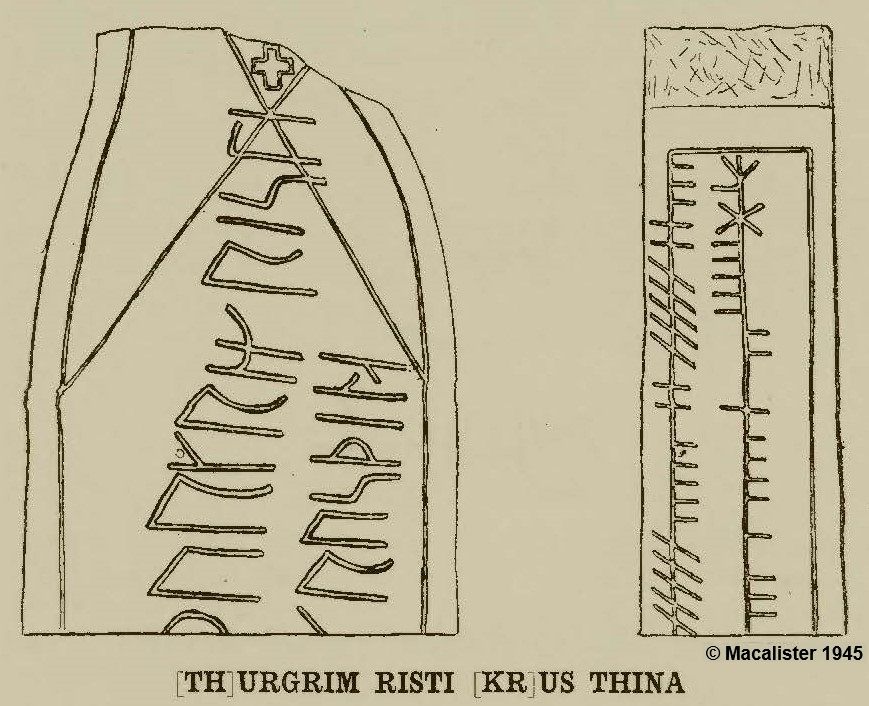
Text field: The ogham inscription is in two lines (unusually down-down) on the narrow side of the stone to the right of the face with the runic inscription. Like the broad faces, this side has a cartouche (though narrow) and what appears to be the first line of the ogham inscription (including a carved stem-line) is centrally positioned inside. The second line of ogham uses the left side of the cartouche as a stem-line. The runic inscription is centrally positioned on the broad face opposite the crucification scene and to the left of the ogham inscription, in two vertical lines (reading upwards) and also inside a cartouche.
Letters: The inscription is pocked in short, quite tightly-spaced strokes and appears to be same technique as used for the runic inscription. Later (reformed) features include a carved stem-line (rather than using the edge of the stone), vowels the same length as consonants, the use of a feather-mark at the beginning of the text and the use of the X-forfid with a vocalic value.
Date: Early twelfth century AD (prosopography)
Edition
Ogham text: ᚛
Transcription: ᚛BENDAC
Critical apparatus:
- Runic inscription on the face of the stone IR 2 (Runic inscription IR 2 in the latest (2020) edition of the Scandinavian Runic-text Database, Department of Scandinavian Languages, Uppsala University): Rune reading: (þ)(u)rgri- [⁓] risli + ¶ (k)rus þina Old West Norse: Þorgrí[mr] reisti/risti kross þenna. Translation: ‘Þorgrímr erected/carved this cross’ 2. In the first line of the ogham inscription, there is no sign of an expected H in the otherwise clear bendacht ‘blessing’. It may have been lost through damage or perhaps it was omitted in error. In the second line, Macalister missed the X- forfid (reading instead an O) and confused the orientation of B- and H- aicmi strokes so that he read TOROQR[IM] (supplying the =IM to match the name in runic inscription) rather than NRXNE[…, or possibly FORXNE[…, representing the preposition for ‘on (behalf of)’ (usual after bendacht) and the first few letters of a personal name ENE.. or ENI… .
Translation
a blessing on En…
References
- Macalister 1917, 493-498
- Macalister 1945, 58-59
- Murray 2019-01, 237-242