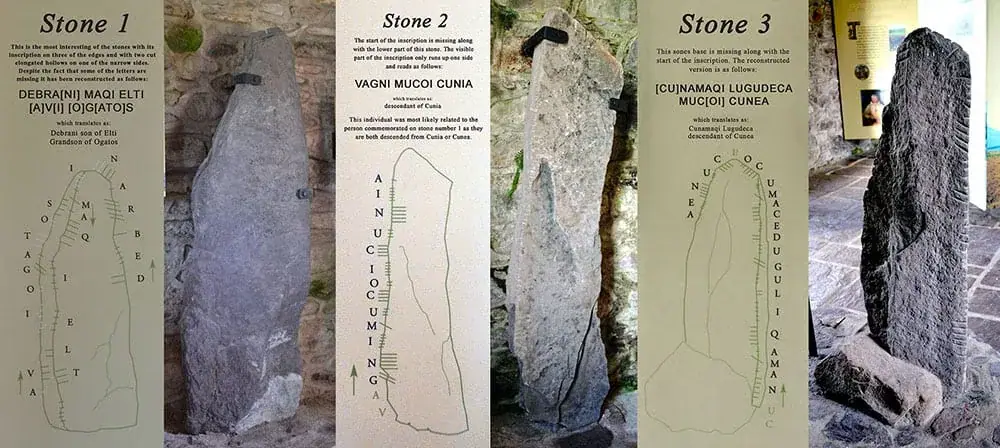
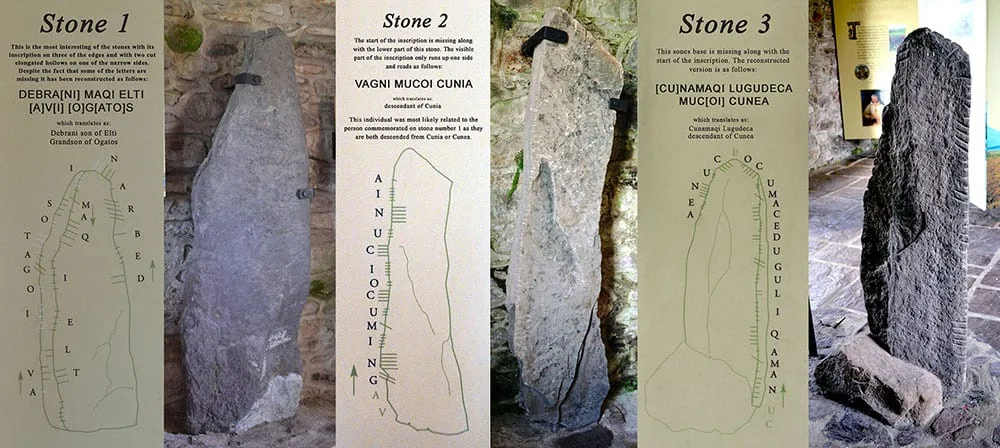
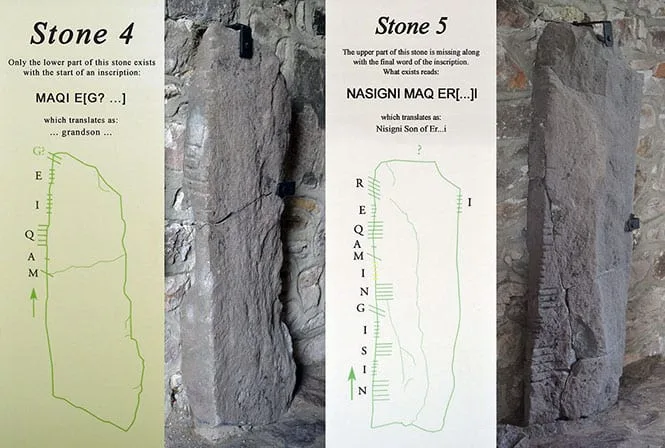
Provenance
Discovery: Discovered in 1857, along with four other ogham stones (I-WAT-026 to I-WAT-029), by William Williams. The find site is known locally as a Cillín/killeen, a more recent geophysical survey has confirmed the existence of an ecclesiastical enclosure (Cill Ghruabháin). The enclosure is bivallate (int. diam. c. 50m; ext. diam. c. 60m), perhaps with an annexe or secondary enclosure attached to the SE, which may be the arc represented on the 1927 map. A number of smaller circular features (diam. c. 10m) within the enclosure could represent hut-sites, or even the church (Purcell 2003, 6-8). Another ogham stone (I-WAT-030) and a fragment of an ogham stone (I-WAT-031) were discovered in 1966 during a non-archaeological dig at the same site.
Findspot: Kilgrovan (Cill Ghruabháin), Co. Waterford, Ireland (ITM Coordinates (approximate): 630844, 593197)
Current repository: Ireland Mount Mellary Abbey Heritage Center (inv. no. )
Last recorded location(s): Mount Mellary Abbey Heritage Centre (seen and photographed in Feb 2017). The five stones originally lay in a fenced off grove off trees at Melleray for over 40 years. In 1977 they were moved indoors and were erected in the foyer of the old secondary school, now the Heritage Centre.
Setting
Mount Mellary Abbey was founded in 1833 by Irish and French Cistercian monks — the first Cistercian monastery established in Ireland after the Reformation — in a remote valley in the Knockmealdown Mountains of Co. Waterford. The community fled post-revolutionary France and settled here on land that was at the time largely barren mountain bog. The monks cleared and cultivated the land themselves, and the monastery has been in continuous occupation since.
The five Kilgrovan stones were brought to Mount Mellary after their discovery and initially kept in a fenced grove of trees on the grounds for over forty years. In 1977 they were moved indoors to the foyer of the old secondary school building, which is now the Heritage Centre. They stand in a line, allowing close inspection of all five inscriptions. The Heritage Centre also holds other artefacts relating to the history of the Kilgrovan ecclesiastical site and the wider Knockmealdown area.
The abbey church itself contains striking stained glass windows. A grotto and holy well in the grounds attract visitors throughout the year. The monastery continues as an active Cistercian community and offers retreat accommodation.
Support
National Monuments Service SMR ID: WA031-045002-
Object type: Slab
Material: Sandstone
Dimensions: H 1.19 × W 0.36 × D 0.05 m
Condition: The lower end of the stone is broken off and we are missing the beginning of the inscription. The top is also damaged resulting in the loss of some ogham strokes. The stone appears to have suffered a cleavage fracture (similar to that of I-WAT-030), although this appears to have been before the inscription was added.
Inscription
Text field: The inscription runs up the right/sinister angle (rather than the more usual dexter), continues across the top and down the opposite angle.
Letters: The ogham strokes have been v-cut with a flat chisel and are evenly spaced without word division. Some of the strokes of the B-aicme (N and L, also B half of G) are longer and stretch the width of the stone on this narrow side. This is paralled on another ogham stone from the site (I-WAT-030), although in this case on the B-aicme, which suggests that both inscriptions may have been carved by the same person. The strokes of the N and L are also sloped, matching the slope of the M and G.
Edition
Ogham text: [ᚉᚒ]ᚅᚐᚋᚐᚊᚔ ᚂᚒᚌᚒᚇᚓᚉᚐ ᚋᚒᚉᚊ[ᚔ] ᚉ̣ᚒᚅᚓᚐ
Transcription: [CU]NAMAQI LUGUDECA MUCO[I] C̣UNEA
Translation
of [Co]nmac of Luguid from the sept of Con[?]
Commentary
Of the initial name, all that survives is -NAMAQI, with CU- a reasonable suggested reconstruction of the start of the name by Macalister (1945, 281). The name CUNAMAQ(Q)I is attested elsewhere in the ogham corpus, for example, I-KER-029 (Ballintaggart, Co. Kerry) and I-KER-021 (Ballinrannig, Co. Kerry). However, it is also possible that MAQI should be taken as a seperate word (MAQI ‘son of’) and that -NA is the end of different personal name.
The following name (presumably the father’s name) is based on the the divine name Lug. This name is well attested in the Old Irish period; and is still in use in the Modern Irish form Lughaí. It is a popular name on Irish ogham stones. It occurs also as LUGUDECCAS (I-WAT-002, Ardmore, Co. Waterford), LUGUDEC (I-MAY-002, Kilmannin, Co. Mayo) and LUGUDUC (I-COR-057, Kilcullen South, Co. Cork). The various forms of the name reflect consecutive stages of language change from PrimIr. *Lugudikas to OIr. Lugaid, gen. Luigdech under the effects of apocope and stress reduction. The second element of the name is the root *dik- ‘to show, point out’. The name therefore means ‘showing or pointing out Lug’, perhaps in the sense of an intermediary between the god and ordinary people. The popular analysis as Lug + the root *dek- ‘to show respect’ (McManus 1991, 103, 178 n.17) is phonologically difficult to justify (Stifter 2010, 23–24) and is therefore rejected here.
Only two strokes of the initial letter of the kin group name survives and so this could be D, T or C. Considering that MUCOI CUNIA is found in another ogham inscription from this site (I-WAT-028), C is tentatively suggested here. However, CUNEA/CUNIA does not appear to be attested elsewhere and seems to be a feminine form of CUNA?
References
- Macalister 1945, 280-281
- McManus 1991, 103, 178 n.17
- Purcell 2003, 6-8