Provenance
Discovery: Discovered before, or possibly in, 1945 by Mr. Austin Cunney (National School Teacher, Attymass), at the back of a farmhouse in the townland (Macalister 1945, 9).
Findspot: Corrower (Corr Odhar), Co. Mayo, Ireland (ITM Coordinates: 529428, 814221)
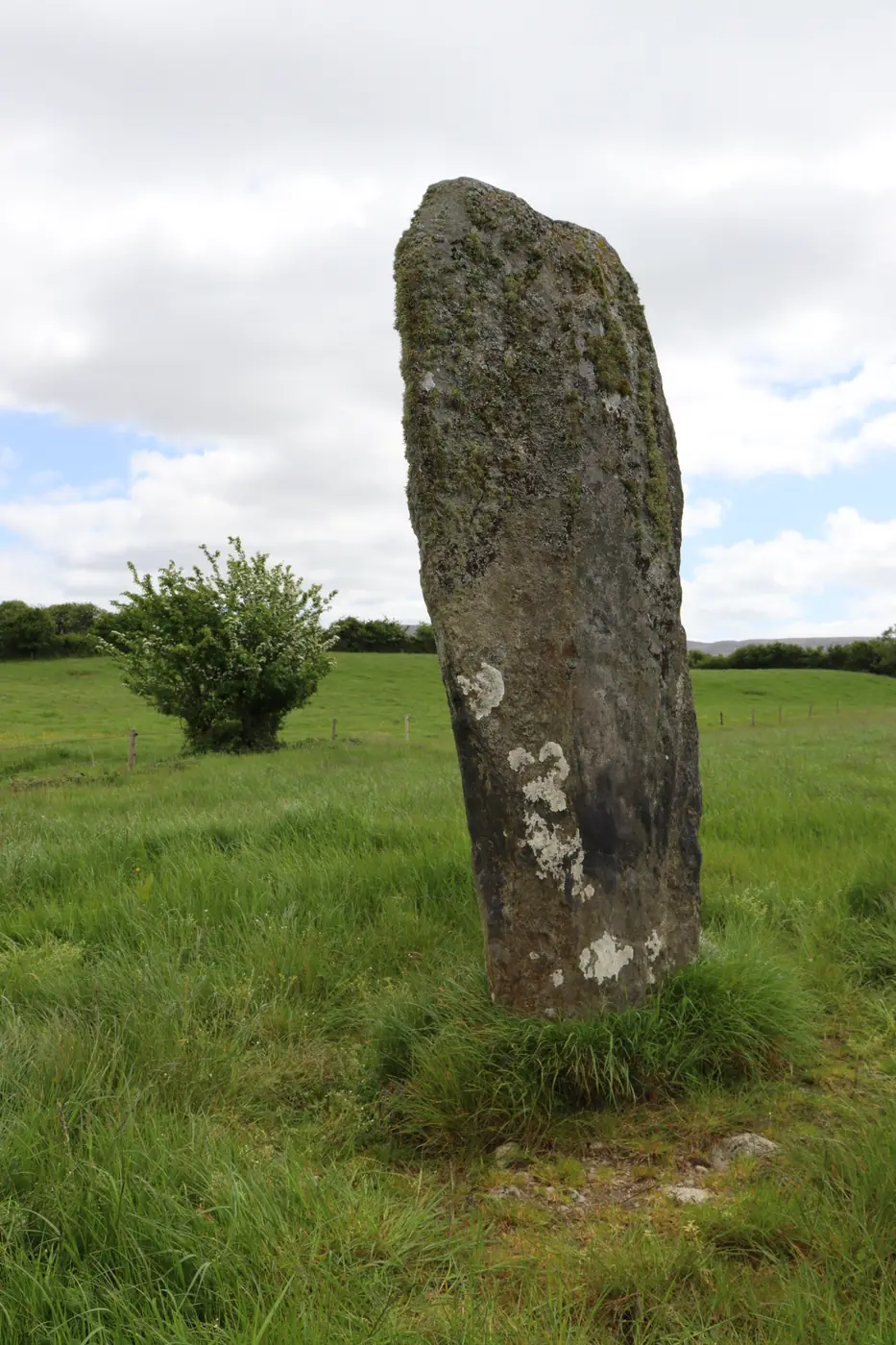
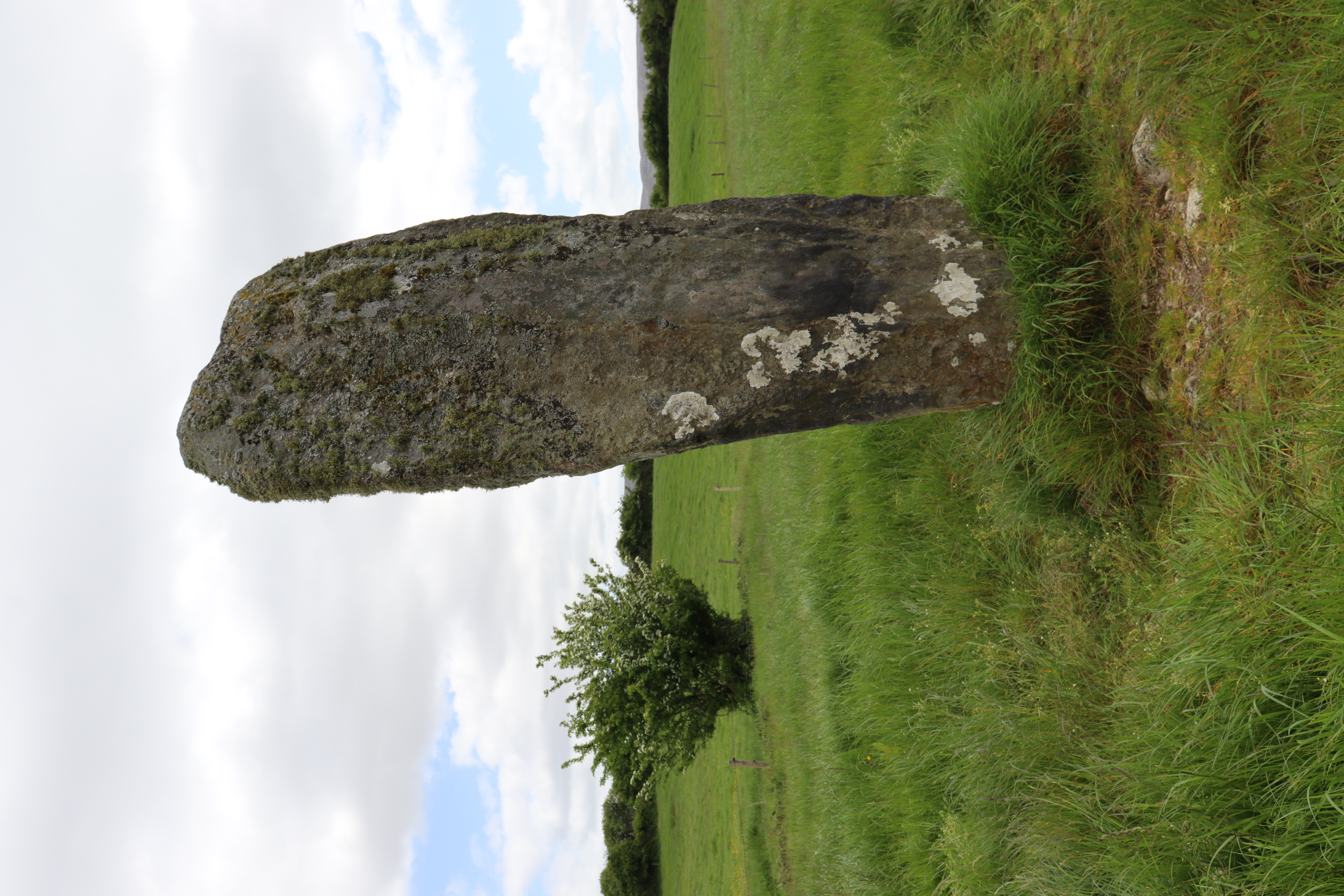
Last recorded location(s): In situ, ‘in a pasture field adjacent to a farmyard, located on a low rise in an undulating landscape of low rounded hills and ridges… Ground rises gently for c. 65m to S to an elevation topped by a cairn (MA040-105----). A rath (MA040-046----) is visible on a low hill c. 380m to NNE’ (Archaeological Survey of Ireland, Field Report 2017). 3D recorded as part of the Mayo Ogham project 2022, funded by The Heritage Council and Mayo County Council.
Support
National Monuments Service SMR ID: MA040-048----
Object type: Slab
Material: Grit
Dimensions: H 3.00 × W 1.05 × D 0.30 m
Condition: The north end of the stone is thickly obscured by lichen, and only a number of slight indentations or possible notches can be seen (3 strokes of a possible N), which may be part of the ogham inscription. On the south end of the stone, the ogham inscription is weathered but clearly visible in places (Archaeological Survey of Ireland, Field Report 2017).
Inscription
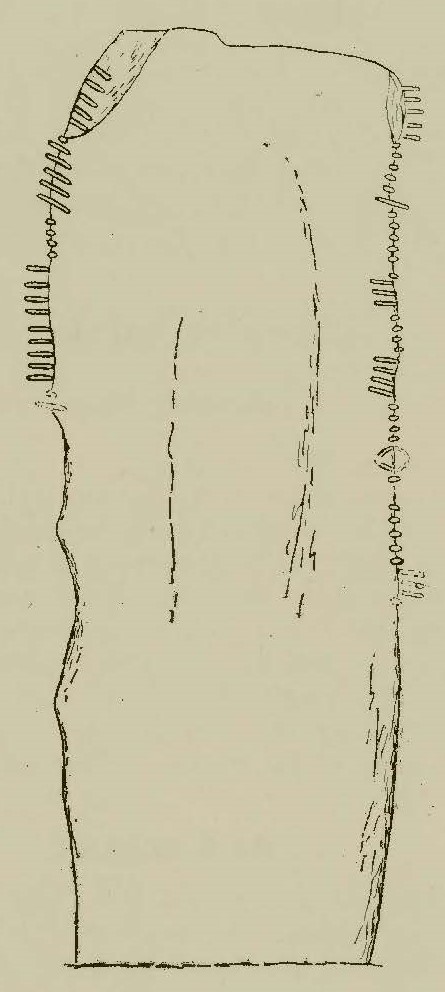
Text field: The stone is roughly rectangular in shape but tapering gently at the base, and tapering also in thickness to relatively narrow edges at the north and south ends, both of which bear an ogham inscription. The exceptional size of the stone suggested to Macalister (1945, 9-10) that it was originally a prehistoric standing stone, adapted by a later ogham carver for an inscription. The inscription reads upwards on both edges but the north angle is now almost totally illegible. On the south end of the stone, the ogham inscription extends from the top of the stone to a point roughly 1.3m above ground.
Letters: Macalister (1945, 10) noted that on both edges the strokes are rather broad and shallow, pocked and rubbed smooth.
Edition
Ogham text: [ᚋᚐ]ᚊ
Transcription: [MA]Q CERAṆ ẠVI AḌECETAỊMIN
Critical apparatus:
- Macalister (1945, 9) read: [---MA]Q CERAN[I] AVI ATHECETAIMIN
Translation
…son of Cíarán grandson/descendant of A?
Commentary
Although only a few scores of a possible N survive of Macalister’s (1945, 9-10) [MA]Q CERAN[I] on the left angle, if correct, this is a late spelling of the commonly occuring name Cíarán (in Old Irish, *ceragni in Prim. Irish) ‘little dark one’ (cíar plus a diminutive suffix).
The second name has not been identified and some of the letters are unclear. Macalister’s (1945, 9-10) reading ‘TH’ in the last name is especially uncertain. This is his interpretation of what Macalister (1945, 9) describes as ‘two lines on the H-surface, converging upward, though their actual meeting-point is effaced, and a curve, which it is just possible to discern on the B surface, closing the figure thus formed’. He takes this to be the 0-forfid (ᚖ or θ) but with a consonant value as it appears to be between two vowels. The only other example noted by Macalister of the use of this forfid on stone is in his equally dubious reading of it in the Kilcolman inscription, Co. Kerry (I-KER-061).
References
- Macalister 1945, 9-10