
Provenance
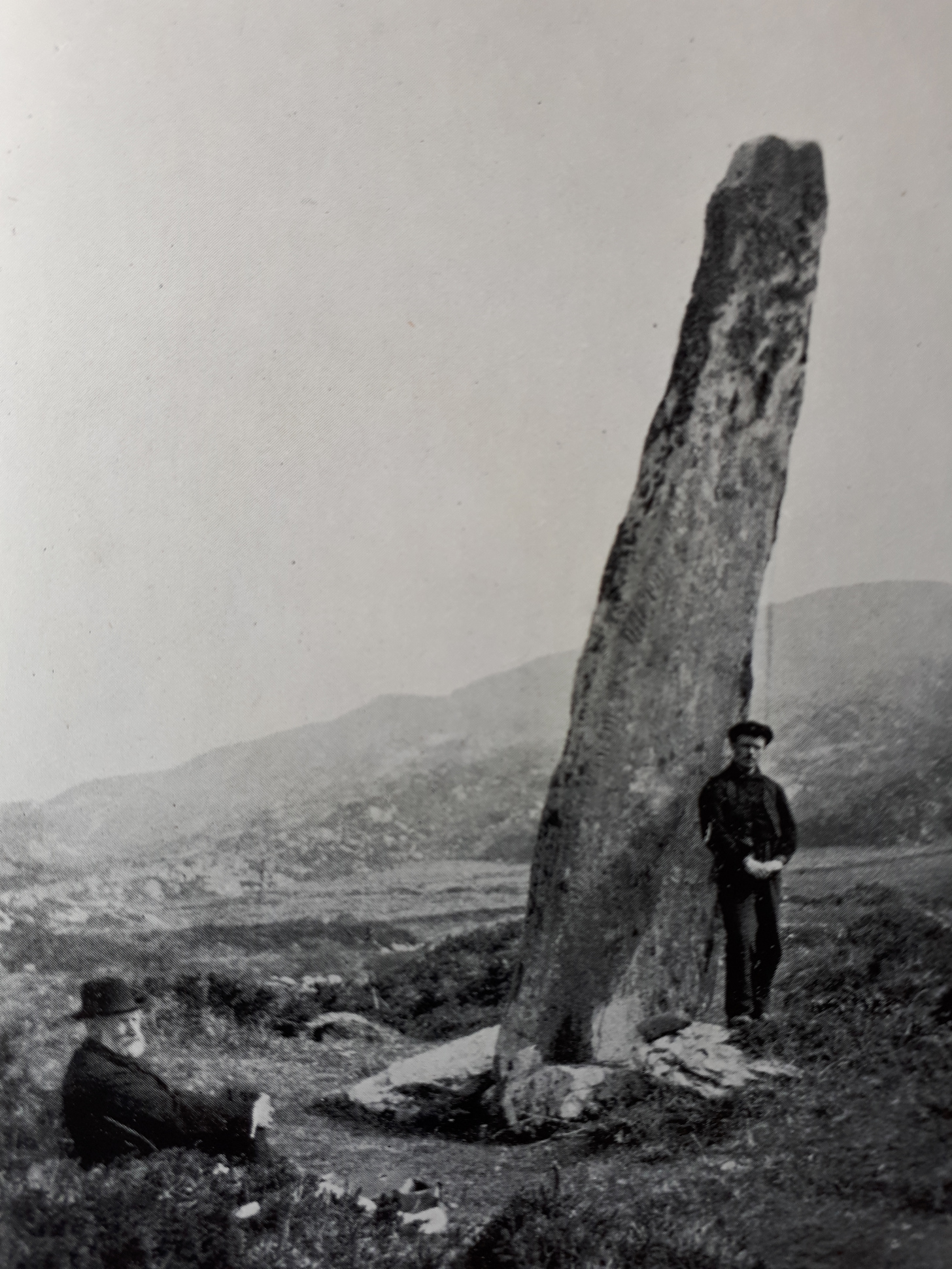
Discovery: First recorded by Brash (1879, 196-200) in 1874 and described by him as ‘leaning considerably’ (see Macalister’s 1907 photograph) with many loose stones around the base.
Findspot: Faunkill and the Woods (Fánchoill agus Na Coillte), Co. Cork, Ireland (ITM Coordinates: 465690, 552974)
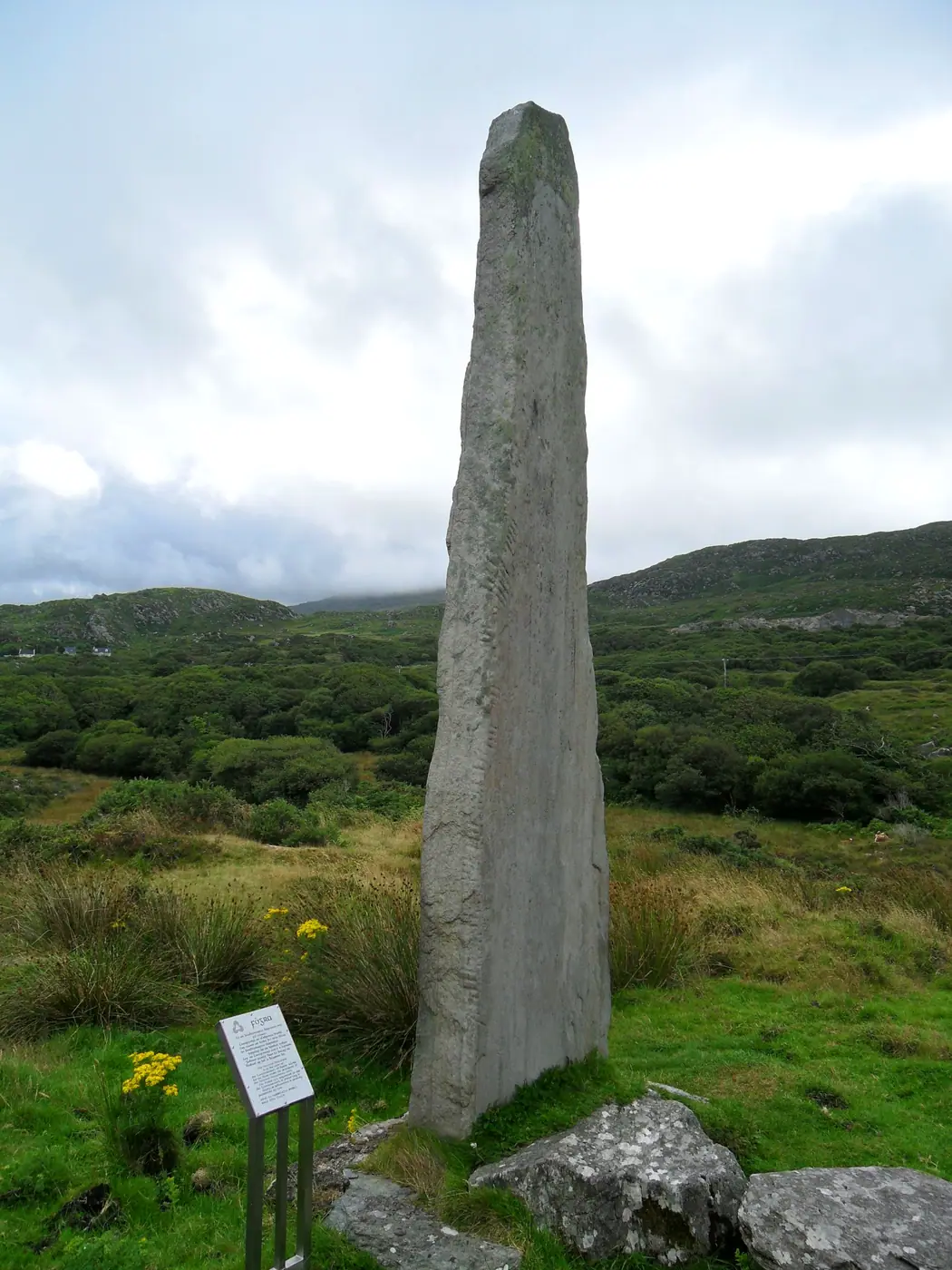
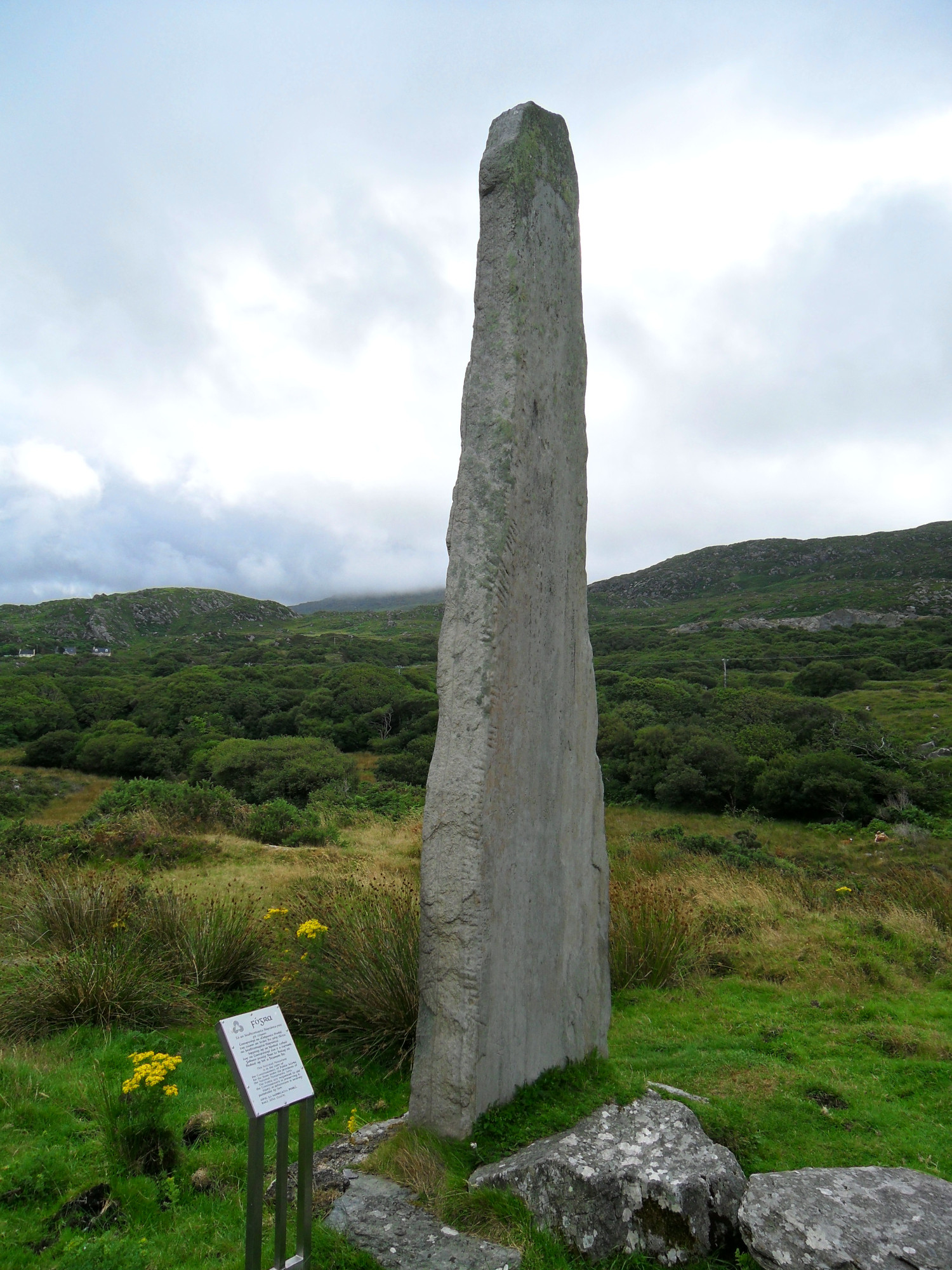
Last recorded location(s): On a rockcrop overlooking Ballycrovane Harbour to the west and better known as the ‘Ballycrovane’ ogham stone. Visited and 3D recorded for the OG(H)AM project in August 2023.
Support
National Monuments Service SMR ID: CO102-013----
Object type: Pillar
Material: Clay slate
Dimensions: H 4.70 × W 1.02 × D 0.32 m
Condition: This monument is subject to a preservation order made under the National Monuments Acts 1930 to 2014 (PO no. 172/1942). The pillar is exceptionally tall and slender, narrowing towards the top and supported at the base with concrete. Brash (1879, 197) recorded a height of 5.33m (17 ft. 6in.) above ground level in 1874. It was presumably straightened and concrete added to the base around the time the Preservation Order was put in place in 1942. The monument is likely a prehistoric standing stone, onto which an ogham inscription was later added. The inscription is worn and partially damaged in places but still legible.
Inscription
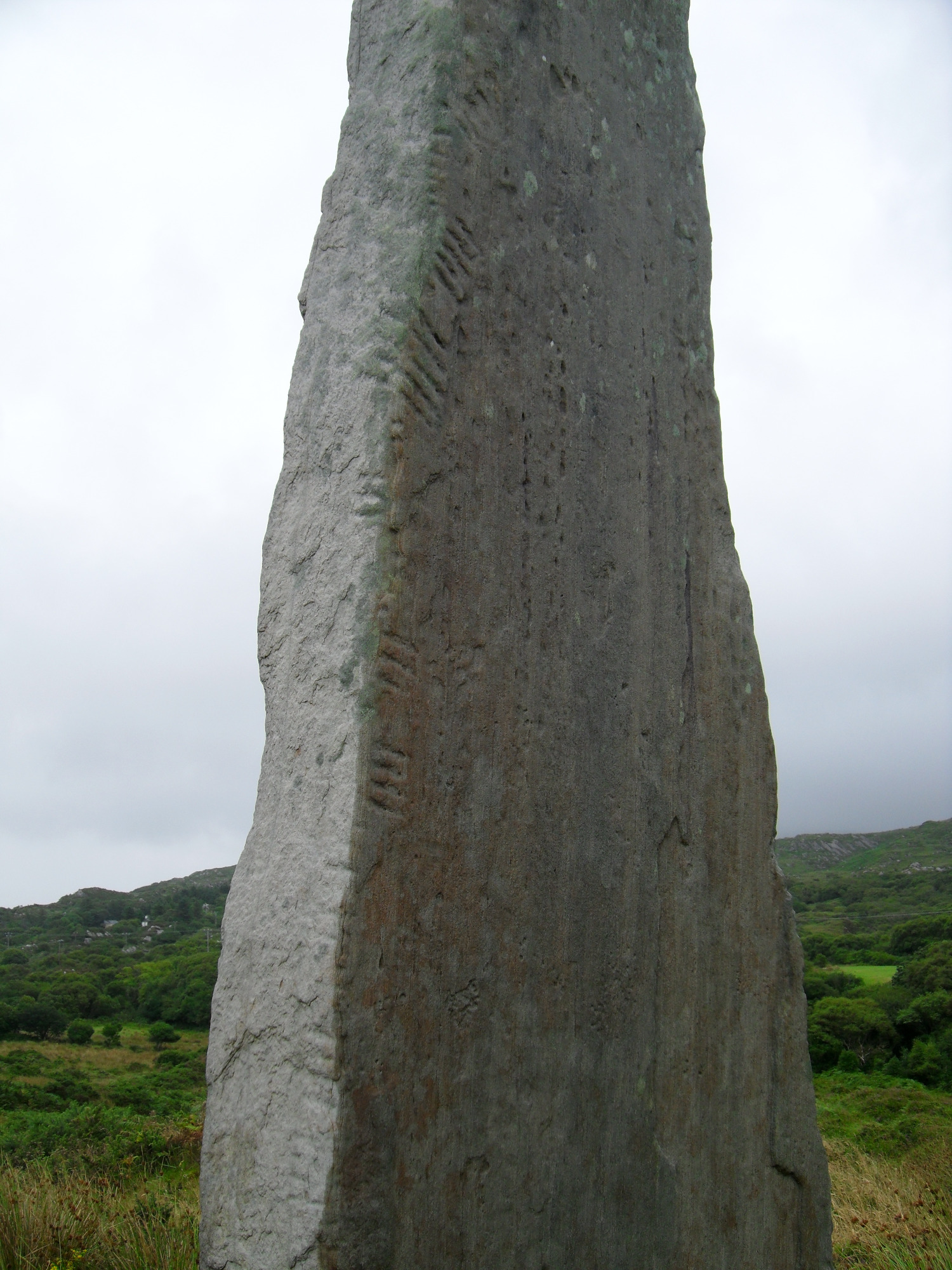
Text field: The ogham inscription runs upwards, for 2.51m (8ft. 3in.), as recorded by Brash (1879, 197), on the left edge of the SSW face which looks towards the bay.
Letters: The inscription is pocked in clear, evenly-spaced strokes. The consonant strokes are on average 7cm in length and 1cm in width, with approximately 1.5-2cm between strokes. As pointed out by Macalister (1945, 71 and earlier Rhys), towards the end of the inscription, two of the characters (N and S) curve to the right away from the angle, as if the carver were having difficulty reaching high enough to position them properly. Macalister (1945, 71) noted that ‘the letter N in TURANIAS is as a height of somewhere about to 10 ft. [3m measurement converted from Macalister] from the ground. Its scores leave the angle to cross the adjacent face of the stone, doubtless because the stance of the lapidary was not high enough to enable him to control his operations adequately. He heightened it - certainly by adding stones to a heap which he had piled up against the pillar - and could then cut the following IA correctly on to the angle; but with the final S he again fell short, and this letter also curves to the right’.
Date: First half, or early second half, of the fifth century
Edition
Ogham text: ᚋᚐᚊᚔᚇᚓᚉᚉᚓᚇᚇᚐᚄ ᚐᚃᚔ ᚈᚒᚏᚐᚅᚔᚐᚄ
Transcription: MAQIDECCEDDAS AVI TURANIAS
Translation
of Mac-Deichet, descendant of Tornae
Commentary
The person commemorated may be tentatively identified with a ‘Mac-Deched m. Cuirp m. Ai m. Tornai’ in the ‘Uí Thornai’ genealogies, where what appears to be an original feminine ancestor name (TURANIAS, nom. TURANIA) is later masculinised. The name MAQI-DECCEDDAS (nom. MAQQAS-DECEDDAS) is quite frequently found in ogham inscriptions where there is some variation in the spelling of the name (MAQ(Q)IDEC(C)ED(D)A). This is the only example surviving with the final consonant intact and may be dated to the first half, or the early second half, of the fifth century (McManus 1991, 93, 97).
References
- Brash 1879, 196-200
- Macalister 1907, 48 (facing)
- Macalister 1945, 70-72, no. 66
- McManus 1991, 93, 97, 112
- Power, Byrne, Egan, Lane, and Sleeman 1992, 125