Provenance
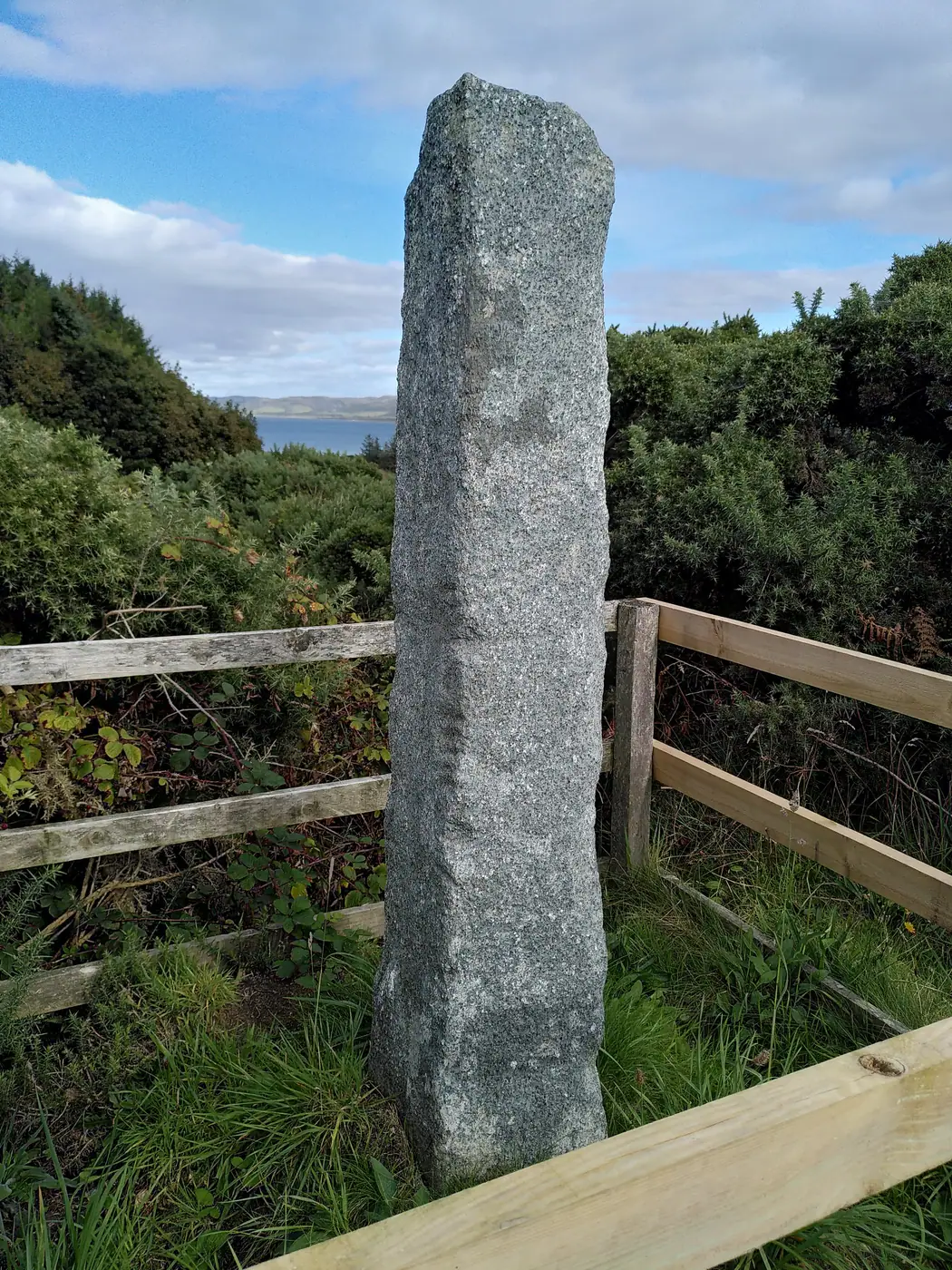
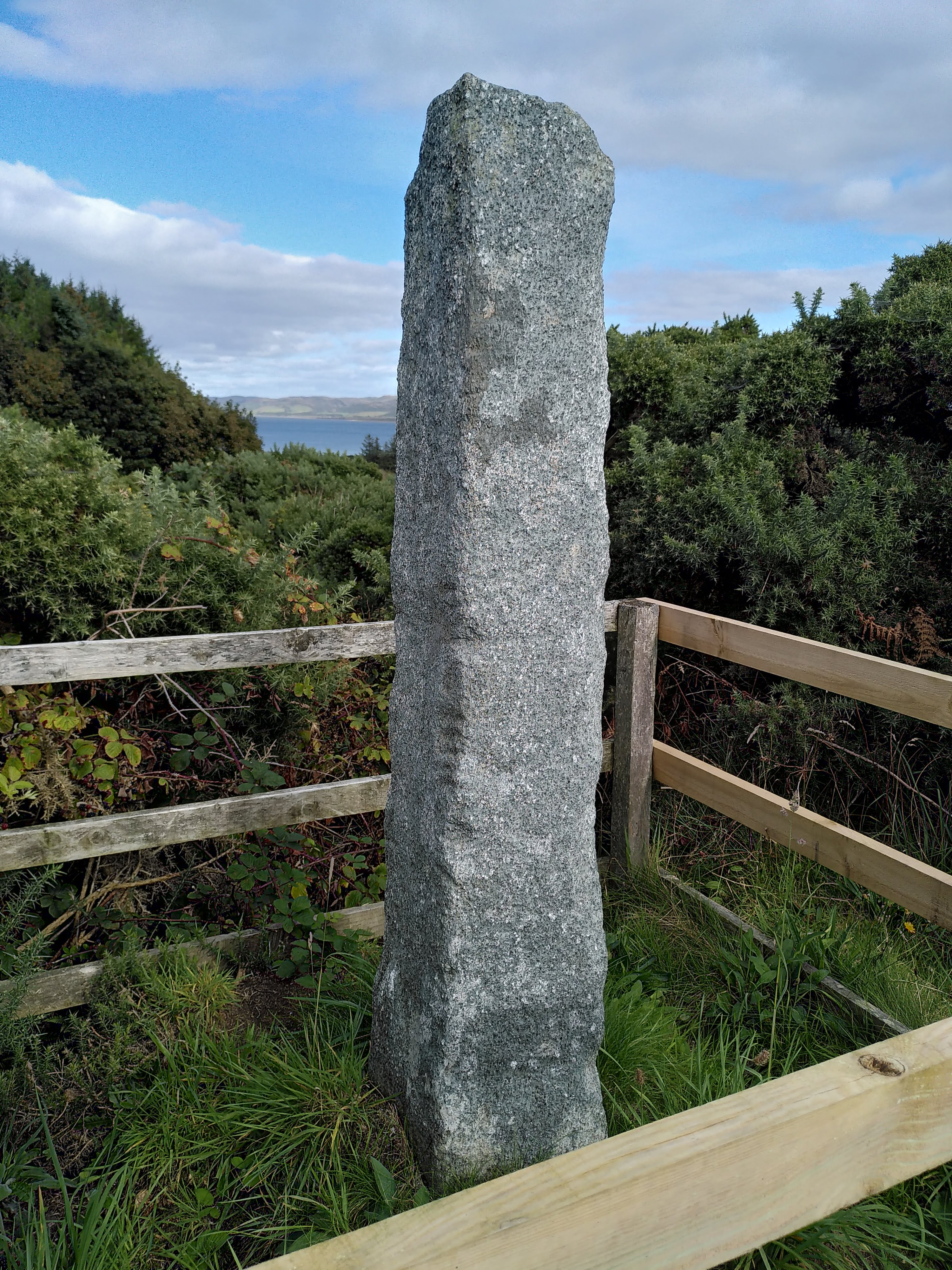
Discovery: Formerly the middle stone of a straight alignment of three stones known locally as the ‘Clocks of Gigha’. The ogham stone is located on a hillock, Cnoc na Carraigh (‘hill of the rock’), about 90 m NW of the ruined chapel of Kilchattan on the island of Gigha. Although the stone has been noted since 1695, the inscription was not noticed until 1873.
Findspot: Gigha and Cara, Argyll, Scotland (National Grid Reference: NR 6426 4817)
Last recorded location(s): Visited and recorded in situ in 2022.
Support
Trove 38529
Object type: Pillar
Material: Granite
Dimensions: H 1.7 × W 0.25 at base, 0.20 at the top × D 0.31 at base, 0.23 at the top m
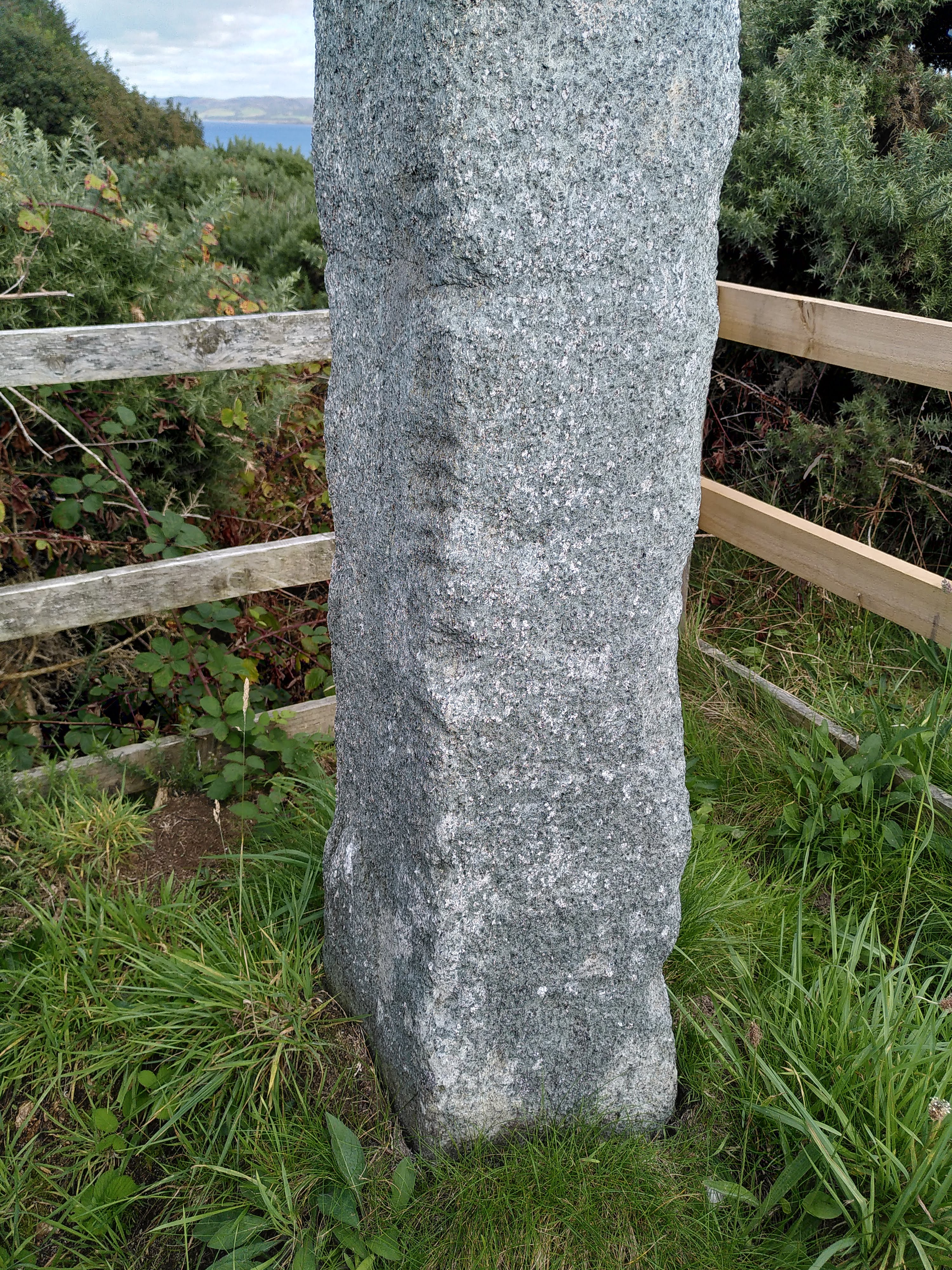
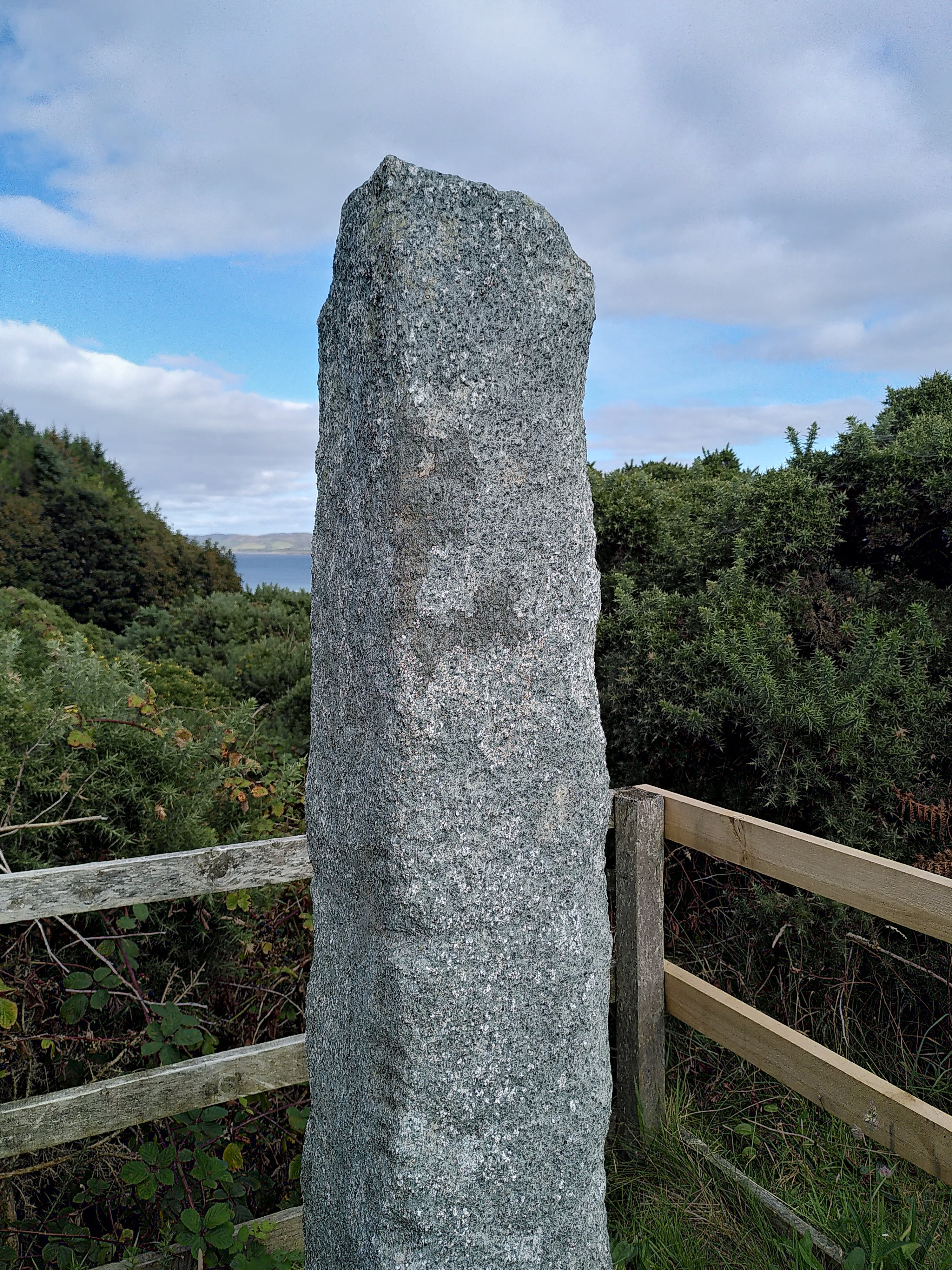
Condition: A tall, square-shaped pillar, it ‘is unclear whether the monument is a re-used pre-historic standing stone or a pillar specially erected for the bearing of the inscription’ (Forsyth 1996, 289). ‘The stone has fallen and been re-erected at least twice’, the first time it was intentionally toppled by some young men while the second fall was as a result of quarrying near the base on one side of the stone (Forsyth 1996, 288-289). There is general weathering with ‘a series of four large, shallow, unevenly spaced chunks missing from the ogham-bearing arris’ (Forsyth 1996, 290). The ogham inscription ‘which is worn and in bad condition, is defaced by series of spalls on the arris’ (Forsyth 1996, 290). The portion of the inscription ‘nearest the ground is the most badly worn and the most disputed’ (Forsyth 1996, 291).
Inscription
Text field: The ogham inscription is on the north west edge of the four-sided pillar stone and reads upwards from the bottom.
Letters: There is a wide range of published interpretations of the ogham that along with its general poor condition make a definitive reading difficult. On the same grounds, it is difficult to make definitive statements about its carving technique. ‘As they now survive, the strokes are finger-scale and with a U-section. Where it can be measured with any certainty the length of h-aicme strokes is about 60mm’ (Forsyth 1996, 291). The gaps between the letters most likely contained vowel notches now lost. Forsyth (ibid. 295) describes the Gigha inscription as ‘ogham with no drawn stem-line and vowels which are little more than nicks - the “text-book” form of the script’.
Edition
Transcription: [. 6.]ṂẠQ[---]CỌG̣ỊṆ[---]
Critical apparatus:
- As Forsyth (1996, 292) notes ‘The first six letters are extremely doubtful’. For the portion of the inscription closest to the ground, the indentations of strokes ‘can be clearly felt on the arris, but the lines are too indistinct to interpret’ (Forsyth 1996, 292). From the seventh character onwards the carving is clearer and there is greater agreement amongst previous editors (Forsyth 1996, 293). 2. Rhys (1899) read: MAQICAGILEB 3. Rhys (1901) read: OGMA MAQI TIGERNI 4. Macalister (1902) read: VICULA MAQ COMGINI 5. Macalister (1945, 484) read: VICULA MAQ CUGINI
Translation
According to Forsyth (1996, 297), Jackson offered ‘a very hypothetical’ interpretation: the son of Coicéile (see Canmore).
Commentary
‘If the letters before the M are not admitted then the formula “MAQ-X” is likely, either as “the son of X”, or more likely, as a compound name with first element MAQ’ (Forsyth 1996, 296). However, Forsyth maintains that there is sufficient evidence for the existence of some ogham carvings before the letter M which consequently implies that Gigha 1 conforms to the Irish formula ‘X son of Y’.
Forsyth (1996, 297) also rejects Macalister’s (1945, 484) suggestion for VICULA as Fiacal meaning ‘tooth’ on the grounds that ‘OIr ia is from earlier e, both long and short i remained as i’. Meanwhile the second name COMGINI is interpreted by Macalister (1945, 484) as OIr Coemgen, which Forsyth (1996, 291) comments is a ‘widespread and well-known male name (Coem + -gen “fair born” (Uhlich 1993,207)), found variously spelled, including Comgani’.
Forsyth (1996, 296) is in favor of considering this example as one of the earliest oghams in Scotland due to the fact that comparable scripts are ubiquitous in Ireland. Moreover, the stone’s size and shape, and the positioning of the inscriptions’ lettering and proportion of its strokes which is, as Forsyth (1996, 297) notes ‘closest of all the Scottish examples to the Southern Irish norm’.
References
- Forsyth 1996, 288-298
- Macalister 1945, 484
- Macalister 1902
- Rhys 1901, 18-23
- Rhys 1899, 390-403