Provenance
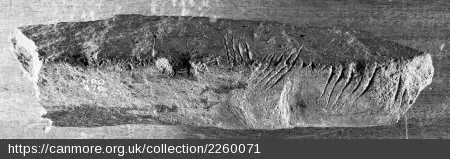
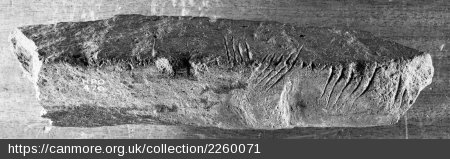
Discovery: The inscriptions can be found on a small pillar-like object discovered 500 m south-west of the North Lodge at Poltalloch at Bruach an Druimein (‘brae of the elder bushes’), a complex multi-period site never fully investigated and still not fully understood (Forsyth 1996, 444). There are indications that the site had been used in the past for ritual and burial purposes, with its earliest non-burial phase being an open-air cooking site with strong evidence of iron-working. J. Hewat Craw discovered the ogham fragment lying on the ground close to the cists in 1931.
Findspot: Kilmartin, Argyll and Bute, Scotland (National Grid Reference: NR 82068 97182)
Current repository: Scotland National Museums of Scotland (inv. no. HPO 470)
Last recorded location(s): The stone is part of the Poltalloch Collection on loan in the National Museums of Scotland and is currently on display in the Queen Street Antiquities Museum (HPO470). Visited and recorded on 6 May 2022.
Support
Trove 39479
Object type: Pillar
Material: Sandstone
Dimensions: H 25.4 × W 8.2 × D 5.7 cm
Condition: A small pillar-like fragment that is ‘badly worn in places’ with ‘numerous chips lost’, but the inscription carving is generally clear (Forsyth 1996, 448). As Forsyth (1996, 448) notes the ‘surface of the opening section is almost completely worn away. There are possible traces of strokes on, or to the left of, the arris, but these are doubtful’ (Forsyth 1996, 448).
Inscription
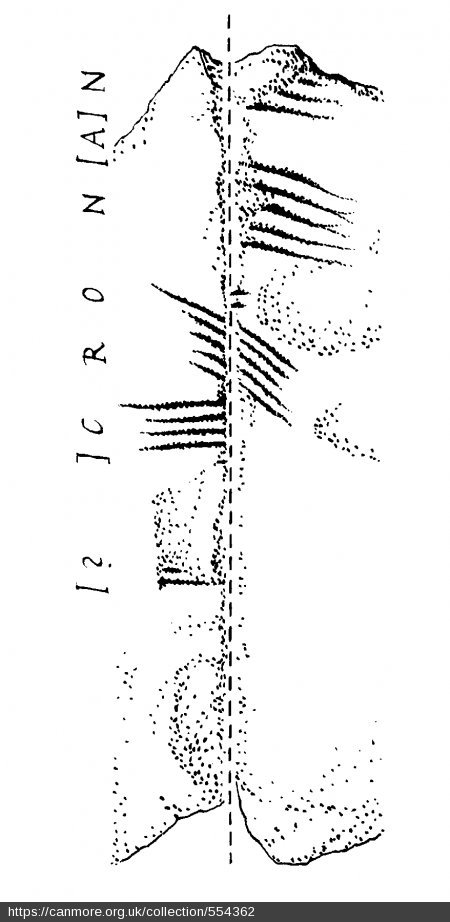
Text field: The inscription is found along one arris of the fragment. The strokes are evenly spaced within letters, though some groups are more cramped than others, and judging from the extant fragment there is extra spacing between letters (Forsyth 1996, 449). The correct orientation is difficult to determine as both ends of the slab are missing. However, of the two possible interpretations, reading from the bottom upwards produces the most plausible reading.
Letters: The ogham letters are v-cut in ‘very fine, sharp strokes’ (Forsyth 1996, 448). In general, their proportions are long and slim with a V-shaped profile. The variation in length of stroke within each group and the manner in which individual strokes trail at the ends indicates confident cutting. The Poltalloch ogham is written with no written stem-line and vowel notches occupying no more than an eighth of the ogham band (Forsyth 1996, 449).
Date: (post apocope)
Edition
Transcription: [---]CRỌN[---]Ṿ[---]
Critical apparatus:
- According to Forsyth (1996, 450), ‘the letters CRON are not in doubt. Less secure are the A and N’. 2. Regarding the apparent letter A, Forsyth (1996, 449) notes that there is ‘a gap with room for a notch but no evidence of one’. Even though ‘previous writers have unanimously identified it as A. The intention, however, may be merely a blank space to differentiate between two successive letters of the B-aicme. The arris is too worn at this point to be certain’ (Forsyth 1996, 449). 3. Similarly, although ‘there is no way of knowing if the doubtful N was the last letter’ of the inscription, it is also difficult to determine this character with complete certainty (Forsyth 1996, 450). There is evidence for ‘two short strokes to the right of, and perpendicular to, the stem, with part of a third clearly visible’ (Forsyth 1996, 449). However, ‘the rest has flaked off, though slight irregularities in the residual surface may be vestiges of further strokes - V, or a subsequent member of the b-aicme: S or, perhaps most likely, N’ (Forsyth 1996, 449). 4. Additionally, there is a possibility that immediately preceding the C is the letter Q which ‘opens up the interesting prospect of the Poltalloch ogham conforming to the typical “X MAQ Y” formula, either MAQ or MAC (McManus 1991 §5.19)’ (Forsyth 1996, 450). Although, the principal objection to this hypothesis is linguistic, ‘one would expect the name to appear in the genitive case, CRONAIN’ (Forsyth 1996, 450).
Translation
the son of Crónán
Commentary
The letters CRON could possibly be interpreted as the Irish name Crónán, which derives from the colour term crón, ‘dark yellow, reddish brown, swarthy’ (Forsyth 1996, 450).
Crón is also derivative of Cróine which is the name of a number of female saints.
Crónán was a common name among early Irishmen some of which had Dal Riadic connections, so ‘without a patronymic qualification there is little chance of narrowing down the list of several possible Crónáns’ (Forsyth 1996, 450-451).
If the suggested reading of the inscription is accepted, the commemorand is in fact the son of Crónán, but there is no indication at all of his own name (Forsyth 1996, 453).
References
- Forsyth 1996, 443-455
- McManus 1991,