Provenance
Discovery: Found by Z. Hawkes and Windele in a souterrain (CO122-049002-) in 1841. Two other ogham stones (I-COR-017- and I-COR-019) were discovered in the souterrain. This stone is the seventh and last lintel in the souterrain. All three stones were ”taken out of the cave sometime toward the end of the nineteenth century, by the proprietor, the late Mr. R. Bence Jones, and placed on a rockery in his garden: but afterwards acquired from him by the Royal Irish Academy” (Macalister 1945, 73).
Findspot: Ahalisky (Achadh Loiscthe), Co. Cork, Ireland (ITM Coordinates: 541423, 547985)
Current repository: Ireland National Museum of Ireland (inv. no. RIA 1927:1)
Last recorded location(s): Now in the National Museum of Ireland, where it was examined and recorded, in collaboration with the Discovery Programme, for the Ogham in 3D project in 2013.
Support
National Monuments Service SMR ID: CO122-049004-
Object type: Pillar
Material: Slate
Dimensions: H 1.52 × W 0.64 × D 0.22 m
Condition: Reused as a lintel in a souterrain. Worn, but otherwise in reasonably good condition. Brash (1879, 146) gives the height as 2.13m (2ft.). 1.52m (4ft. 12in.) is the height above the display stand.
Inscription
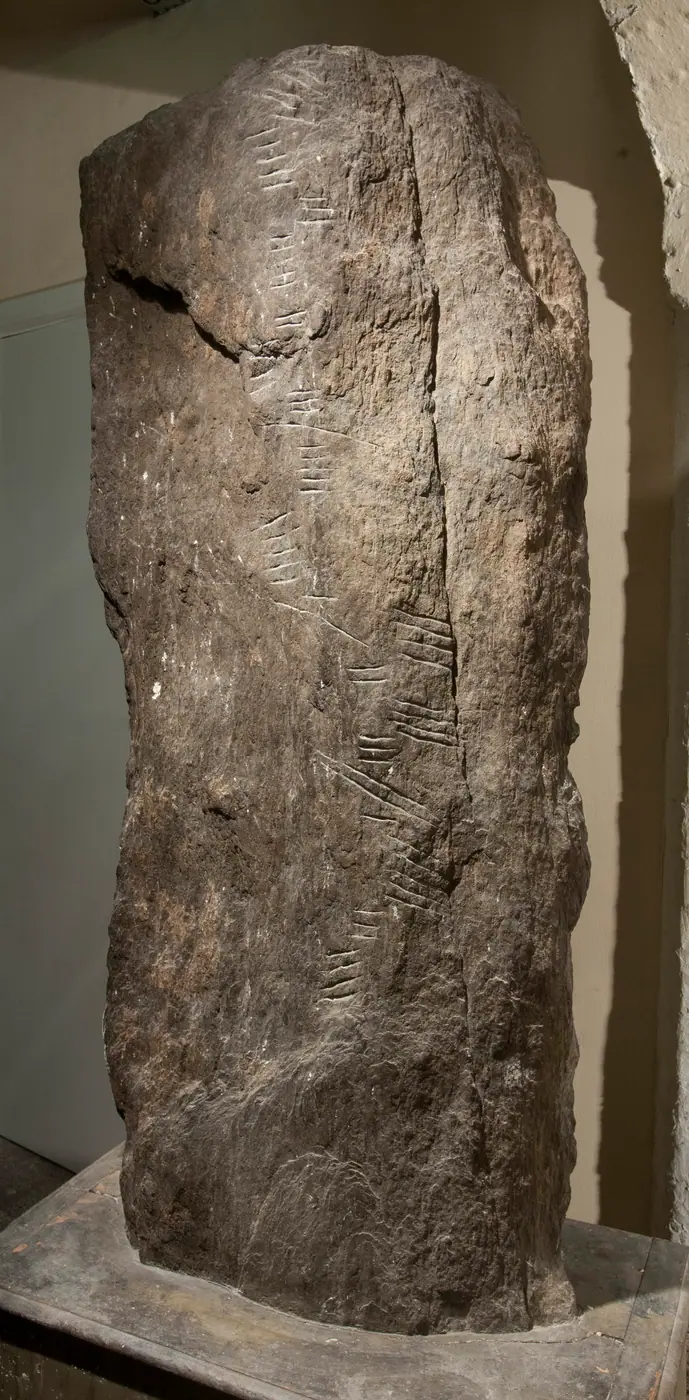
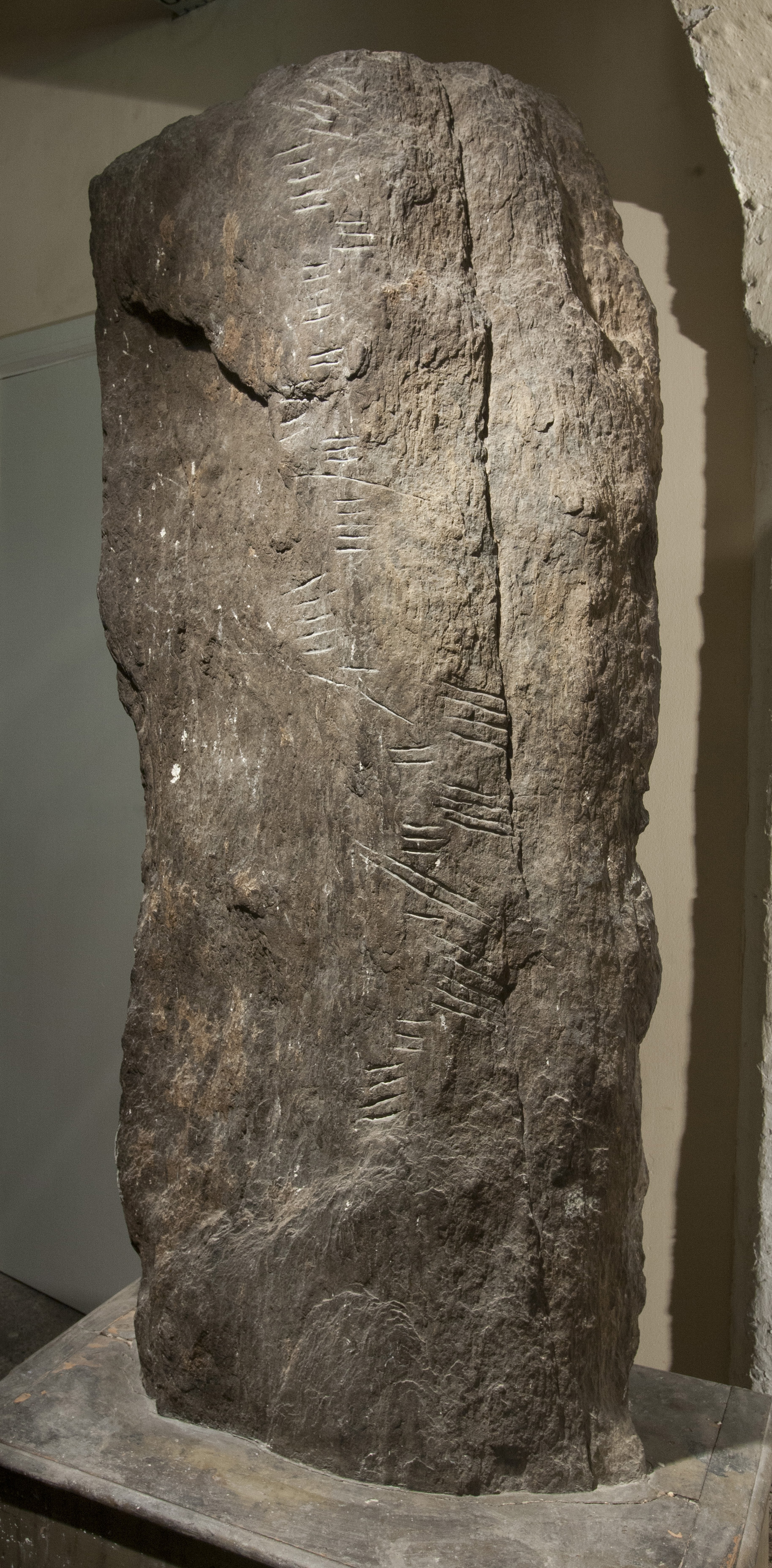
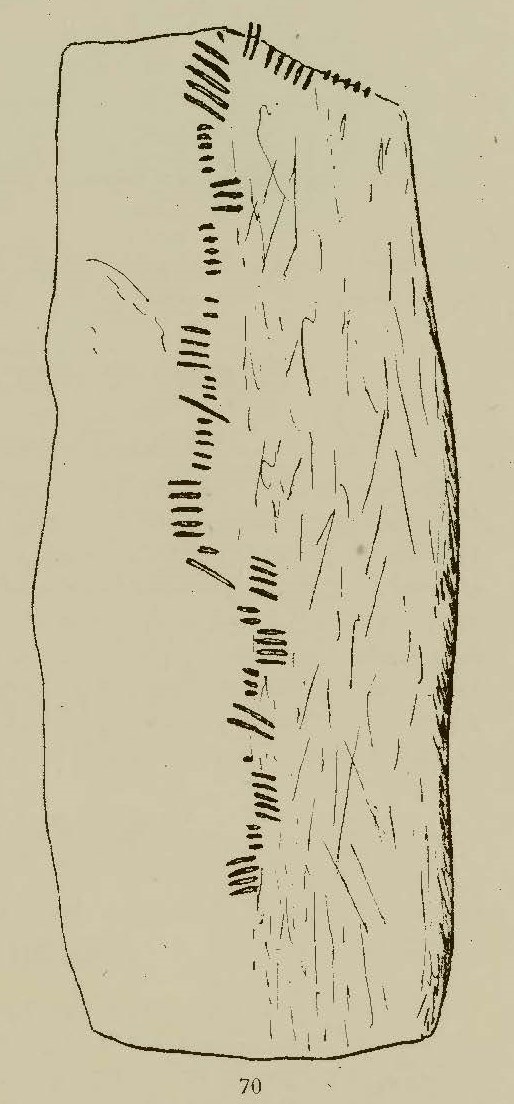
Text field: As noted by Macalister (1945, 73-74), the inscription begins on ‘a very obtuse angle, in the middle of one of the broad faces of the slab; not on an edge, except the last few letters, which run along the edge of the top’. The inscription is not in a continuous line, the beginning of MAQI is above and overlapping the end of the preceding name (Macalister 1945, 74). Although unusal, a comparable layout occurs at Painestown, Co. Meath I-MEA-001). Macalister (1945, 74) also notes that there is evidence of ‘artificial flaking’ on the edge, which may suggest that an earlier inscription was removed.
Letters: The ogham strokes are quite finely scored in the ‘Cork style’ and, despite the slightly over-lapping lines on the face (noted above), the layout is mainly even and neat, except for the erratic R near the top of the stone. The vowel strokes are quite long, almost as long as some of the consonant strokes. This, along with the absence of a clear stemline, makes following the text a bit difficult but the reading is quite certain.
Date: Probably fifth century (linguistic)
Edition
Ogham text: ᚉᚒᚅᚐᚌᚒᚄᚑᚄ ᚋᚐᚊᚔ ᚋᚒᚉᚑᚔ ᚃᚔᚏ̣ᚐᚌᚅᚔ
Transcription: CUNAGUSOS MAQI MUCOI VIṚAGNI
Translation
of Congus (*Cunagussus) son of the descendant of *Ferán/*Fírán (*Viragnas/*Vīragnas)
Commentary
CUNAGUSOS is attested in OIr. as Congus ‘having a hound’s power’. It is a compound of the nominal stems *kun- ‘dog, hound’ < PIE *k̑un- and *gustu- ‘power, violence’ < PIE *g̑us-tu- ‘choice, quality condition’. The name is attested a second time as CUNAGUSSOS in I-COR-056 (= CIIC 107; Glenagloch, Co. Cork). Since vowel length cannot be expressed in ogham and the name is not continued in Old Irish, it is formally undecidable if VIRAGNI stands for *u̯iragno- ‘dear man, little man’ (OIr. *Ferán) or *u̯īragno- ‘true one’ (OIr. *Fírán). However, the etymon *u̯iro- ‘man’ < PIE *u̯iHro- ‘young man’ is much more common in Celtic onomastics than *u̯īro- ‘true’ < PIE *u̯eh₁-ro-. The name is probably also attested as VIRR[c. 2]ANNI in I-KER-075 (= CIIC 206; Kilcoolaght, Co. Kerry). All Primitive Irish endings are preserved and there is no sign of vowel affection. The inscription therefore appears to belong to the earliest phase of ogham in the 5th century.
References
- Brash 1879, 145-148
- Macalister 1945, 73-74, no. 70
- Power, Byrne, Egan, Lane, and Sleeman 1992, 124, no. 1029
- Ziegler 1994, 159, 248