Provenance
Discovery: The stone formerly stood upright at the north-west end of a long mound near Ackergill Tower. The stone was found in August 1896 by John Nicholson on the links towards the south side of Keiss Bay (Allen 1903, 28). It was given to the National Antiquities Museum in 1897 (Allen 1903, 29).
Findspot: Wick, Caithness, Scotland (National Grid Reference: ND 3483 5499)
Current repository: Scotland National Museums of Scotland (inv. no. IB168)
Last recorded location(s): Recorded in the National Museum of Scotland on June 16th 2022.
Support
Trove 9243
Object type: Class I Pictish symbol stone
Material: Slate
Dimensions: H 1.2 × W 0.6 × D 0.08 m
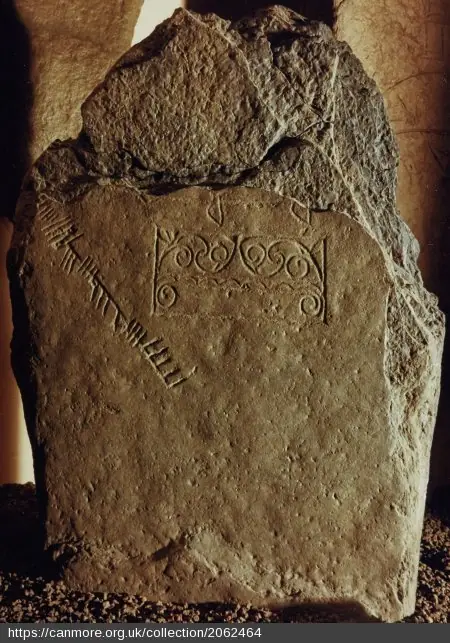
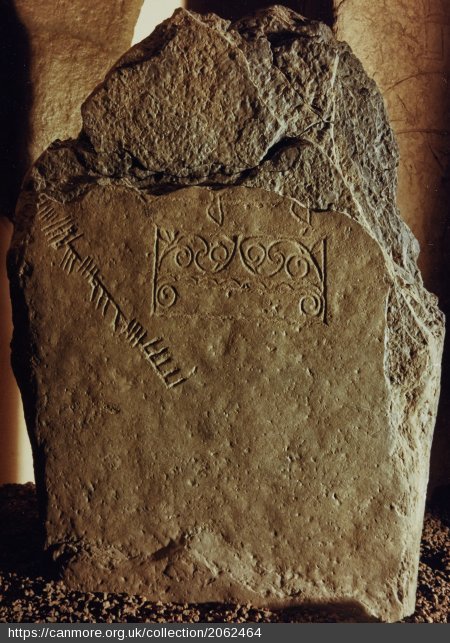
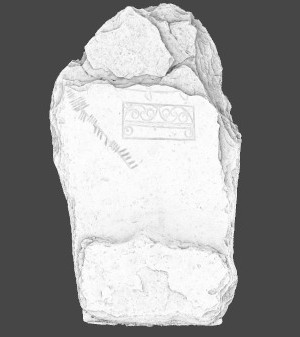
Decoration: Towards the centre of the front face of the slab are two closely packed Pictish symbols - the remains of a fish and the so-called rectangle (Forsyth 1996, 14).
Condition: ‘The various fragments of this slab have been cemented back together, but the surface of the upper pan is missing, taking part of a symbol and perhaps part of the ogham with it. The remaining carving is clear and well-preserved’ (Forsyth 1996, 13). Therefore, the ogham inscription may be complete as it is, but the possibility of lost letters cannot be completely ruled out (Forsyth 1996, 13).
Inscription
Text field: The ogham inscription is carved towards the left edge of the front face at an acute angle and on a drawn stem-line (Forsyth 1996, 13-14). The inscription reads from the bottom up. The stem stops c.6cm short of the outer edge of the stone, but nothing of the original surface remains in the area beyond the last stroke (Forsyth 1996, 16).
Letters: The inscription was pocked and rubbed smooth as is typical for Class I stones (Forsyth 1996, 13). According to Forsyth (1996, 15), ‘the vowel strokes are slighter and more closely spaced than the consonants. The strokes of the last two consonants appear thinner and more cramped than those of the first three’. Forsyth (1996, 16) also notes the ‘increasing compression of strokes and the curtailment of the first stroke of’ the eighth letter ‘because of the overhang of the last stroke of’ the seventh letter which suggests that the carver was running out of space.
Edition
Ogham text: ᚅᚓᚆ
Transcription: NEHTETRỊ
Critical apparatus:
- The group of strokes at the end of the inscription has previously been interpreted as a group of five vowel strokes across the stem, - I, due to ‘the frequency with which final (genitive) -I is encountered’ (Forsyth 1996, 16-17). However, Forsyth (1996, 17) highlights that ‘the final stroke is thicker than the previous four and separated from them by a distance greater than that which separates the four from one another’. Furthermore, ‘the upper (left-hand) portion of the final stroke appears to cross the stem only barely, certainly less than the previous four strokes’ (Forsyth 1996, 17). Forsyth (1996, 17) also comments that this differentiation from the other four strokes might indicate that this group of five strokes might be interpreted as two letters, ‘the first must be E, and the second probably B’, resulting in the following reading: NEHTETREB
Translation
Although the ogham letters are clear, apart from the very last letter(s), an exact meaning has not been determined.
Commentary
The ogham inscription and the symbols can be considered contemporary (Forsyth 1996, 13). The symbols are placed slightly to the right to allow for the ogham and the carving technique employed is the same for both (Forsyth 1996, 13).
The inscription likely consists of a personal name and Forsyth (1996, 18) remarks that ‘depending on how the word is segmented, possible known personal name elements can be identified’. For instance, Neht- may be connected with the well-attested Pictish name Nechtan, or in less Gaelicised spelling Neikthon.
Additionally, in Irish tradition Necht appears as the divine figure Nuadu Neht, the Old Irish verbal adjective meaning ‘clean, pure, white’ from the root *nikto- ‘lavé’, ‘washed’. As a noun, Old lrish necht means ‘niece’ but it is not attested as a personal name element. Another possibility is that Neht might be connected with the common Old Irish noun néit, ‘combat, lutte’, and the name of the Irish war god Néid and could be compared with the Gaulish divine name Neto, the war god of the Accitani. The related element Neta- is associated with Old Irish nia ‘champion’, ‘hero’ or its homonym ‘sister’s son, nephew’.
However, the inscription might represent a compounded Nehtet-ri(g) or an uncompounded Nehtet Ri(g) with the second element operating perhaps as a title, ‘Nehtet the king’.
If the alternative reading NEHTETREB is accepted, then the final TREB immediately demands comparison with Celtic *trebo- ‘inhabitation’, ‘settlement’, cognate with Latin tribus, and English thorp. The Welsh reflex tref ‘homestead, hamlet’ is very common as a place-name element. Its Irish cognate is, however, extremely rare as a place-name, though common enough as a noun, treb, meaning, perhaps under influence of the Latin, ‘house, farm, holding, household, tribe, stock’
References
- Allen and Anderson 1903, 28-29
- Forsyth 1996, 11-22