Provenance
Discovery: First noted in 1855 as having been discovered built into the east wall of St Declan’s Oratory by Mr. Windele (Fitzgerald 1855, 230). One of three ogham stones discovered at this site (see also I-WAT-003 and I-WAT-004). Other early features at Ardmore include the cathedral ruins (Romanesque), a round tower and a graveyard, all within a D-shaped enclosure (dims. c. 200m N-S; c. 130m E-W; WA040-008023-).
Findspot: Ardmore (Aird Mhór), Ardocheasty (Ard Ó Séasta), Co. Waterford, Ireland (ITM Coordinates (approximate): 618842, 577448)
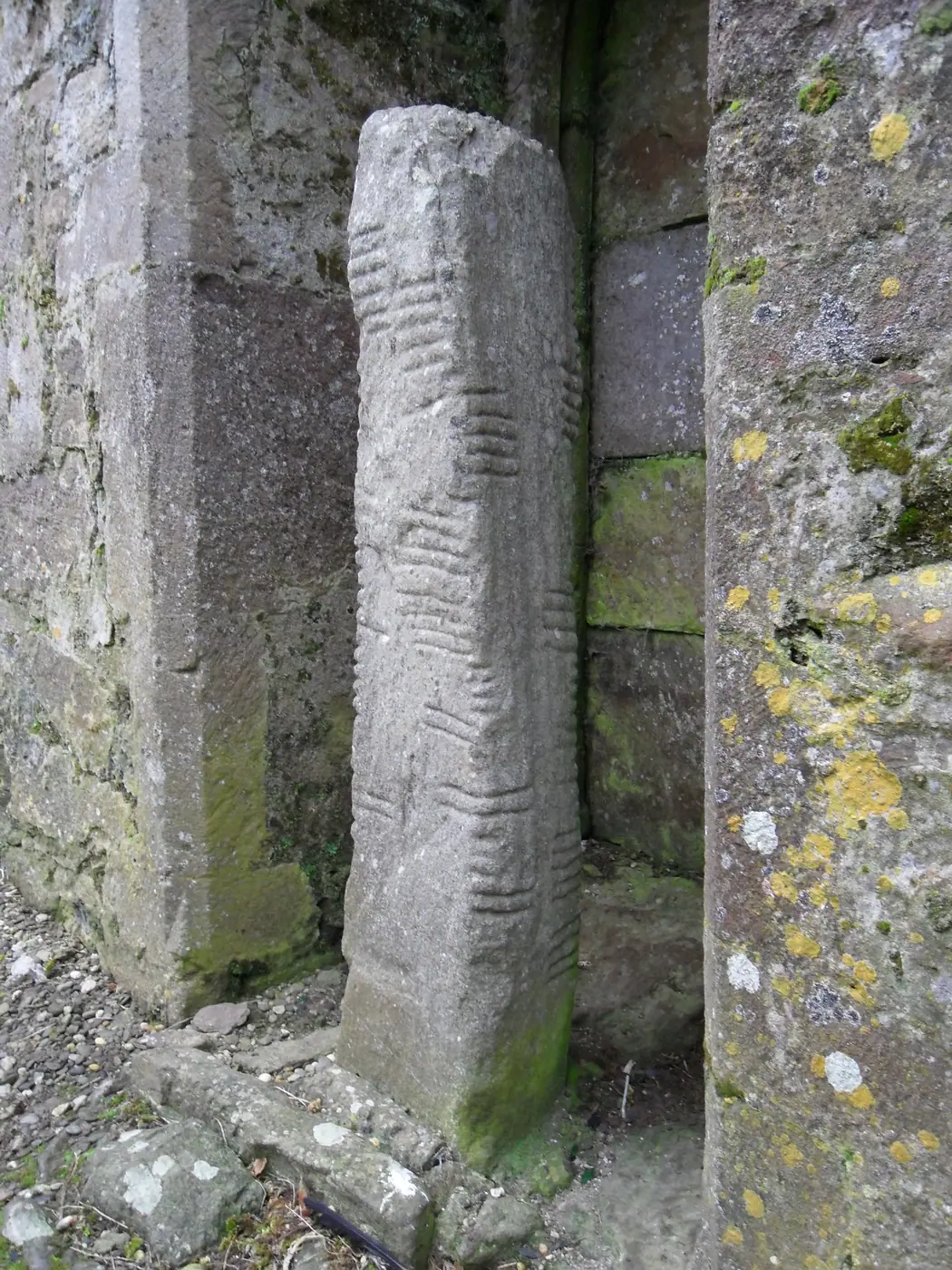
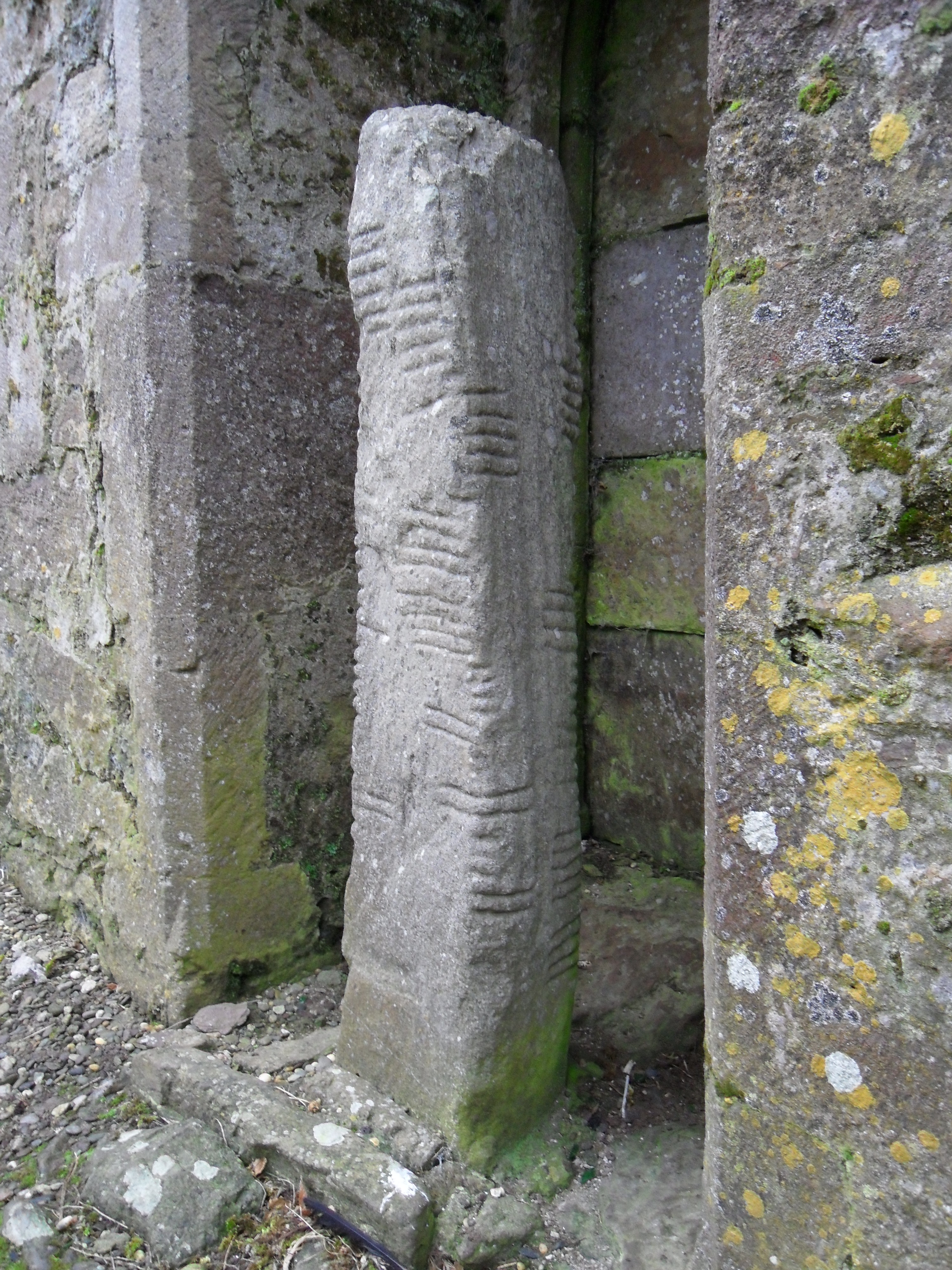
Last recorded location(s): Displayed in a niche of the chancel of the ruined cathedral at Ardmore opposite Ardmore 3 (I-WAT-004). Examined and recorded in 3D by the Discovery Programme in 2012 as part of the OGHAM in 3D project.
Support
National Monuments Service SMR ID: WA040-008005-
Object type: Pillar
Material: Sandstone
Dimensions: H 1.27 × W 0.28 × D 0.30 m
Condition: The top of the stone has been spalled away, probably by the masons who reused it as building material.
Inscription
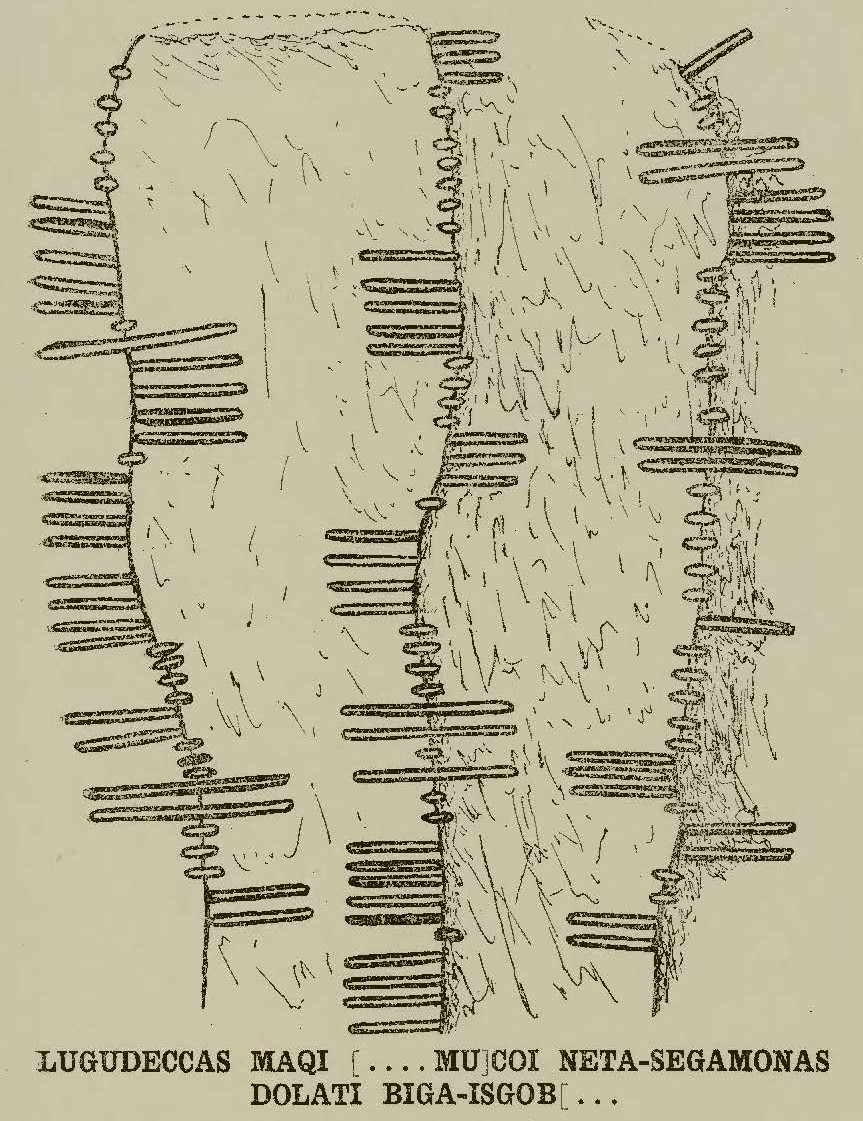
Text field: There is ogham on three angles of this pillar. On two of the angles it clearly reads up-down. On the third it appears to read upwards.
Letters: Macalister’s (1945, 258) claim that the pillar ‘bears two independent inscriptions in Ogham: the first, on two angles (up-down), pocked; the second, on a third angle, chiselled’ is questionable. The ‘first’ text, running up the left angle and down the right, follows an expected ogham formula (X MAQI Y MUCOI Z) with recognisable personal names. The text on the ‘third’ angle, however, appears to be unintelligible. Nevertheless, the carving technique (pocked) and style of both are identical. For example, it is noteworthy that all of the consonant strokes are at right angle to the angle/stemline. Consonants from the Aicme Muine (Ms and Gs in this inscription) are generally distinguished by their oblique angle. Although this distinction is not always strictly adhered to within the corpus, the consistency of the style of the text on all angles of this stone would suggest that it was carved by the same hand. Whether or not it is a single inscription or two seperate inscriptions is difficult to determine without an interpretation of the ‘third’ angle.
Date: Probably pre-sixth century A.D. (linguistic)
Edition
Ogham text: ᚂᚒᚌᚒᚇᚓᚉᚉᚐᚄ ᚋᚐᚊᚔ̣[---
Transcription: LUGUDECCAS MAQỊ[--- MU]C̣OI NETASEGAMONAS DOLATIBIGAISGO[---]
Critical apparatus:
- Macalister (1945, 259) read: LUGUDECCAS MAQỊ[---] [MU]C̣OI NETA-SEGAMONAS DOLATI BIGAIS-GOB[.. ? ..]
Translation
of Luguid son of […] from the kin of Nad-Segamon
Commentary
The personal name of the person commemorated is based on the the divine name Lug. This name is well attested in the Old Irish period; and is still in use in the Modern Irish form Lughaí. It is a popular name on Irish ogham stones. It occurs also as LUGUDEC (I-MAY-002, Kilmannin, Co. Mayo; LUGUDECA (I-WAT-025, Kilgrovan, Co. Waterford), and LUGUDUC (I-COR-057, Kilcullen South, Co. Cork). The various forms of the name reflect consecutive stages of language change from PrimIr. *Lugudikas to OIr. Lugaid, gen. Luigdech under the effects of apocope and stress reduction. The second element of the name is the root *dik- ‘to show, point out’. The name therefore means ‘showing or pointing out Lug’, perhaps in the sense of an intermediary between the god and ordinary people. The popular analysis as Lug + the root *dek- ‘to show respect’ (McManus 1991: 103, 178 n.17) is phonologically difficult to justify (Stifter 2010: 23–24) and is therefore rejected here.
Unfortunately the father’s name, which would have followed MAQI ‘son of’, has been lost due to the damage at the top of the stone. However, the inscription continues with a kin group or sept name, MUCOI NETASEGAMONAS ‘the kin of Nad-Segamon (‘champion of *Segamū’)’. It is noteworthy that a Nia Segamon is listed in the historical sources as a prehistoric king of Cashel and that his ‘supposed grandson, Lugaid Luaigni, is also listed as a prehistoric king of Munster and Ireland’ (Bhreathnach 2014, 43-44). Although it is impossible to say for certain, it may be that this inscription commemorates this important king. The fact that MUCOI NETASEGAMONAS is also found on an ogham stone at nearby Island (I-WAT-042) and possibly also Knockboy (I-WAT-033) may suggest that this was a dynasty which controlled the area of west Waterford in the 5th century. Both personal names in this inscription display pre-apocope -as endings, suggesting a pre-6th century date (McManus 1991, 1033, 116)
Macalister (1945, 259) reads the third angle as two words, DOLATI (presumably he takes this as a name) and BIGA-ISGOB = uici episcopus ‘rural or assistant bishop’ and says ‘this Ogham, therefore, intruded on the earlier inscription, is of a Christian character’. There are a few problems with this interpretation, which McManus (1991, 61) rightly describes as ‘extremely doubtful’. BIGU bec DS p. 18
References
- Bhreathnach 2014, 43-44
- Fitzgerald 1855, 226, 230-231
- Macalister 1945, 257-260
- McManus 1991, 61, 103, 116
- Moore 1999, 197
- Rhys 1903, 381–386
- Westropp 1903, 353–380