Provenance
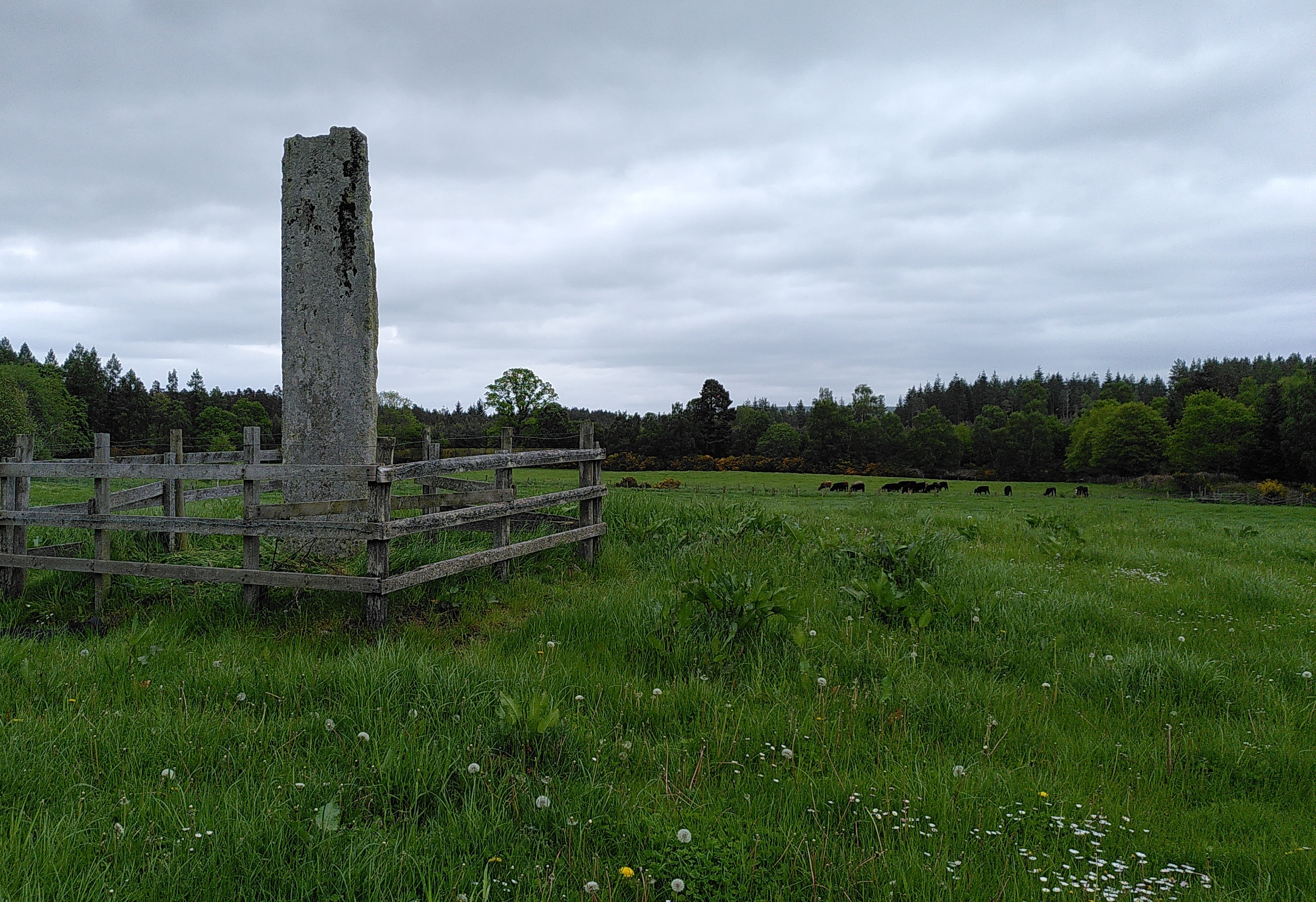
Discovery: The stone was moved from somewhere in the Laigh of Moray around 1820 to a field north of Altyre House; however, the exact original location is not known (Calder and Jackson 1957, 246; Forsyth 1996, 23). William Rhind may have been unknowingly referring to the ogham letters when he mentioned Runic knots on the Altyre Stone in 1839 and he was later quoted by John Stuart (1856, 35) in his description of the stone in 1856, where he noted the considerable weathering of the carving (Forsyth 1996, 24). The first intimation of an ogham inscription specifically, however, comes from a hand-written note in the National Museums of Scotland Library’s copy of the Early Christian Monuments of Scotland by J. Graham Callander, who was keeper between the years 1919-1938 (Forsyth 1996, 24). Following this note, an official reading along with an illustration was first published in 1957 in the Proceedings of the Society of Antiquaries of Scotland (Calder and Jackson 1957, 247).
Findspot: Rafford, Moray, Scotland (National Grid Reference: NJ 1374 6633)
Last recorded location(s): Recorded in Altyre House estate, NJ 0391 5537, on May 23rd 2023.
Support
Trove 15812
Object type: Cross-slab
Material: Sandstone
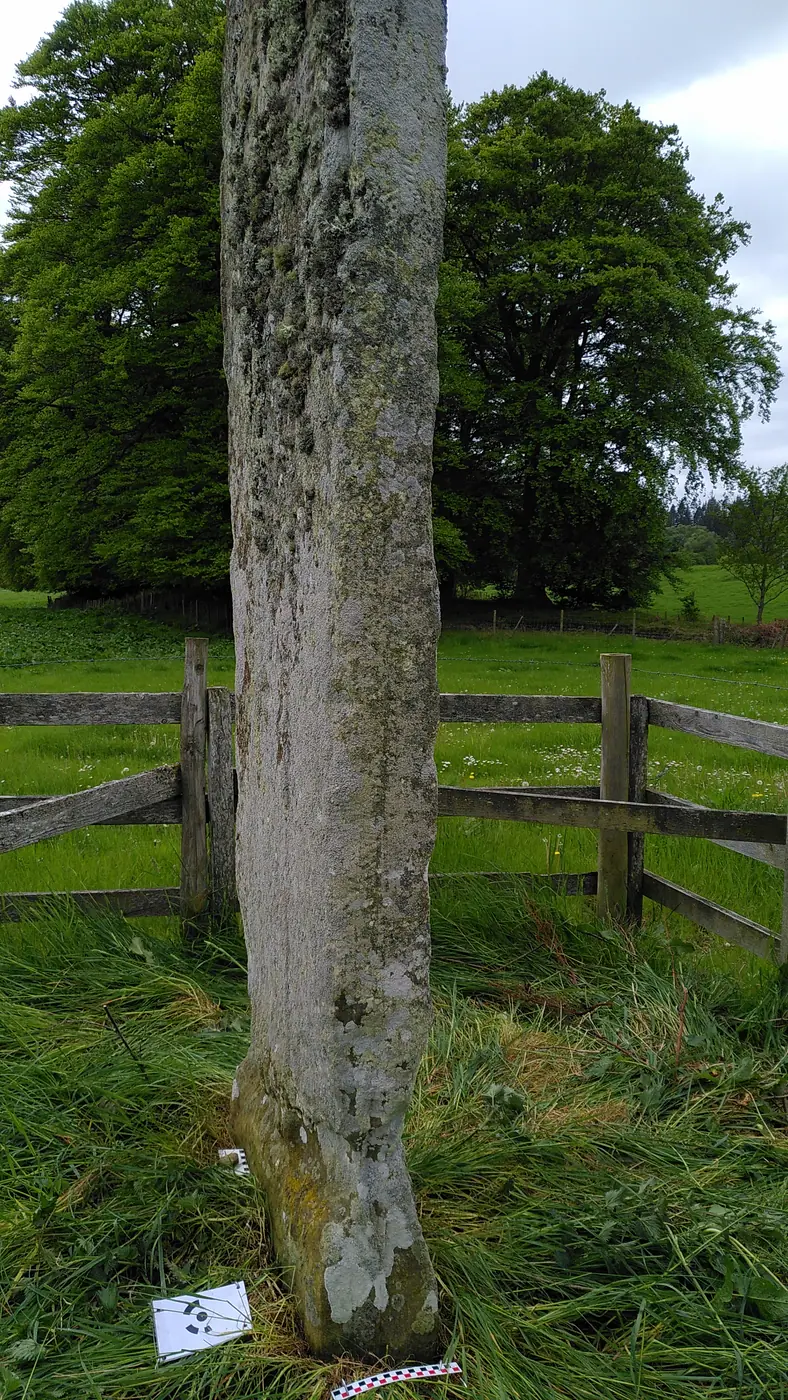
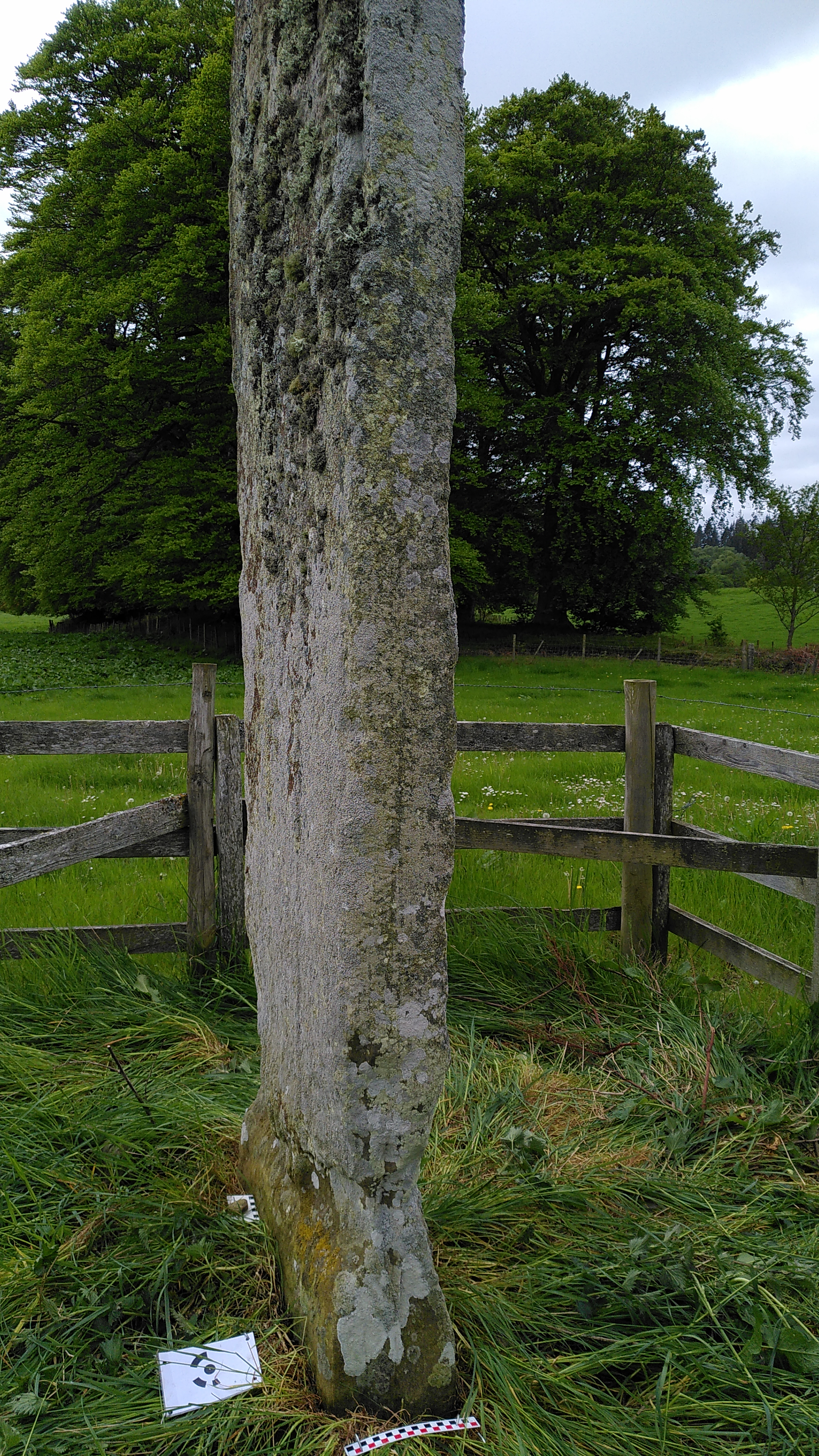
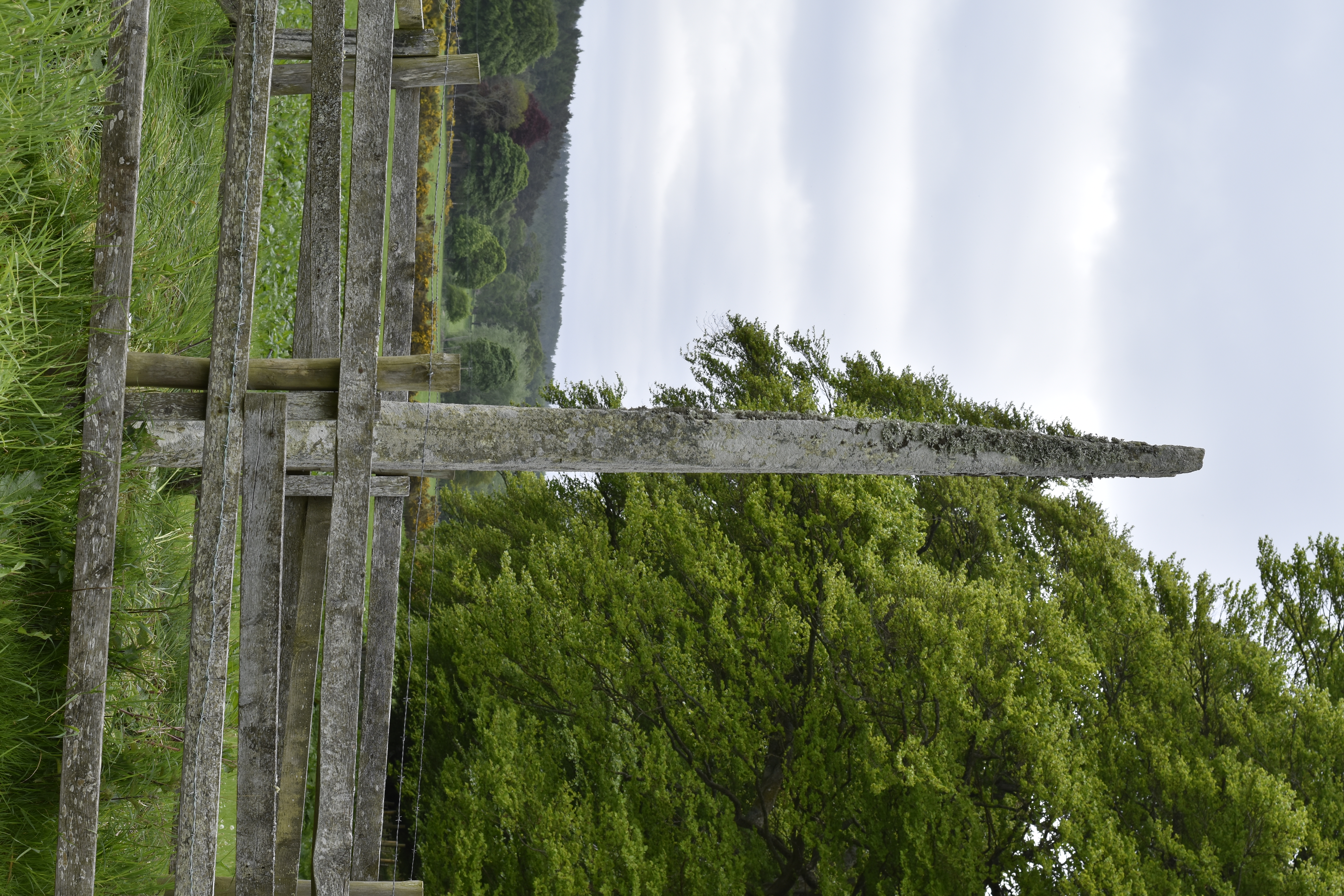
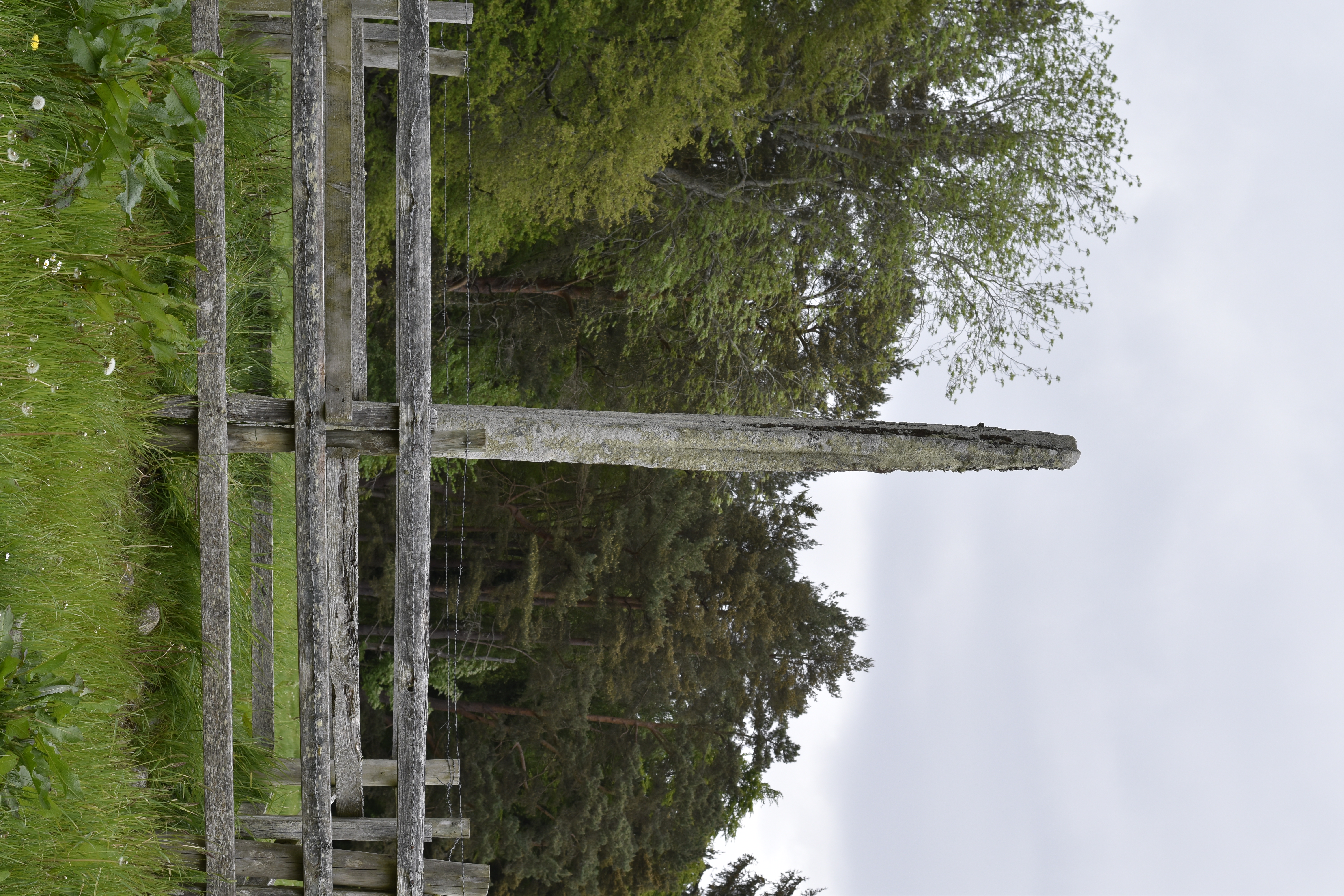
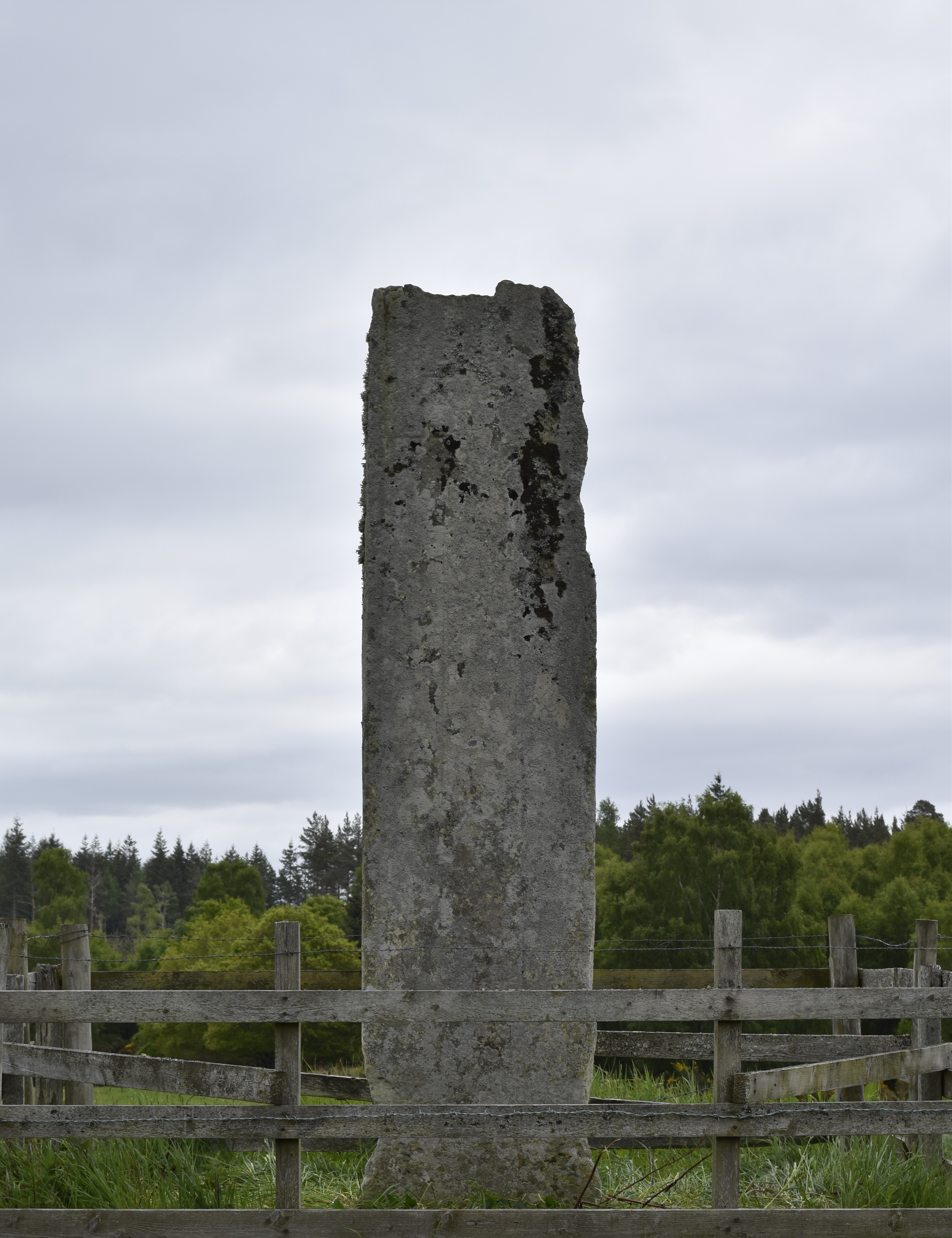
Dimensions: H 3.3 × W 0.86 × D 0.18 m
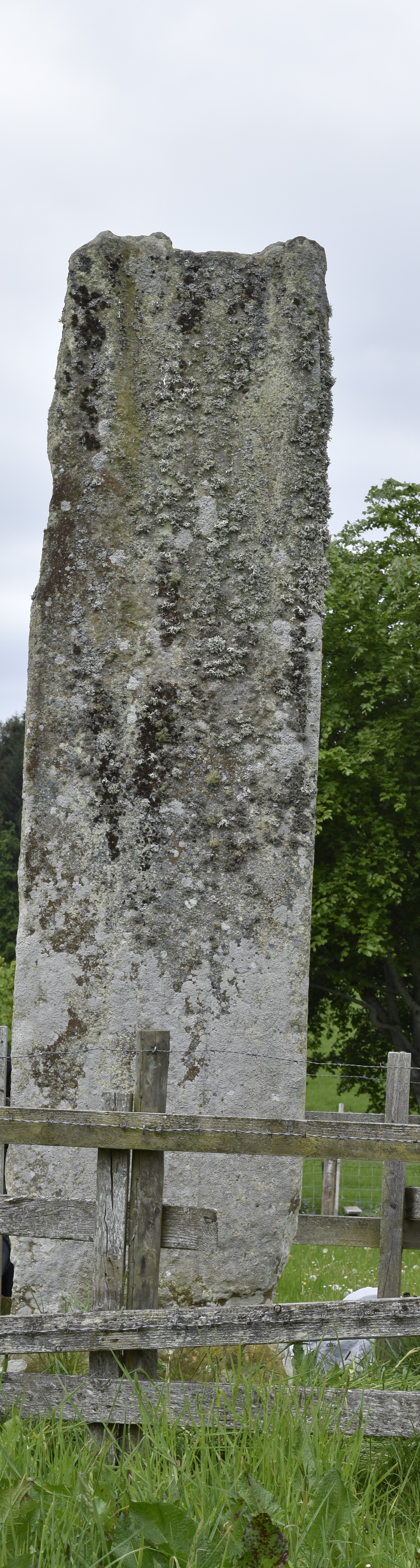
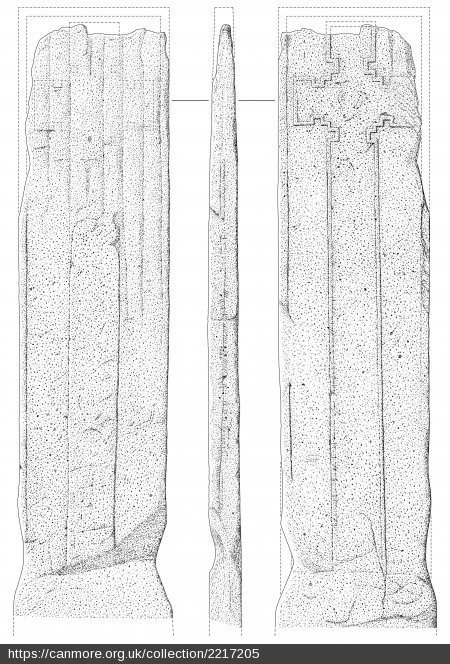
Decoration: The slab is sculpted in relief on two faces with crosses. The cross on the back is cut in shallow relief and only the vertical shaft survives (Forsyth 1996, 28). On the front face, the square-armed cross with double square hollows for arm pits protrudes by 1.5 cm from the surface and its outline is still preserved (Forsyth 1996, 28).
Condition: The cross-slab is severely weathered and thickly covered in lichen (Forsyth 1996, 27). There may be a section of ogham missing from the beginning and certain portions of the ogham are doubtful (Forsyth 1996, 27). However, the termination of the ogham inscription is clearly visible so it is certain that nothing has been lost from the end. There is no trace of any ogham on the right edge, but much of its surface has weathered away. The possibility of a second ogham inscription on the face of the cross-slab cannot be confirmed until the lichen has been removed (Forsyth 1996, 25).
Inscription
Text field: On the better preserved face of the cross-slab, the ogham inscription occupies most of the lower half of the narrow left edge. The inscription is visible at the lowest point on the intact surface, about 0.6 m from the current ground level. The stem-line is substantial, incised deep and wide, and is visible for approximately 1.25 m and stops cleanly with the last letter (Forsyth 1996, 29). Additionally, there might be the remnants of another ogham inscription running up the side of the cross-shaft on the face of the cross-slab (Forsyth 1996, 25).
Letters: It appears the ogham inscription on the left edge was pocked and rubbed, though the surface is too weathered and lichen-encrusted to be certain (Forsyth 1996, 30). The ogham strokes are quite thin and are unlikely to have been deep when freshly carved (Forsyth 1996, 35). The letters are generously spaced, with long straight vowel strokes taking up the whole width of the ogham band (Forsyth 1996, 35). Generally, the ogham inscription seems to have been ‘very competently and evenly cut in a formal measured style’ (Forsyth 1996, 30). The ogham inscription on the face of the cross-slab appears to have been ‘cut in a slightly finer script’ than the ogham inscription on the edge (Forsyth 1996, 29).
Date: Later eighth or ninth century
Edition
Transcription: [---]AM MAQQ .ALLM[---]AHHRRASSUDDS
Critical apparatus:
- The main obstacle to a satisfactory interpretation of the Altyre ogham is the uncertainty over the weathered sections of text. The intact portions are very clear, but where there is doubt it is considerable. Furthermore, although the letters MAQQ, a form of Irish MAQ(Q)I ‘son’, can be segmented straight away, the segmentation of the rest of the inscription proves problematic. 2. There is doubt over whether there is a second ogham inscription on the front face of the slab (Forsyth 1996, 29). An incised line around the cross can be discerned and while this could be the stem-line of an ogham inscription, its primary purpose is to outline the cross, which in turn suggests that the ogham would have been a secondary addition (Forsyth 1996, 29). The surviving carving is too weathered to be able to reconstruct the text (Forsyth 1996, 29). As Forsyth (1996, 29) suggests, if this inscription were to be accepted as genuine and secondary to the original carving, then this would imply that the ogham on the edge of the slab is also a later addition.
Translation
The extant text is not sufficient to identify the language or the meaning of the text (Forsyth 1996, 39).
Commentary
Too little of the text survives to make clear the identification of the language of the inscription, whether Pictish or Irish. Personal names ending in -am are few in both Gaelic and Brittonic sources, but the Pictish King-List has a king Galam and one of the donors in a charter dated c.738-40 in the Book of Llandaff was a certain Riatam (Rhiadaf) (Forsyth 1996, 38). Forsyth (1996, 38) notes that the element RRASSUDDS calls to mind the Resad of the St. Ninian’s Isle chape, but is otherwise not recognisable as any attested personal name (though possibly related to Brittonic Ris > Rhys?).
It is difficult to determine the significance of the text given its precise original location is unknown, yet Forsyth (1996, 39) notes its ‘general context is a late Pictish Moray increasingly drawn into Gaeldom, more specifically the environs of the major secular power centre of Burghead and the important ecclesiastical site at Kinneddar’.
‘At its current height of 3.3m, Altyre is the second tallest sculptured slab from early medieval Scotland, shorter only than the giant Sueno’s Stone (6.10m)’ (Forsyth 1996, 39).
References
- Allen and Anderson 1903, 136
- Calder and Jackson 1957, 246-250
- Forsyth 1996, 23-40
- Stuart 1856, 35