Provenance
Discovery: The stone is one of six carved stones located inside the Lochgoilhead parish church in Lochgoilhead and Kilmory. The church was first recorded at the closing of the 14th century and later sources attribute it as a dedication to the Three Holy Brethen. ‘The ogham inscripton was discovered inside the church in the early 1990s’ yet nothing is known about when or from where it was brought into the building (Forsyth 1996, 374).
Findspot: Lochgoilhead and Kilmorich, Argyll, Scotland (National Grid Reference: NN 19851 01461)
Last recorded location(s): The Lochgoilhead stone and inscription was examined and observed by Forsyth in November 1992 during its time in Edinburgh in the care of the Royal Commission on the Ancient and Historical Monuments of Scotland (RCAHMS) team. The stone was 3D recorded by the OG(H)AM team on 16 September 2022 inside the Lochgoilhead parish church in Lochgoilhead and Kilmory.
Support
Trove 318854
Object type: Unclassified
Material: Sandstone
Dimensions: H 0.420 × W 160 × D 0.115-0.075 m
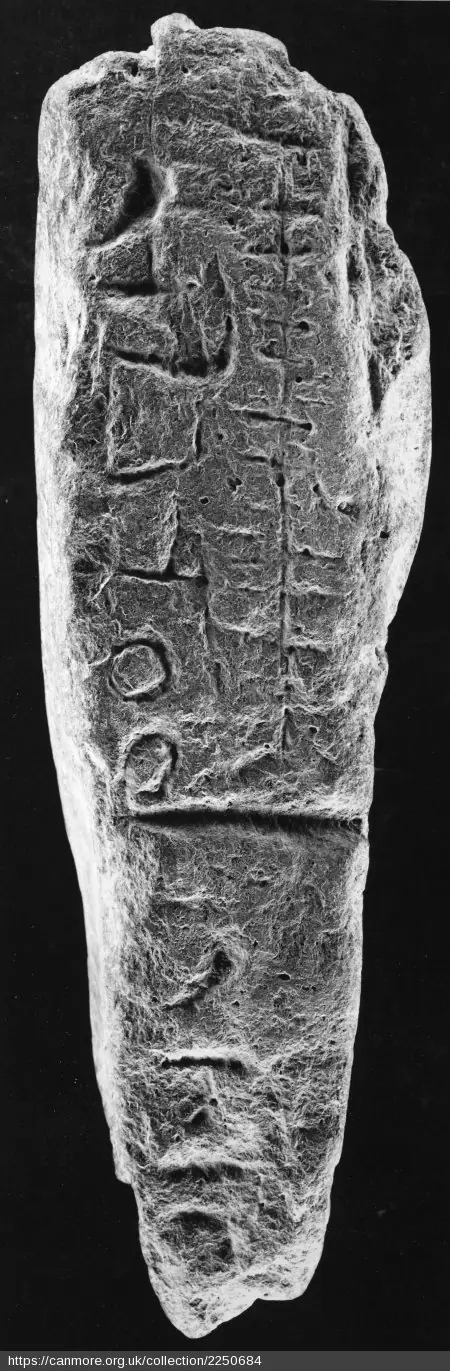
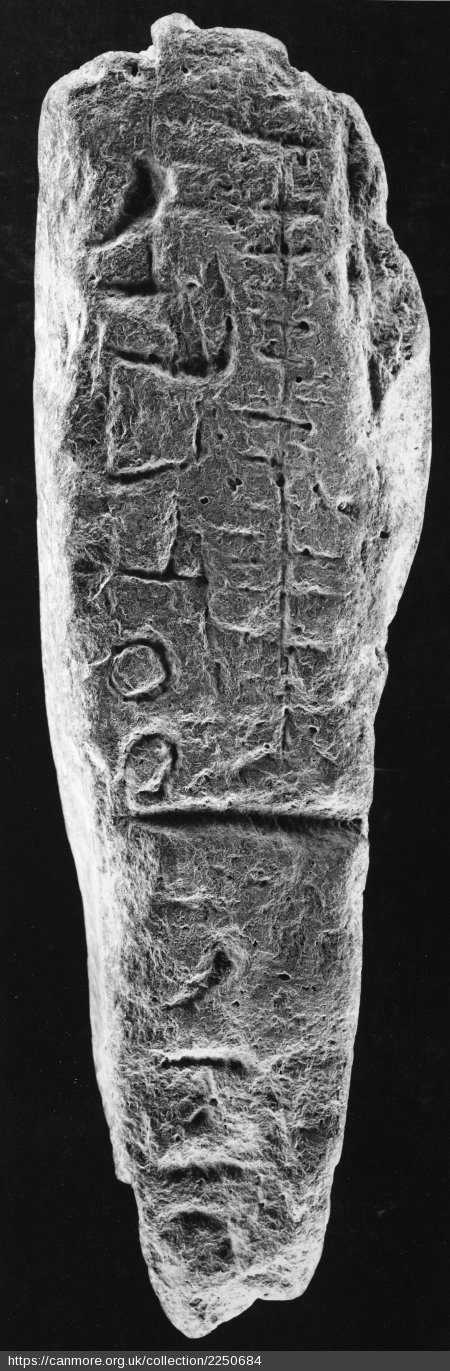
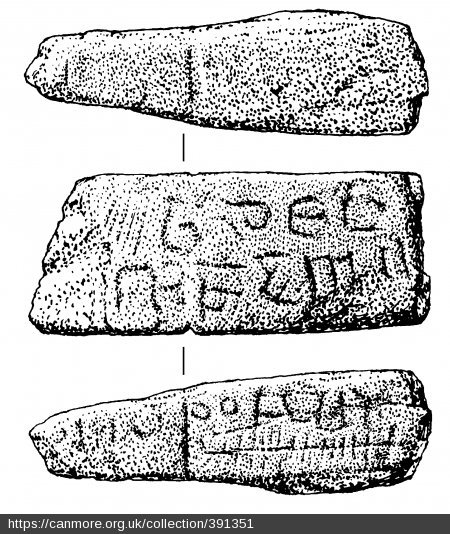
Decoration: Three of the four edges and faces of this block bear evidence of carving. Edge A is plain except for a ‘deep V-section’ groove. The left end of face B has apparently been cut away, but the undamaged part of face B bears two lines of irregularly incised roman lettering. The ogham inscription is located on edge C which exhibits two lines of lettering to the right of another deep V-section groove. Edge D is the roughest out of all the surfaces and appears to be uncarved.
Condition: An oddly shaped, fine-grained sandstone block which has been described previously by the RCAHMS as a ‘fragment of an inscribed pillar’, the Loghgoilhead ogham stone looks unfinished with possibly various different hands crafting each letter over periods of time. Forsyth (1996, 375) suggests that ‘perhaps the block of stone was selected for carving’ but then ‘abandoned ending up as chisel-fodder’. The stone is fragmentary and damaged with the surface severely abraded at points. However as Forsyth (1996, 375) notes ‘only a small portion has been lost’. Interestingly, the patterns of wear suggest an eventful life with a potential of time in the sea. The begining and end of the ogham text on face C are badly worn making any reading of those portions of the inscription uncertain.
Inscription
Text field: The upper inscription on edge C appears to be roman while the lower inscription is in the ogham alphabet. The stem-line of the ogham inscription is 195 mm long, running parallel to the edge of the stone. The stem appears to have been cut before and again after the cutting of the strokes, which perhaps explains why some of the strokes appear to not quite reach the stem.
Letters: The individual strokes are of varying length between 20 and 35 mm and 3 and 6 mm in breadth. The inscription has been chiselled. The carving is as Forsyth (1996, 377) observed ‘course and scrappy, doubtless because of the intractability of the stone and the subsequent abuse the block has suffered’. Lochgoilhead is written in a rather scruffy ‘form of the script with perpendicular b- and h- strokes and long vowel-strokes occupying between half the ogham band and all of it. The letters are not widely spaced and there is considerable variation in strokes of the same aicme’ (Forsyth 1996, 379).
Edition
Ogham text: ᚛
Transcription: ᚛MUDMALIḌṂ →
Critical apparatus:
- Forsyth (1996, 377-378) noted that the ‘first short stroke above the line sloping diagonally backwards’ could be interpreted as ‘a bounding mark indicating the beginning of the inscription’. 2. The fifth letter is distinctive as it consists of ‘one stroke, perpendicular through the stem, with what appears to be a diagonal flap attached to each end’, lending it the appearance of an ‘angular, open S’ (Forsyth 1996, 378). 3. Similarly, the ‘two very short parallel strokes, sloping diagonally backwards, stopping well short of the stem’ before the final character in the inscription, ‘may perhaps be some form of punctuation or directional indicators, perhaps to be taken together with’ the opening character ‘as bracketing the text in some way’ (Forsyth 1996, 378). It is also quite possibe that these strokes are not connected with the ogham but ‘relate to the line of roman letters above’ instead (Forsyth 1996, 378). 4. At the end of the stem is a ‘long perpendicular stroke, thicker than the other strokes’ and its ‘more substantial aspect suggests it should be interpreted as a termination mark’ rather than a concluding letter (Forsyth 1996, 378). However, due to the wear to the stone the purpose of these beginning and end marks remains doubtful. 5. Forsyth (1996, 378-379) remarked that orientation of the text is uncertain and could have been intended to be read from both directions. From left-to-right the text reads: (/h)MUD(?)ALI( /d) In the opposite direction the text reads: ( /1)ID(?)LUM( lb)
Translation
Noble prince
Commentary
If the suggested reading is correct it could be interperted as the personal name Mud-mali. The first element may be from the adjective muad meaning ‘noble’ or ‘good’ while the second element may be correlated to the common personal name Magl, OIr. mál meaning ‘prince’, which is normally found in compound names such as this one. As Forsyth (1996, 380-381) notes ‘Although there is no extant example of the two elements MOD/MUAD and MAGL-/MAL together, the combination is theoretically possible, perhaps with meaning ‘noble prince”.
If the fifth letter is not M as the suggested reading implies then another possibility offered by Forsyth (1996, 382) is the interpretation VALI from the root meaning ‘to be strong’, a very common element in Celtic personal names.
If letter 5 is a modified A then the potential reading Forsyth (1996, 382) purposes is Mudali, with the MU possibily serving as an abbreviation for MUCOI. It is important to note that these readings do not exhaust all possibilities. A better understanding of how the three texts (the groove, the roman and the ogham inscription) relate to one another would greatly assist in providing a more accurate interpretation.
The difficulty in defining the original purpose of the Lochgoilhead stone has led to many explanations of which, as Forsyth (1996, 383) comments one ‘is no more implausible than any other’.
References
- Forsyth 1996, 374-384