Provenance
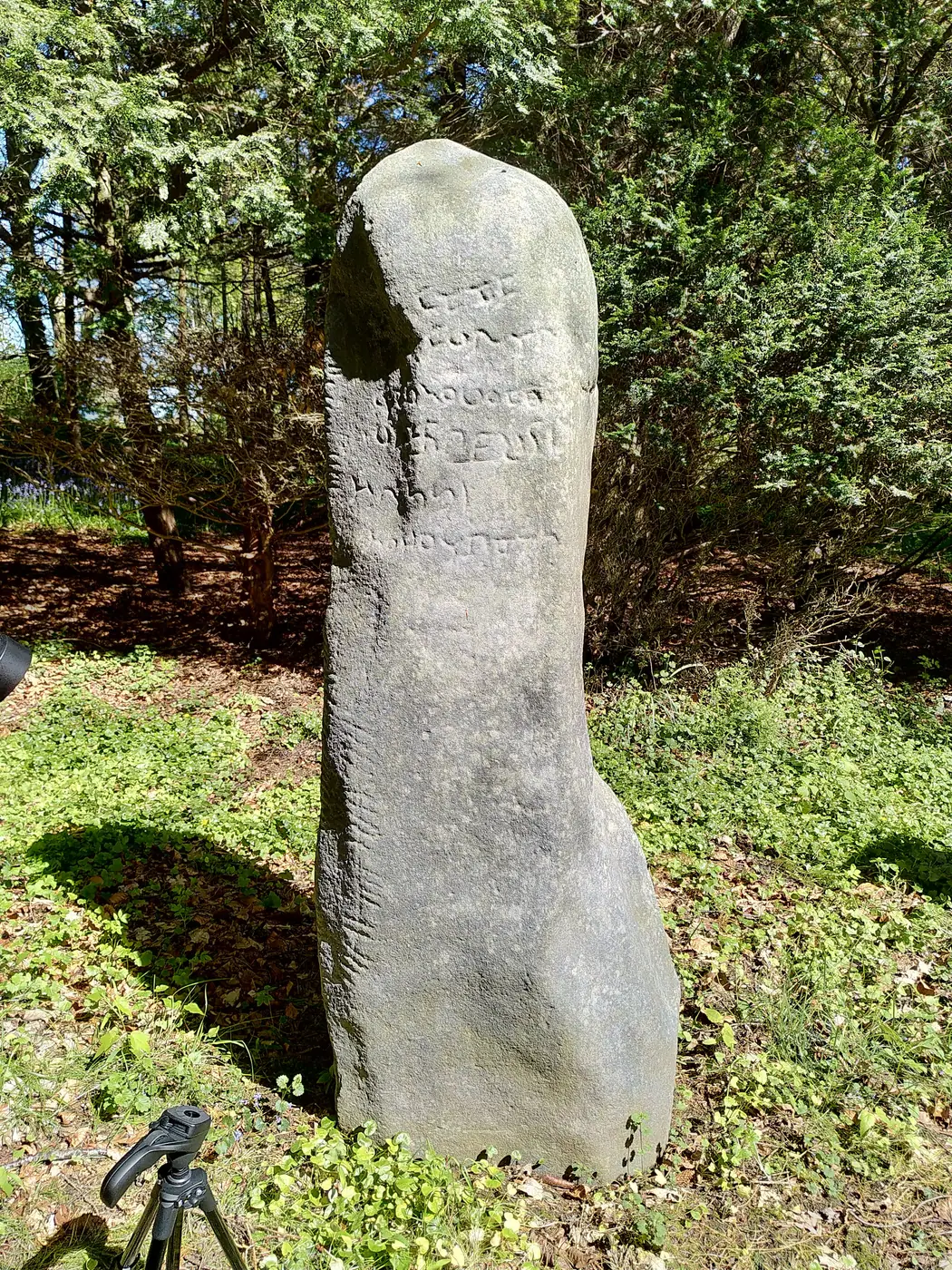
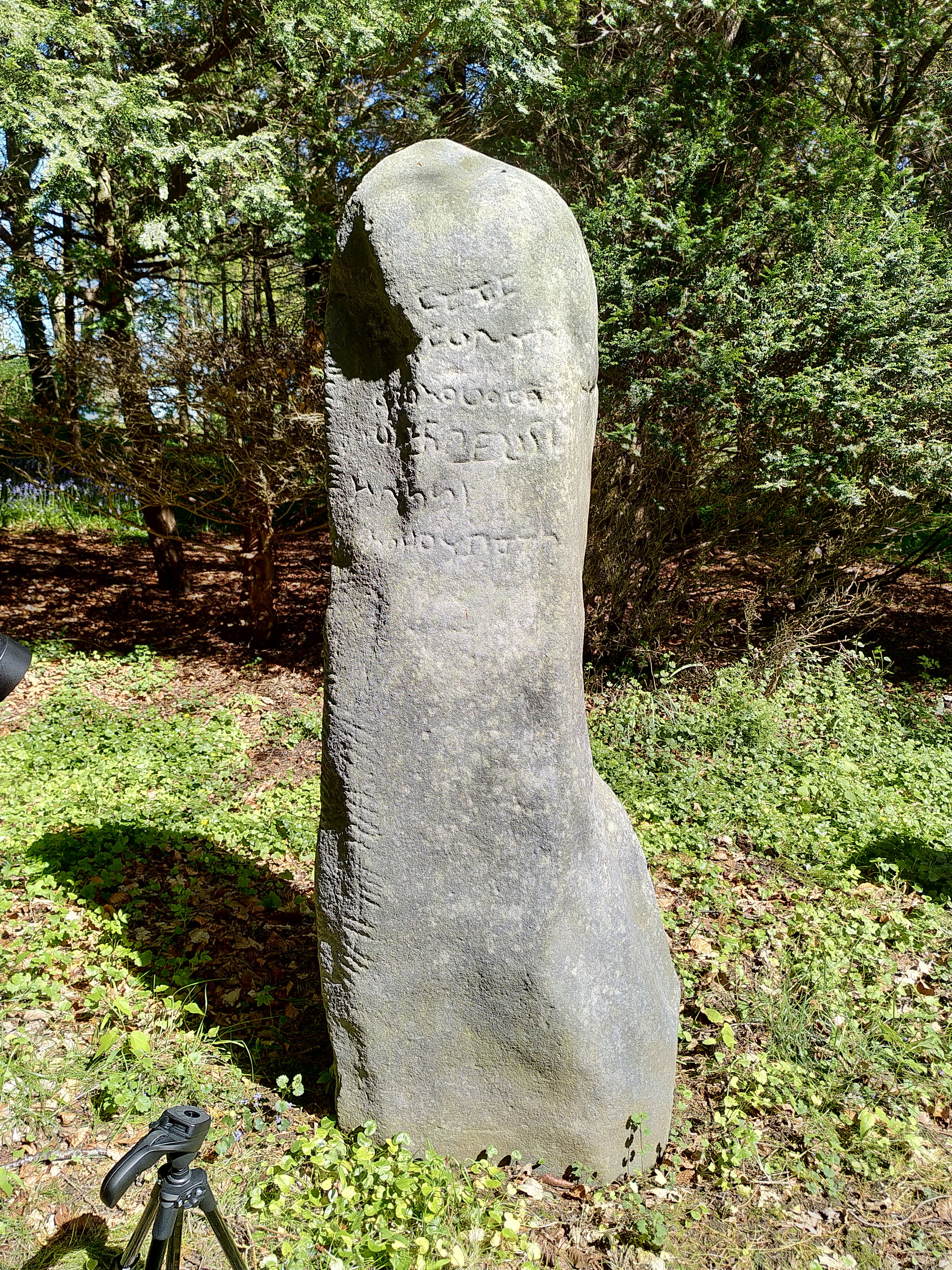
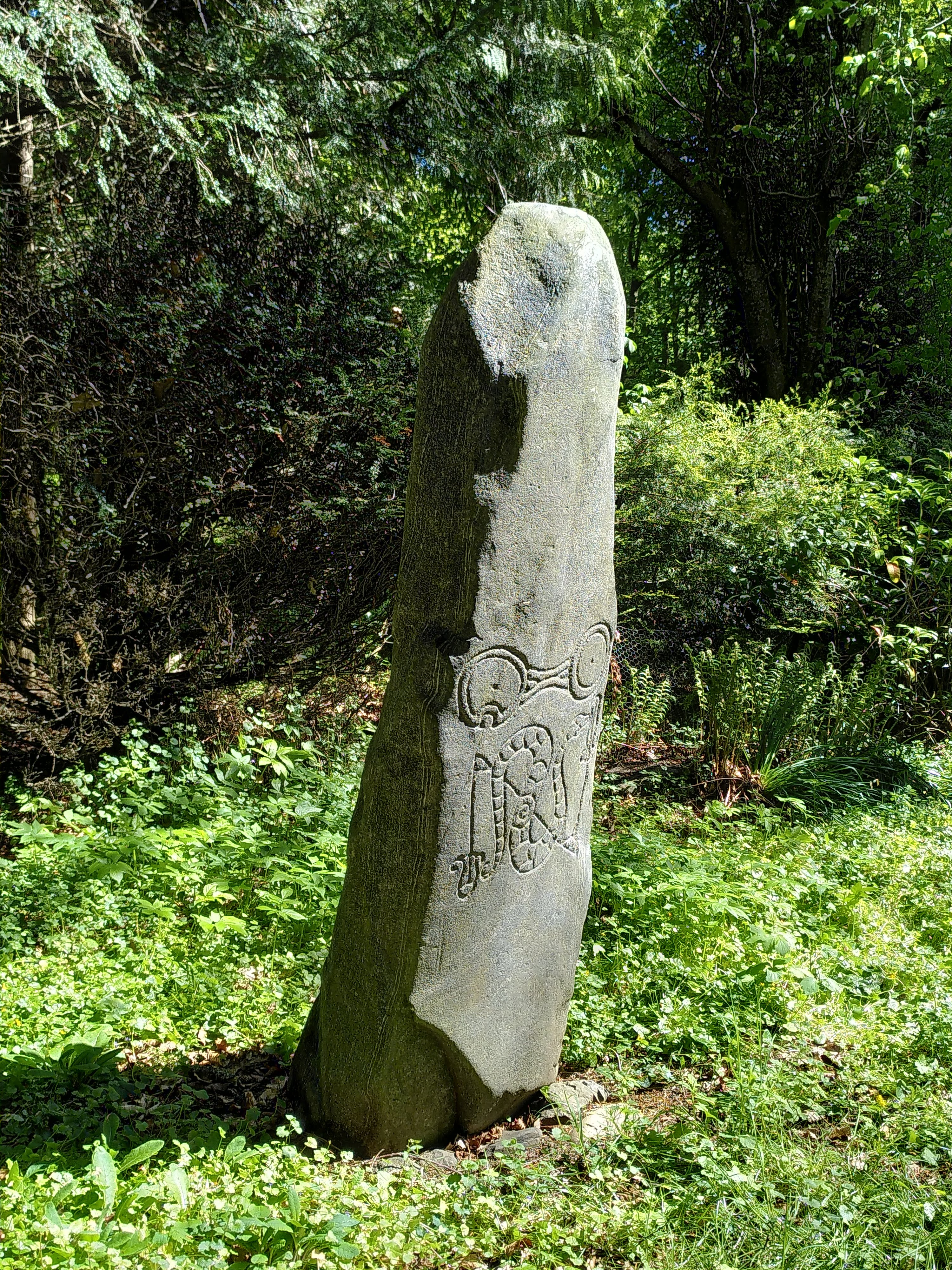
Discovery: Found around 1803 and first recorded by John Stuart in 1835 in a wood about a mile from Newton House, and subsequently moved to the grounds of the house by the 1850s (Forsyth 1996, 420-422). The ogham stone is closely associated with the Newton symbol stone which, allegedly, ‘originally stood half a mile west of the inscribed stone’ and was later moved behind Newton House in 1794 (Forsyth 1996, 421). In 1873, both the inscribed stone and symbol stone were moved again and positioned side by side on the lawn of Newton house.
Findspot: Culsalmond, Aberdeenshire, Scotland (National Grid Reference: NJ 6623 2972)
Last recorded location(s): Recorded on the grounds of Newton House on May 15th 2022.
Support
Trove 18086
Object type: Pillar
Material: Granite
Dimensions: H 2.09 × W 0.70 × D 0.40 m
Condition: The inscribed stone is an irregular, ridged pillar (grey gneissose granite) complete with a well preserved carving, though the final portion of the longer text has been defaced (Forsyth 1996, 424, 426). There is a symbol stone nearby which features two motifs, a double-disc (without Z-rod) and a serpent-and-Z-rod. The symbol stone is of the same material and is ‘very similar in general appearance to the inscribed stone’ (Forsyth 1996, 439).
Inscription
Text field: There are six lines of seemingly Roman alphabetic characters at the top right of the pillar and an ogham inscription runs on the left-hand edge, consisting of a longer 14.5 and a shorter 5 section and reading from the top down (Forsyth 1996, 424-426). The shorter section of ogham script has a drawn-in stem ‘inserted between the distal tips of the first two strokes of’ the 20th letter (Forsyth 1996, 430). After the 20th letter, the drawn-in stem curves sharply to the left and then continues straight up, parallel to the initial hypothetical stem (Forsyth 1996, 430).
Letters: The ogham strokes appear to have been pocked and rubbed smooth (Gordon 1956, 41). From the 14th letter onwards, the inscription is more tightly packed but there are clear gaps between all the ogham letters throughout (Forsyth 1996, 426, 430). Forsyth (1996, 431) further notes that ‘the vowel strokes are rather long, at least as long as, if not longer than, b- and h- aicme stokes and almost as long as some m-aicme’. An average of 4-6cm for the longer section, and for the shorter section, an average of 7.5cm for long strokes and 5cm for short strokes (Forsyth 1996, 425).
Date: Sixth or seventh century A.D. (textual context)
Edition
Ogham text: ᚔᚇᚇᚐᚏᚏᚅᚅᚅ ᚃᚑᚏᚏᚓᚅᚅᚔ ᚕ
Transcription: IDDARRNNN VORRENNI K«U»⟦IE[..]⟧-`ỤOSRṚ´
Critical apparatus:
- The ogham and non-ogham inscriptions are not transliterations of each other and do not seem to correspond with any section of the other (Forsyth 1996, 425). The non-ogham inscription was initially believed to be a forgery from the early nineteenth century, but Gordon (1956, 41, 44) disproved this in his study, showing that the two had indeed been carved by different hands but used a similar technique. 2. It is unclear whether the defaced portion of the longer ogham section is repeated at the start of the drawn stem-line. The shorter section could be a correction or an alteration, but it seems more likely that it is a continuation of the longer section (Forsyth 1996, 426). 3. While unusual, reading the ogham inscription from the top down (left-to-right with the head to the right) is more feasible because it provides a more intelligible reading and would also explain the curving of the shorter section at the bottom of the stone (Forsyth 1996, 427). If the inscription had started at the bottom, the inscription could have progressed upwards and could have continued across the top of the stone and down if more space was needed, as is the case for certain Irish stones (Forsyth 1996, 427). 4. Forsyth (1996, 436) suggests three possible interpretations for the ogham inscription: 1) three personal names with no formula words: ‘Idamon (, or :) Vorenn (and) [?]’; 2) three names plus KOI: ‘Idamon: Vorenn koi [?]’ ; 3) three names plus ipe: either ‘X, Y ipe Z ’, or ‘X, Y, ipe-Z’.
Translation
Given the uncertainty of the final section of the inscription, it is not possible to assuredly determine its syntax and in extension its meaning.
Commentary
The nearby symbol stone has been carved ‘using the same basic technique as’ the inscribed stone (Forsyth 1996, 430). Gordon (1956, 43) described the lines of the symbol stone as ‘deeply and roughly pocked’ and, on average, a few millimetres broader than the inscribed stone’s letters.
‘As for the two sections of ogham, the longer clearly predates, though not necessarily by much, the shorter’ (Forsyth 1996, 426). Without an improved understanding of the text, it is not possible to determine the date of origin accurately. It could be dated anywhere between the sixth or eighth century, though more likely in the seventh century and earlier given the subsequent decline of the individual inscribed memorial as a monument type throughout the British Isles (Forsyth 1996, 441).
References
- Diack 1922,
- Forsyth 1996, 420-442
- Gordon 1956-11-30, 40-46