Provenance
Discovery: Found during grave-digging in Mail churchyard in 1903.
Findspot: Dunrossness, Shetland, Scotland (National Grid Reference: HU 4330 2790)
Current repository: Scotland National Museums of Scotland (inv. no. IB182)
Last recorded location(s): Now in the National Museums of Scotland, where it was seen and recorded in 3d (using photogrammetry) for the OG(H)AM project in June 2022.
Support
Mail Cemetery Trove: 938
Object type: Slab
Material: Sandstone
Dimensions: H 0.44 × W 0.26 × D 0.05 m
Condition: Three sections of ogham survive. The stone is severely trimmed and much of the immediate surface is lost to lamination.
Inscription
Text field: The inscription consists of three lines of ogham. The three lines are straight and roughly parallel except for the lower end of the middle line, which curves towards the centre.
Letters: The ogham scores are deep incisions with U-section and rounded ends. The strokes vary in length from 7-16mm. The strokes are short and widely spaced, giving the letters a squat, stumpy appearance.
Edition
Ogham text: ᚕ
Transcription: XTTECG̣[---] [---]VVṚ[---] [---]V᛬ DATTVḄ[---]
Critical apparatus:
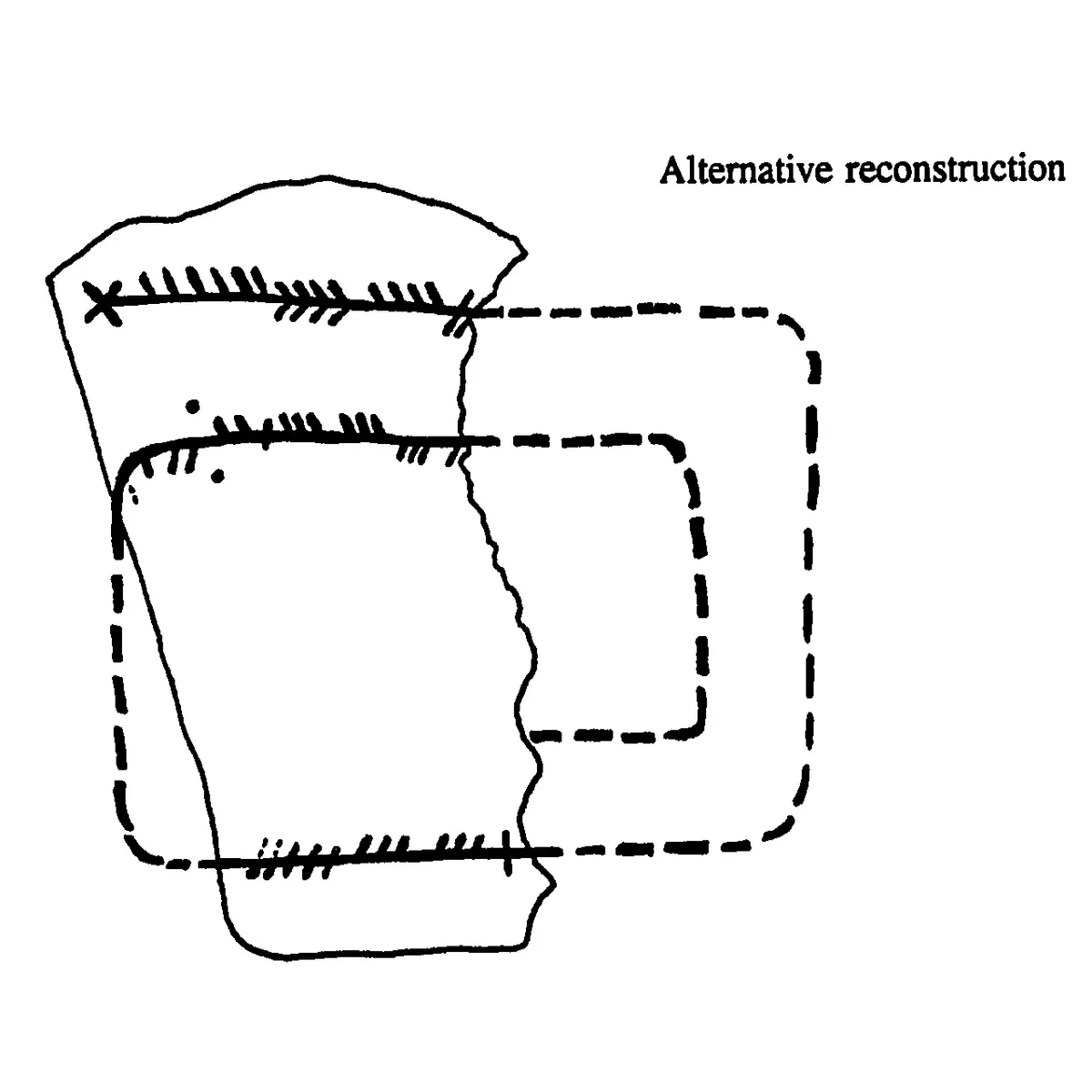
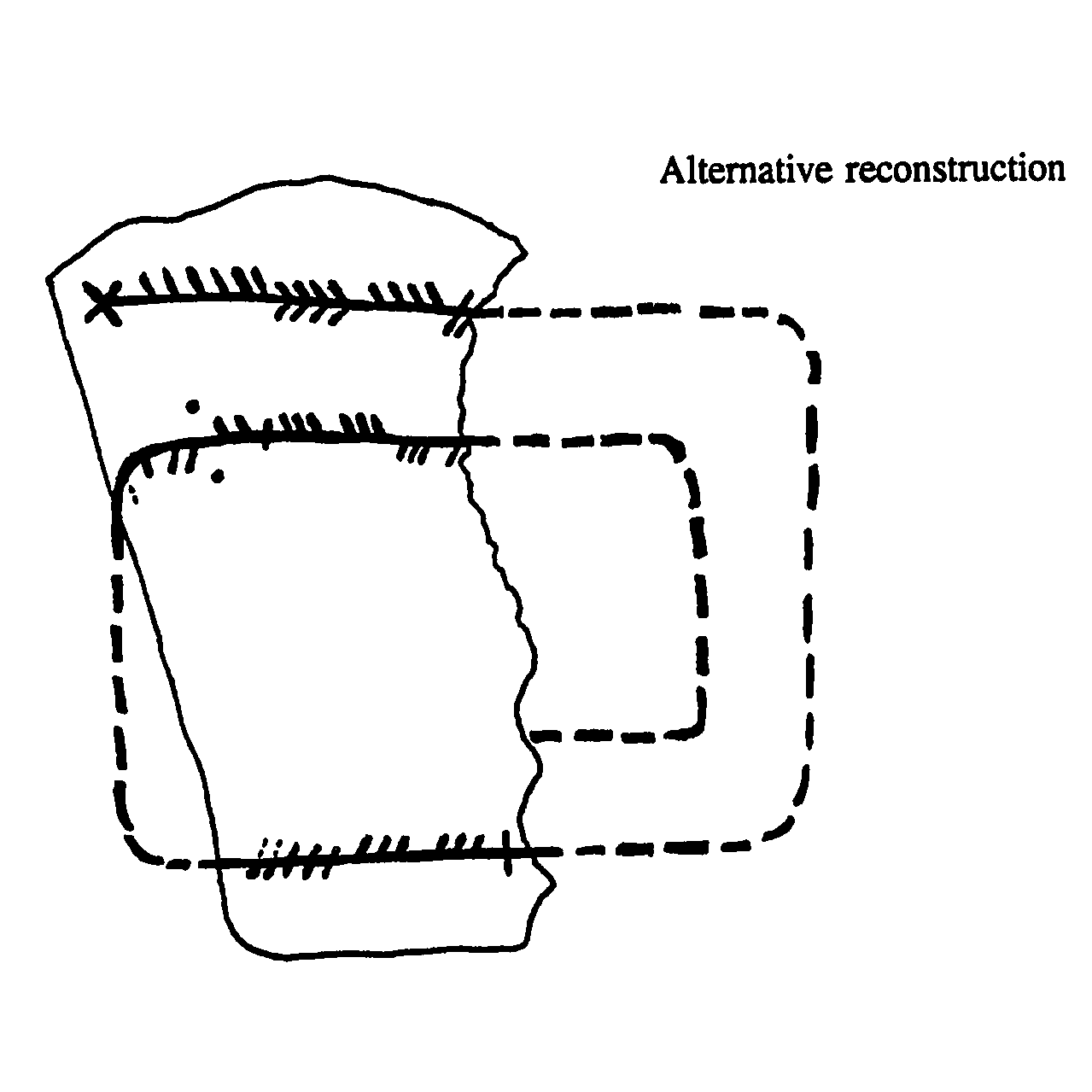
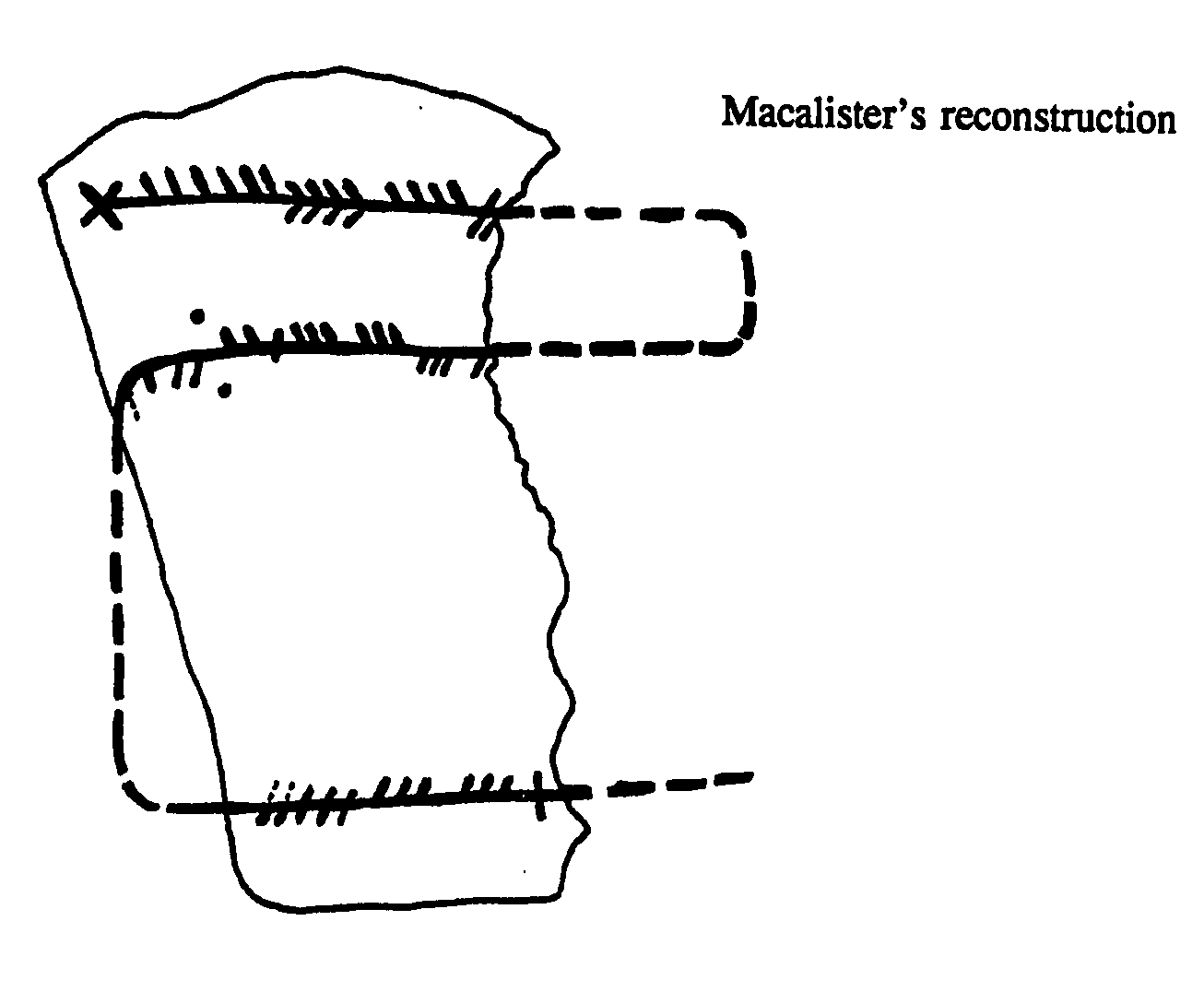
- A pair of dots preserved in the middle section indicates word-division. The inscription also preserves two supplementary letters, the X-forfid and the angled vowel A. The three lines of ogham text may have been entirely separate, but the curving stem of the middle line seems to indicate that second and third lines were joined. The three lines can be interpreted as one continuous line but in the form of a spiral. There are perhaps at least five letters missing between the third and second lines and an unknown number of letters lost at the end. Forsyth (1996, 224) supplies two possible interpretations: Etteco-[ ]-affr-[ ]-af : dattur; Etteco-[ ]-aw(w)r-[ ]-aw: dattw(w) 2. Macalister (1940, 216) read: ETTEC[o+- a+]TVVALT- -RTTA-
Translation
Forsyth (1996, 225) reasons that the text may possibly mean something similar to ‘this is as far as (the territory of) X’.
Commentary
The opening sequence may be compared with EHHTECON- of Cunningsburgh 2 and ETTECU- of Lunnasting which would imply a Brittonic interpretation. In this context Etteco might also mean something similar to ‘this is/these are as long as’, perhaps indicating that this fragment might have functioned as a territorial marker aswell. The remaining fragments of text are too short to give much clue as to meaning. The final segment recollects Bressay’s DATTRR: which has been compared with ON dottir ‘daughter’ but insufficient remains of the Cunningsburgh 3 text on which to base such a reconstruction. Similarly -affr could be a Norse male personal name in the nominative.
References
- Forsyth 1996, 219-226
- Macalister and Ryan 1940, 216
- Padel 1972, 85-8