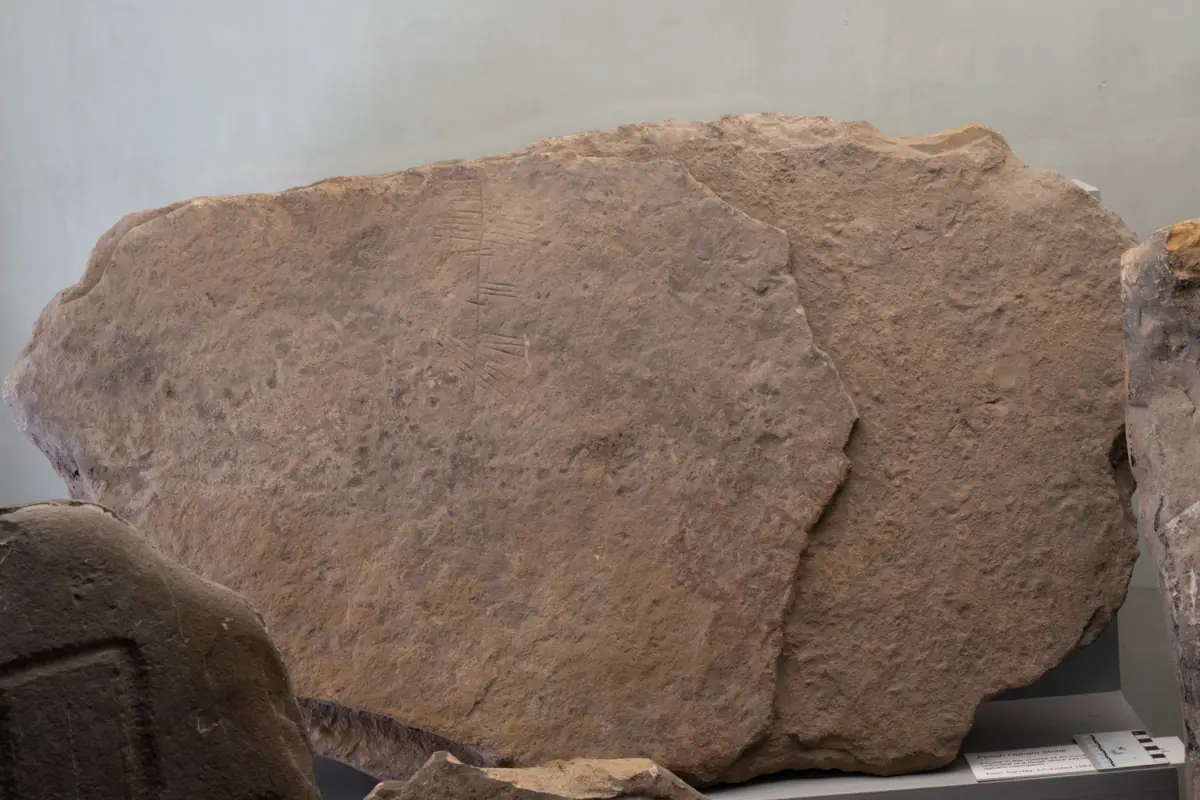
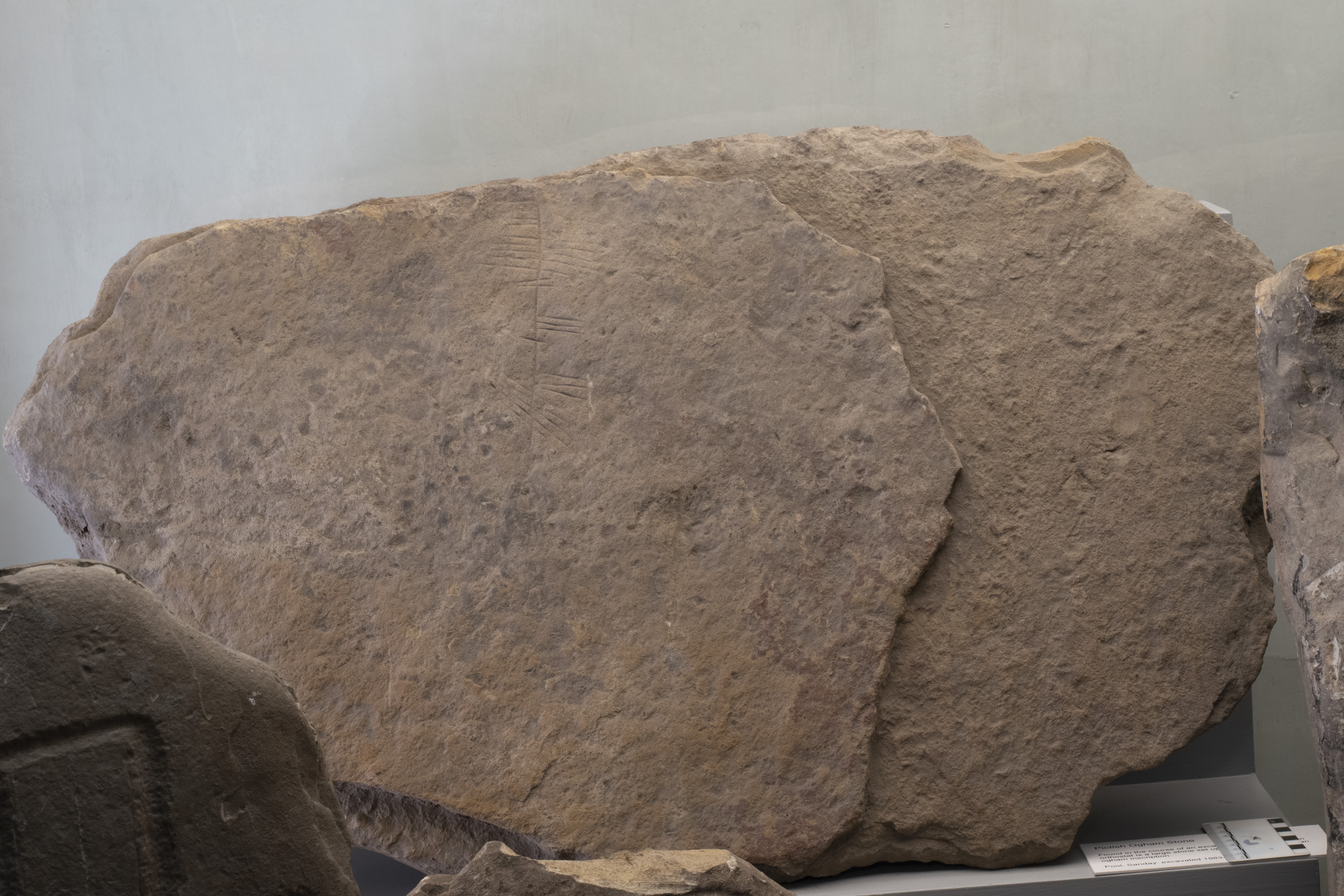
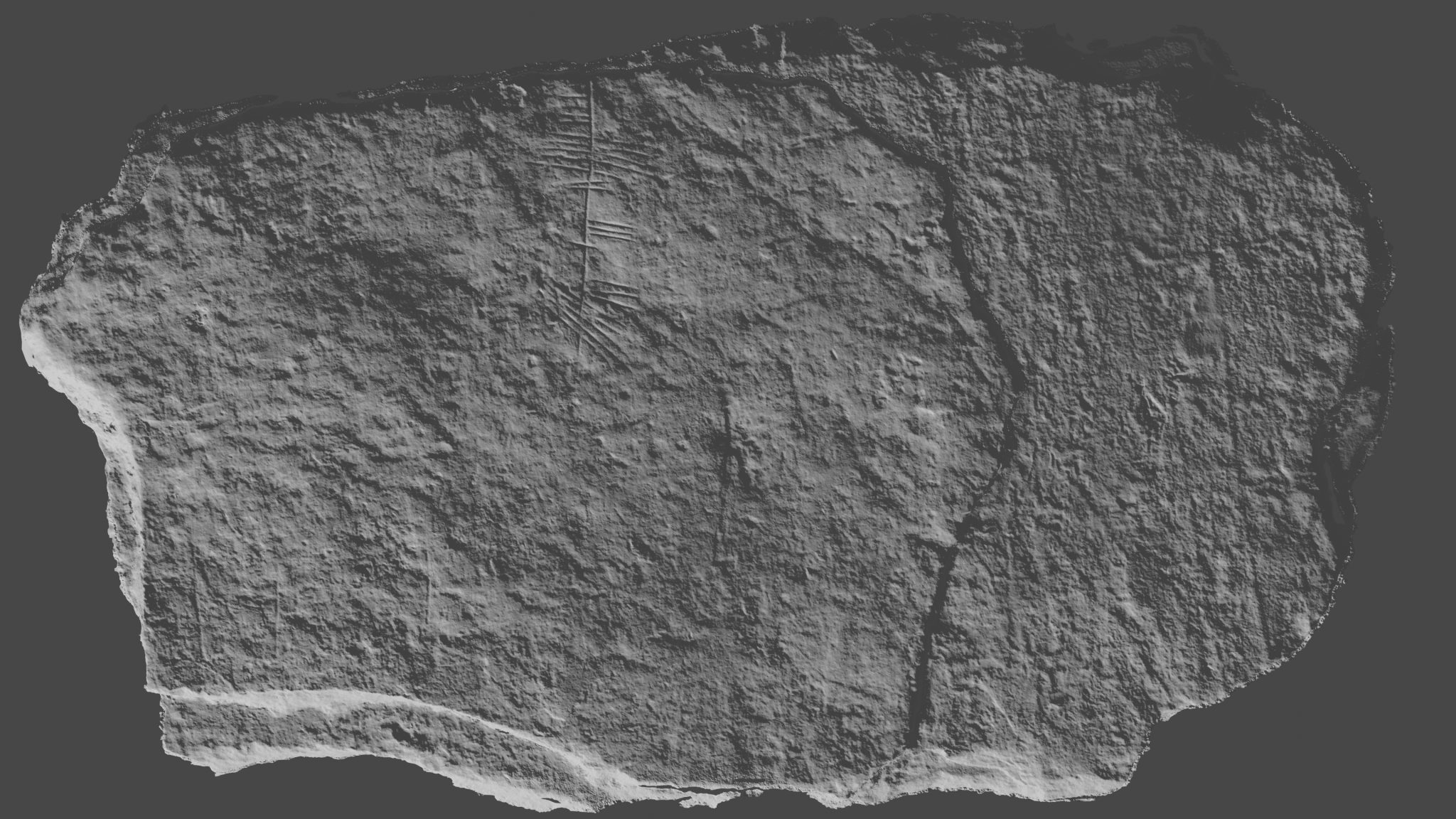
Provenance
Discovery: Found during excavation of a Pictish settlement in 1985, erected as an orthostat and probably reused as such.
Findspot: Sanday, Orkney, Scotland (National Grid Reference: HY 6194 3785)
Current repository: Scotland Orkney Museum
Last recorded location(s): Now in Orkney Museum.
Support
Object type: Slab
Material: Stone type unknown
Dimensions: H 0.85 × W 0.5 × D 0.6 m
Decoration: At least two human figures carved in different styles are visible on the slab.
Condition: The slab is broken and severely weathered. The end of the ogham inscription is missing or damaged. The graffiti figures which predate the ogham text are worn.
Inscription
Text field: The ogham inscription is inscribed on an artificial stemline, running vertically up the surface of the stone. The inscription reads upwards.
Letters: The ogham inscription appears to have been scored. Letters belonging to the same word appear to be grouped closer together and there seems to be evidence for the intentional spacing of words in the inscription.
Date: Early ninth century
Edition
Ogham text: ᚛
Transcription: ᚛ARV AV ORC[---]
Critical apparatus:
- Katherine Forsyth (pers. comm.) has noted that the splaying of the strokes on the right-hand side of the inscription implies that the stone was upright when it was carved.
Translation
‘inheritance of/from Orkney’ [or ‘of an Orcadian’]
Commentary
Forsyth (1996, 456-459) drew attention to the correspondence between ORC and the local tribal/geographic name Orc, as in fecht Orc (‘expedition to Orkney’, Annals of Ulster 580.3) and bellum for Orcaib (‘battle against the Orcadians’, Annals of Ulster 708).
David Stifter tentatively suggests that the text could have an Old Norse influence: arf af Orc, with arf understood as the accusative of ‘inheritance’. This interpretation means that the large blank spaces before and after af were intentional and separated the words of the inscription.
References
- Forsyth 1996, 456-459
- Kasten 2025-02-07