Provenance
Discovery: ‘The Inchyra slab was found on 19th of February 1945 during ploughing in former parkland on the Carse of Gowrie, 120m south of Inchyra House, in the parish of St Madoes, Perthshire’ (Forsyth 1996, 333). The stone was found lying flat about 0.3m below ground level, resting on forty-nine water-rolled stones, and ‘oriented WNW-ESE’ (Forsyth 1996, 333).
Findspot: St Madoes, Perthshire, Scotland (National Grid Reference: NO 1904 2120)
Current repository: Scotland Perth Museum (inv. no. PMAG: 5/1945)
Last recorded location(s): ‘Dr James Richardson re-examined the slab and recognized the third set of symbols, and three further lines of ogham’ (Forsyth 1996, 334). The slab was examined by Forsyth at the Perth Art Gallery and Museum.
Support
Trove 28250
Object type: Class I Pictish symbol stone
Material: Sandstone
Dimensions: H 1.6 × W narrow end-0.31, broad end-0.43 × D 0.07-0.09 m
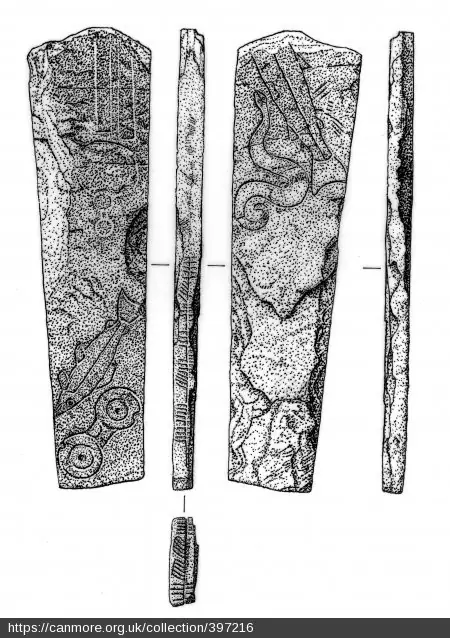
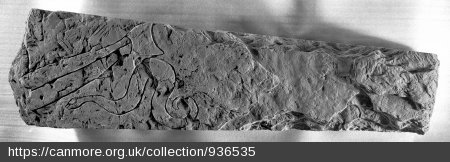
Decoration: The slab is incised on both broad faces with three pairs of Pictish symbols. At the narrow end of the smooth face of the slab, a notched double-disc and fish was finely pocked and rubbed. At the broad end of the smooth face of the slab is an ‘indistinct group of symbols which were not noticed at first’: a mirror and tuning fork (Forsyth 1996, 338). On the rougher of the two broad faces, there is a serpent and fish which were cut with a chisel or knife, to produce a V-section groove (Forsyth 1996, 339).
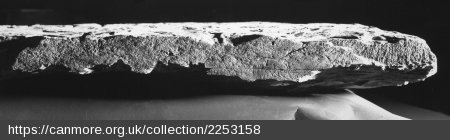
Condition: The stone appears to have been reused three times. The narrow end of the slab is intact but the broad end is broken with a portion missing. The face of the slab is smooth while the other side is rough with general flaking, especially noticeable on the edges, that has affected parts of the carving, some of which have been recovered. The rough side may indicate that it was exposed to water. Some sections of the ogham inscriptions have been lost, the ogham inscription A (ii) is severely damaged. Both the mirror and tuning fork at the broad end of the smooth face of the slab are incomplete and partially defaced. The upper part of the fish on the rough face of the slab has been lost due to a fracture.
Inscription
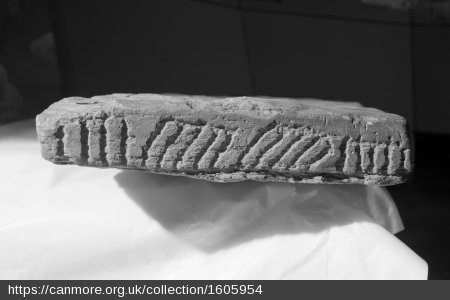
Text field: There are three ogham inscriptions, arranged in a total of five lines which appear at five different positions on the stone. The inscriptions are labelled A, with A separated as A(i), A(ii) (read together), and the subsequent B and C. A(i) and A(ii): A(i) starts 0.045 below B along the narrow edge at a total of 0.450 long with a blank section of 0.230 long. This is read with A(ii), vertically upwards as casual inscriptions that Forsyth (1996, 343) denotes as potentially grafitti. A(ii) starts on the opposite long edge, ending at a wear section of 0.230, itself running at 0.240 in total. While Padel (1972, 103) was inclined to associate the ogham with the incomplete symbols on the smooth face, Forsyth (1996, 343) thinks they need not necessarily be associated with any symbol. The stemline is haphazard and erratic. B: The boldest inscription on the slab, ogham inscripton B was the only one noticed initially, starting midway along the long side at a total of 0.790 length. The inscription continues up to the narrow end and around the corner across the top neatly framing the fish and notched double-disc. C: Being the shortest ogham on the slab, inscription C runs without a stem-line on the broad rough face of the slab, to the right of the fish’s back. The inscripton is incised a little to the left of vertical yet reads upwards confidently.
Letters: The inscriptions were executed by potentially three different hands and carving techniques at three different phases. The inscriptions are chiselled and pocked. A more detailed description by Forsyth (1996, 342-354) follows: A(i) and A(ii): The ogham inscriptions are both chiselled and legible. Written in an informal and cursive hand the spacing, length and slope of inscriptions A are somewhat of a careless nature. The vowels are found as short strokes across the stem and occupy a minimum of the middle third of the ogham band. B: Sharing the same execution of a deeply pocked technique, the ogham can potentially be associated with the decoration. Ogham inscription B has bind-strokes with vowels that occupy the entire ogham band but lacks supplementary letters or forfeda. The component strokes are generally parallel but vary in how widely spaced they are, giving the letters an uneven quality. C: The inscripton is chiselled but lacks a stem-line. Forsyth (1996, 353) comments that the ‘incongruity of Ichyra C, is merely that a stemless ogham was carved on a slab with sharp and angular arrises’ which may point to the theory that C was the third ogham carved on the basis that both narrow edges of the broad end where occupied by A(i-ii).
Edition
Ogham text: ᚓᚈᚈᚂᚔᚓᚈᚏᚓᚅᚖ ᚔᚅᚓᚆᚆᚓᚈᚓᚄᚉᚔᚓ[. ᚄ̣ᚓᚈᚒ̣
Transcription: 1 ETTLIETRENIDDORS 2 [---]ỤHTUA[.]GẸD[---] 3 INEHHETESCIE[..]-INNE 4 ṢETỤ
Critical apparatus:
- While the ogham inscriptions B and C are complete and independent, A (i-ii) may be part of a single text. Furthermore, as Forsyth (1996, 344) highlights, there is a connection between the ogham inscriptions and symbols: ‘Inscription B is associated with the fish and double-disc, C with the fish and serpent, A (i) and (ii) go together and may be associated with either of the symbol statements at the broad end, or both of them, or neither of them’. 2. For the interpretation of the scripts, the difficulty arises from the lack of clarity in segmentation when the texts do not conform to the standard formulas of ogham such as ‘X MAQ Y’. Moreover, Forsyth (1996, 354) comments that ‘since we do not know the functions of the monument in its various phases of use we have few clues as to the kind of message to expect’. On the same basis there is also a general uncertainty regarding the language of the inscriptions, whether we should be looking for text in Irish or Pictish.
Translation
The lack of clarity in segmentation in the inscriptions makes interpretation and translation difficult.
Commentary
For the interpretation of ogham inscription A(i), Forsyth (1996, 355) comments that ‘the sequence of letters is too long for a single personal name yet no word division is indicated’. Moreover, ‘the initial ETT is paralleled in the roman alphabet inscription from St. Vigeans, where it appears between two personal names’ potentially as a variant spelling of et meaning ‘and’. The ETT also found in the opening sequence of Cunningsburgh and Lunnasting, may be some form of the copula it-e taken with the -S at the end of the section to mean ‘this is’. Alternatively in Irish terms, the LIE may mean ‘OIr. lie “stone”’, the word also later came to mean ‘“grave” or “tomb” or a stone functioning as a landmark’ (Forsyth 1996, 356). Additionally, ‘Irish tren is an adjective meaning “strong”, but is also used as a substantive meaning “strong man”’ (Forsyth 1996, 356). The TREN- element also appears alone as an independent name as TRENU, or it could also be the genitive of the name Tren.
For the interpretation of ogham inscription A(ii) the text is, as Forsyth (1996, 357) comments, ‘too short and fragmentary to be made much sense of’.
For the interpretation of ogham inscription B, Forsyth (1996, 357) argues it is a formal one of a different kind of message from ogham A which is more closely associated with graffiti. The beginning INNE of both sections in Irish inne means ‘wealth’ or ‘private possesions’. As with A, B has a lack of clarity with segmentation which makes interpretation difficult.
For the interpretation of ogham inscription C, Forsyth (1996, 357-358) places it closer to the informality of A. The clear correlation with the fish symbol is strengthened by oghams Ackergill (NEHT-), Golspie (NET-), and Latheron (NETU) all of which feature fish. The extant visible carving, however, reads SETU, which may be a hypocoristic form of a personal name like Irish Sétnae or similar. The inscription most likely consists of a personal name (Forsyth 1996, 358).
The Inchyra slab reflects the standard Class I symbol stone oghams in not conforming to the formula ‘X MAQI Y’. Impossible to date closely, Forsyth (1996, 358) comments that ‘the slab’s regular shape, the use of chisel for some of the carving, and certain features of the ogham script, are more plausible interpreted at a date later rather than earlier in the sequence of Class I monuments’.
References
- Forsyth 1996, 333-359
- Stevenson 1959, 33-55