Provenance
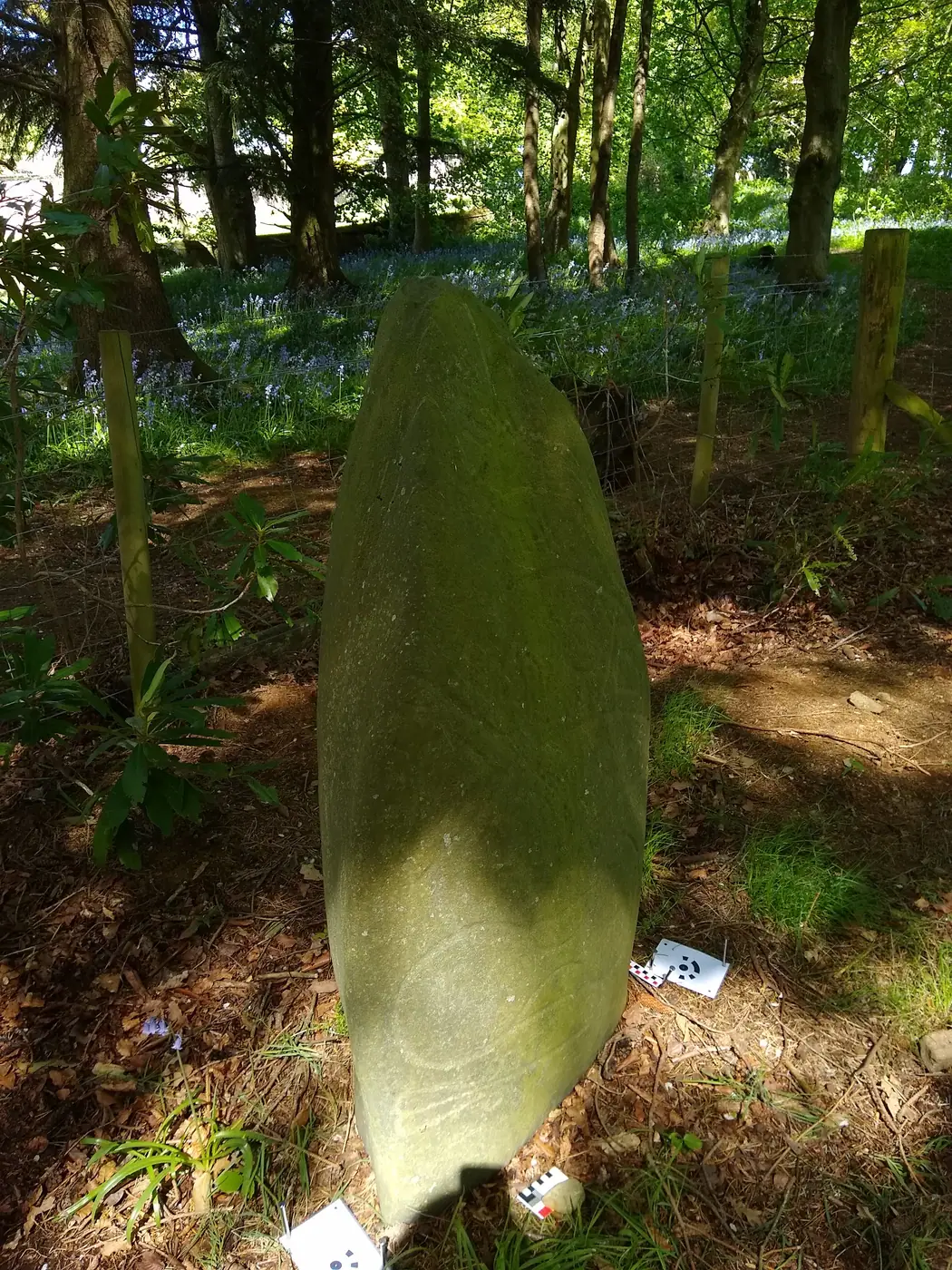
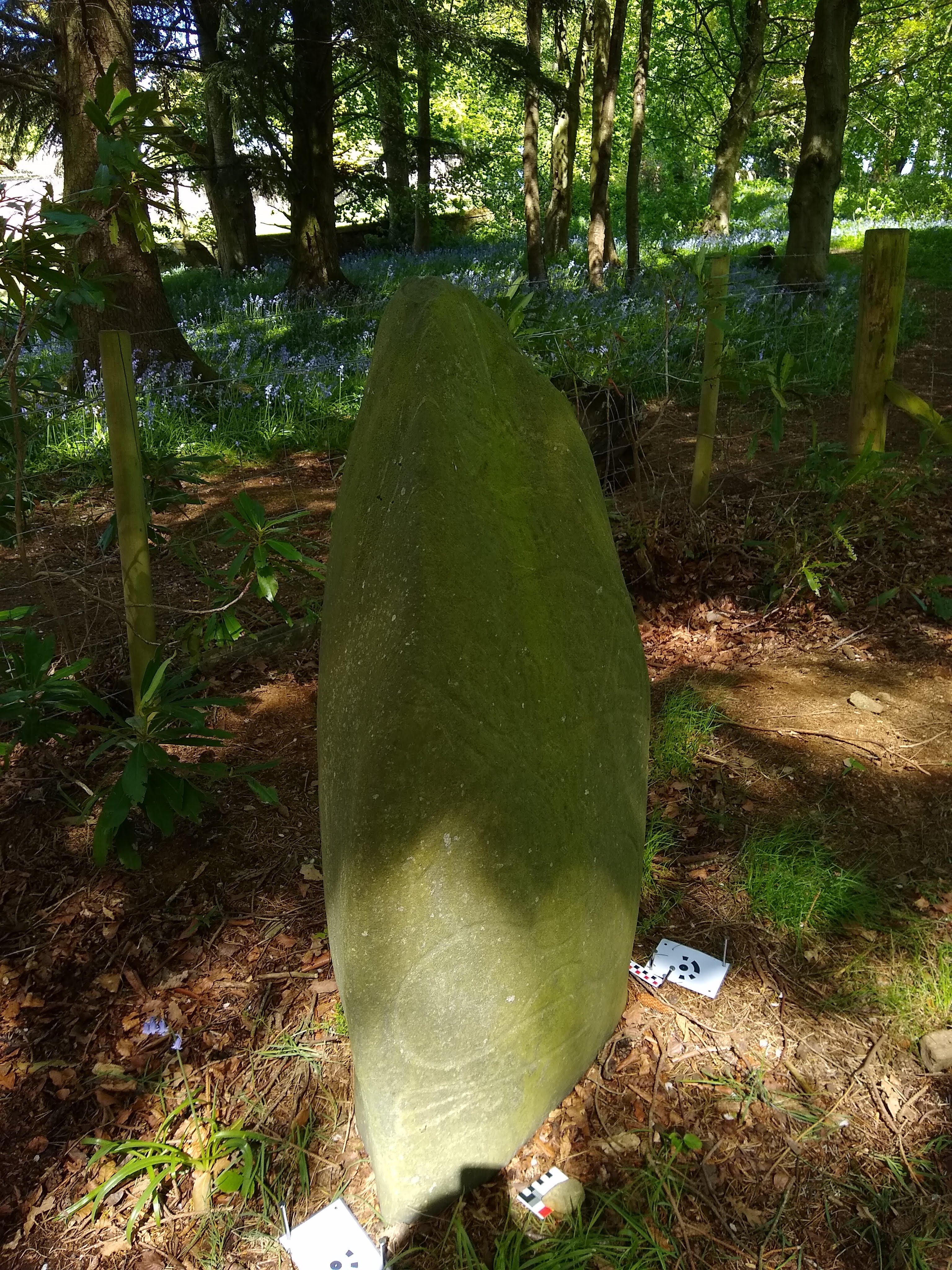
Discovery: First mentioned by J Stuart in 1856. This was one of four stones found lying on the ground on the Moor of Carden to the west of Logie Elphinstone House in or prior to about 1821. At that time the moor was planted and three of the stones were built into the enclosing wall, while the fourth (which is not known certainly to have been carved) was used as a floor slab in a kiln and ‘split by the heat and destroyed’ (Stuart 1856, 4). The three symbol stones were subsequently removed from the wall and erected in the house grounds (Forsyth 1996, 385).
Findspot: Chapel Of Garioch, Aberdeenshire, Scotland (National Grid Reference: NJ 7034 2588)
Last recorded location(s): Recorded on the grounds of Logie Elphinstone House, to the west of the house at NJ 7033 2588, on May 18th 2022.
Support
Trove 18855
Object type: Class I Pictish symbol stone
Material: Granite
Dimensions: H 1.37 × W 0.76 × D 0.45 m
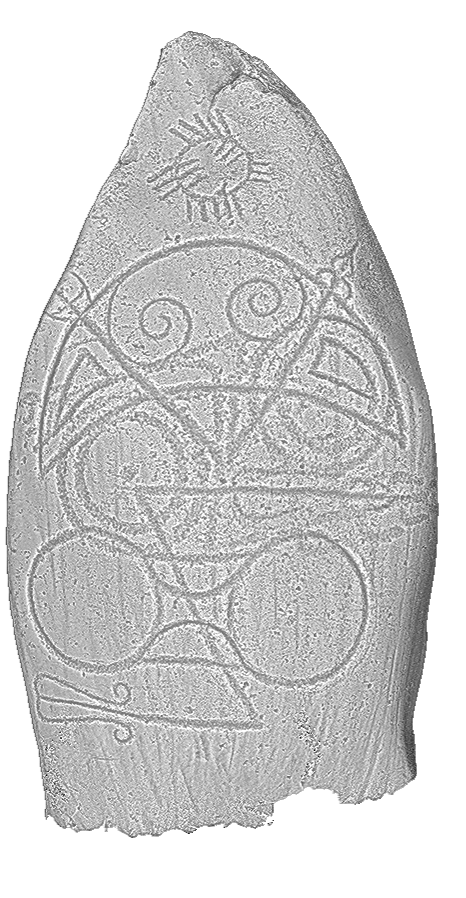
Decoration: The lower two-thirds are occupied by a pair of Pictish symbols, a ‘crescent-and-V-rod over double-disc-and-Z rod’ (Forsyth 1996, 390). The carving of the symbols is ‘broader, deeper, and smoother’ than the ogham carving, ‘but this may reflect nothing more than the larger scale of the former’ (Forsyth 1996, 391).
Condition: The monument is likely a prehistoric standing stone (blue granite) which was reused for the carving of Pictish symbols and an ogham inscription both of which are intact and well-preserved.
Inscription
Text field: The ogham inscription is cut on a circular stem in the middle of the top third of the pointed pillar. The reading starts from the 10 o’clock position, as this is where the largest gap is located, and continues clockwise (Forsyth 1996, 394).
Letters: The ogham inscription and symbols were pocked and rubbed smooth, a technique that is typical of Pictish Class I carvings (Forsyth 1996, 391). Strokes are generally evenly spaced and there are generous gaps between letters, though it is important to keep in mind the possibility of distortion due to the circular stem (Forsyth 1996, 396). The number of strokes per letter is accepted as: 5, 3, 3, 5, 3. The shortest letter strokes are 3cm long, the longest are 7cm, and the remainder vary between 4 and 6cm (Forsyth 1996, 393).
Edition
Ogham text: ᚊᚃᚈᚊᚒ
Transcription: QFTQU
Critical apparatus:
- According to Forsyth (1996, 398), the lack of vowels ‘strongly suggests that the sequence is either encoded, or has no linguistic significance’. 2. There are two ‘clearly artificial’ scores outside the stem beyond the first and third strokes of the second letter which might be intended as punctuation marks ‘added to differentiate group 2 from the strokes on either side’ (Forsyth 1996, 395).
Translation
Logie is the shortest complete monumental ogham text in Scotland and as such cannot be readily interpreted (Forsyth 1996, 398).
Commentary
The placement of the symbols suggests that the ogham was accounted for in the original design which further implies that the ogham relates to the same phase as the symbols, though it cannot be definitively proved. The stone is a palimpsest as there are visible remains of a partially-erased double-disc and Z-rod under the symbols; however, the overall layout strongly supports the assumption that the ogham relates to the second phase (Forsyth 1996, 391-392).
References
- Forsyth 1996, 385-401
- Stuart 1856, 4