Provenance
Discovery: First noticed by Sergeant Lyons in 1900. Recorded that ‘the stone had fallen from its erect position, and had lain on the ground until it was re-erected in the year 1861’ (Macalister 1945, 8-9). Mistakenly recorded by Macalister (1945, 8) and others to be in the neighbouring townland of Tullaghaun.
Findspot: Ballybeg (An Baile Beag), Co. Mayo, Ireland (ITM Coordinates: 553975, 775414)
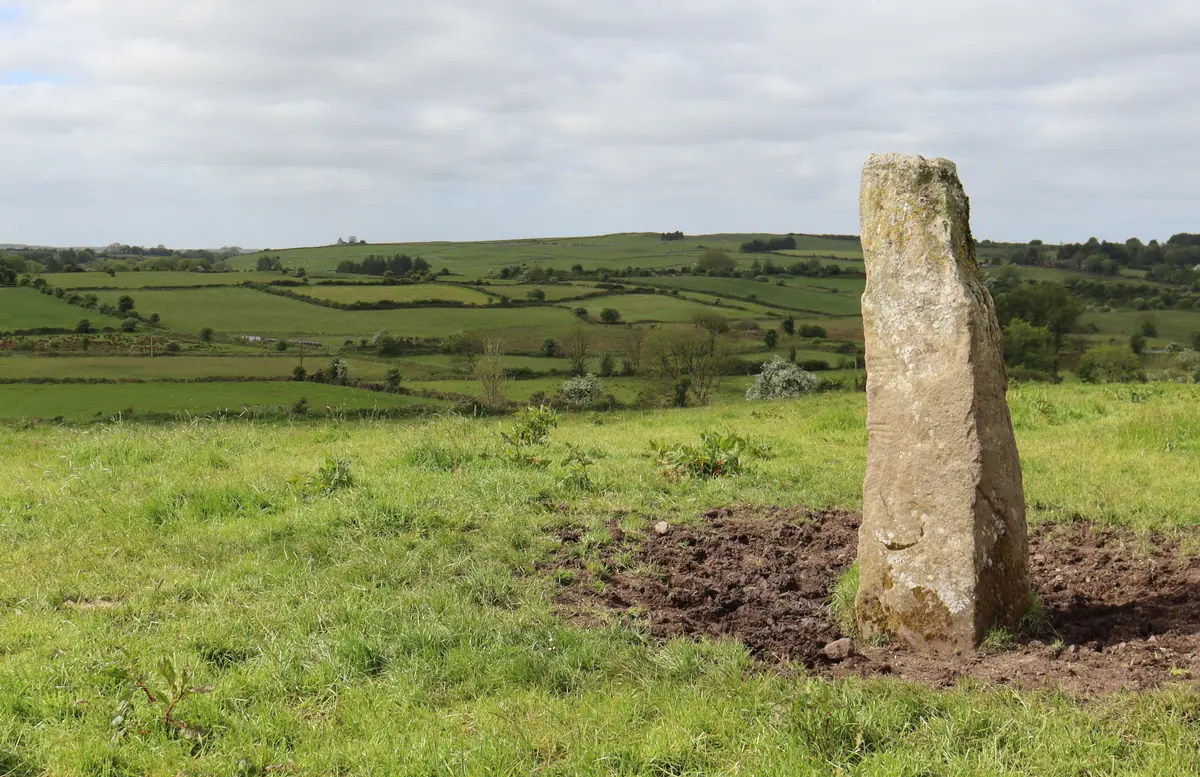
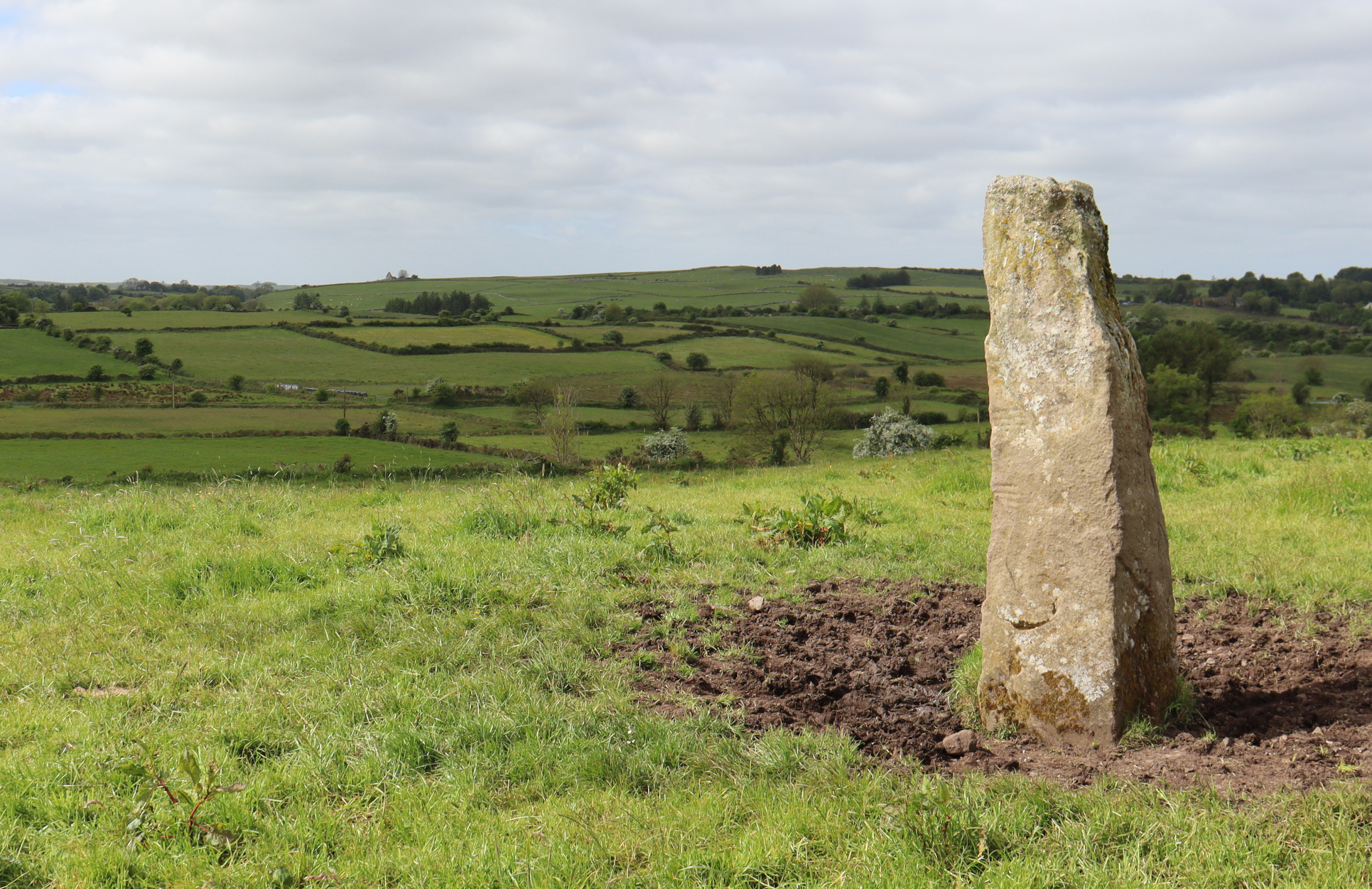
Last recorded location(s): In situ on a broad level terrace on a ridge. To the south of the stone, the ridge slope falls steeply, giving extensive views south-east to west across a broad valley. On the far side of the valley to the south-south-west, the horizon is defined by a high ridge, Kiltullagh Hill, on the summit of which a standing stone is visible, and to the east of that Killtullagh church. Both the ogham stone and the standing stone are located close to the Mayo/Roscommon border (Archaeological Survey of Ireland, Field Report 2017). Visited and 3D recorded as part of the Mayo Ogham project 2022, funded by The Heritage Council and Mayo County Council.
Support
National Monuments Service SMR ID: MA103-022----
Object type: Pillar
Dimensions: H 2.20 × W 0.57 × D 0.50 m
Condition: The ogham stone is roughly rectangular in profile and narrows towards the top. Sections of the inscription appear to have been damaged by flaking or abrasion of the stone surface, and in parts the sharpness of the corner has been somewhat rounded by use of the stone as a scratching post by farm stock (Archaeological Survey of Ireland, Field Report 2017). The inscription is also quite weathered and some characters are unclear due to damage. For example, Macalister (1945, 8-9) read the initial character as a Q but only 4 scores, at most are evident. Four of the expected five notches of the final I in the personal name survive. Although there is no trace on the stone, a final I in MAQI may have been lost, as suggested by Macalister (1945, 9).
Inscription
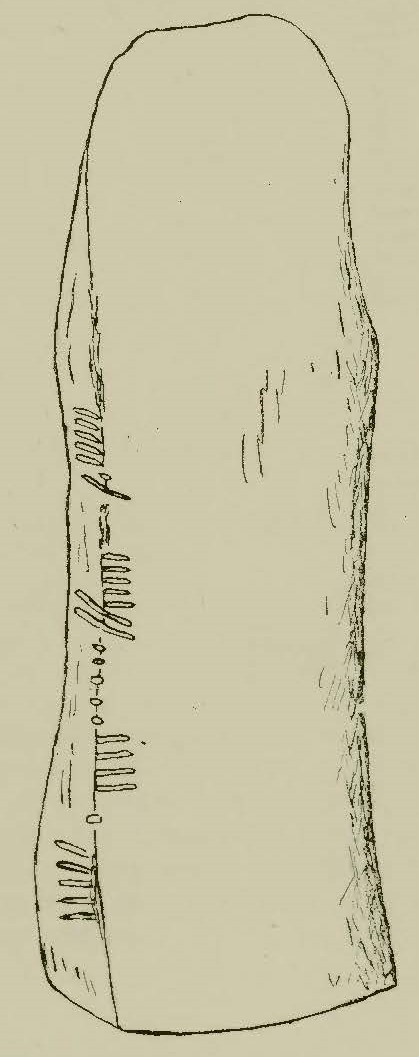
Text field: The ogham inscription is cut across the sharply right-angled south-east corner (reading up).
Letters: The pocked scores are large, broad and regularly spaced.
Edition
Ogham text: ᚉ̣[ᚐ]ᚄᚓ̣ᚌᚅᚔ ᚋᚐ̣ᚊ̣[ᚔ---
Transcription: C̣[A]SẸGNI MẠQ̣[I---]
Critical apparatus:
- Macalister (1945, 9) read: QASIGN[I] MAQ[I---]
Translation
of Caissíne, son of…
Commentary
Some letters read by Macalister (1945, 8) are not now clear, including the initial Q, which looks more like a C. However, there are traces of most of the notches of the final I in the personal name, which would later be something like Caissíne ‘little curly-haired one’ (cas ‘curly (haired)’ + diminutive -íne). Unfortunately, nothing remains of the father’s name.
References
- Macalister 1945, 8-9