Provenance
Discovery: First reported by Brash (1869, 260-264) that the ogham stone was unearthed by a farmer around 1851 in the course of potato cultivation in a rath/ringfort (Lisheenagreine ‘Little fort of the sun’ CO084-090001-) and is thought to have come from the souterrain (CO084-090002-) afterwards excavated in the interior by local historian, Rev. Lyons (Brash 1869c, 260-264; Power 1992, 125; O’Brien 2021, 47-49). McManus (2004, 11) notes that this stone was probably acquired for the UCC collection by Sir Bertram Windle in or around 1907.
Findspot: Garranes (An Garrán), Co. Cork, Ireland (ITM Coordinates: 547221, 563003)
Current repository: Ireland University College Cork (inv. no. 4)
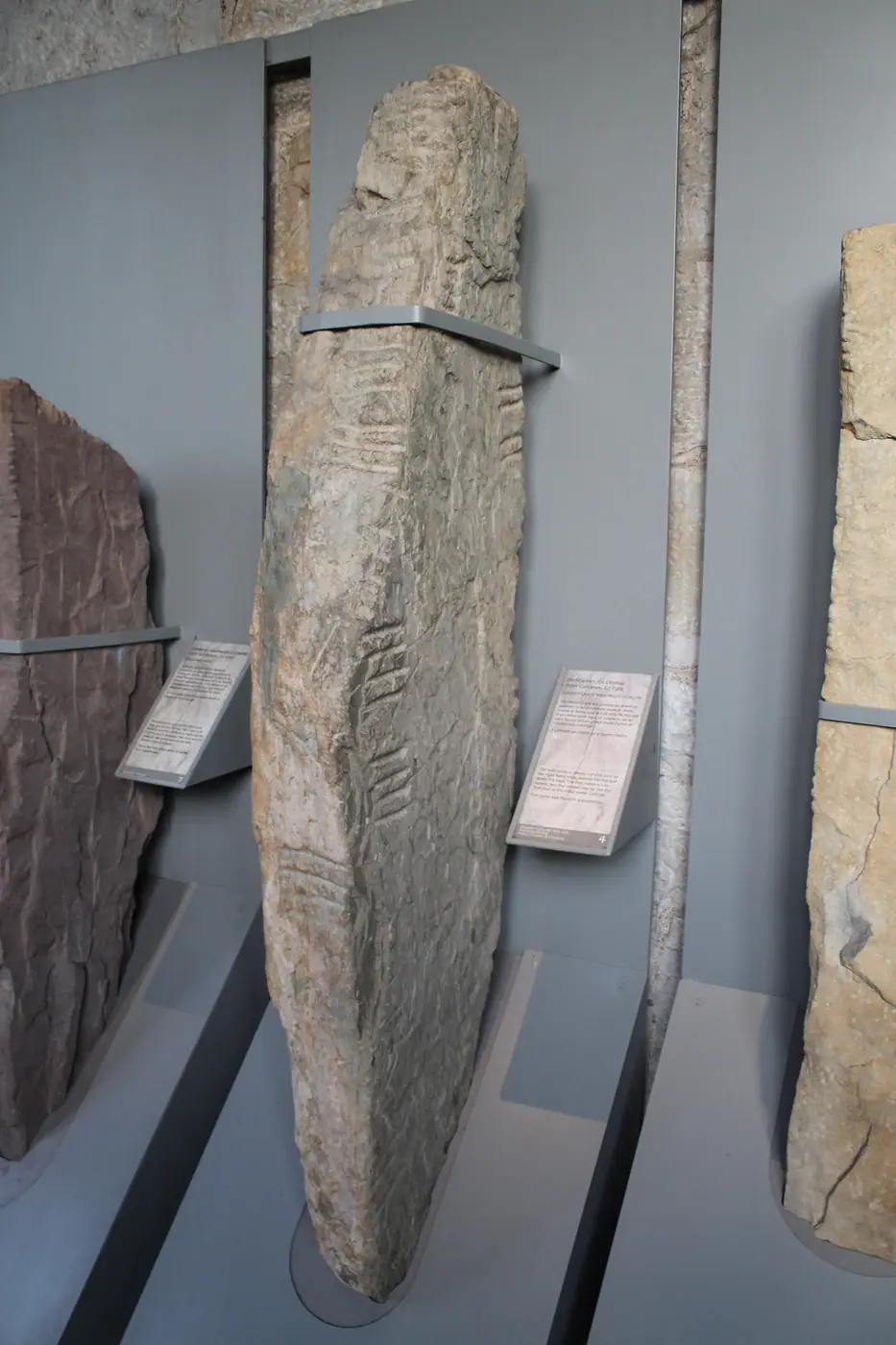
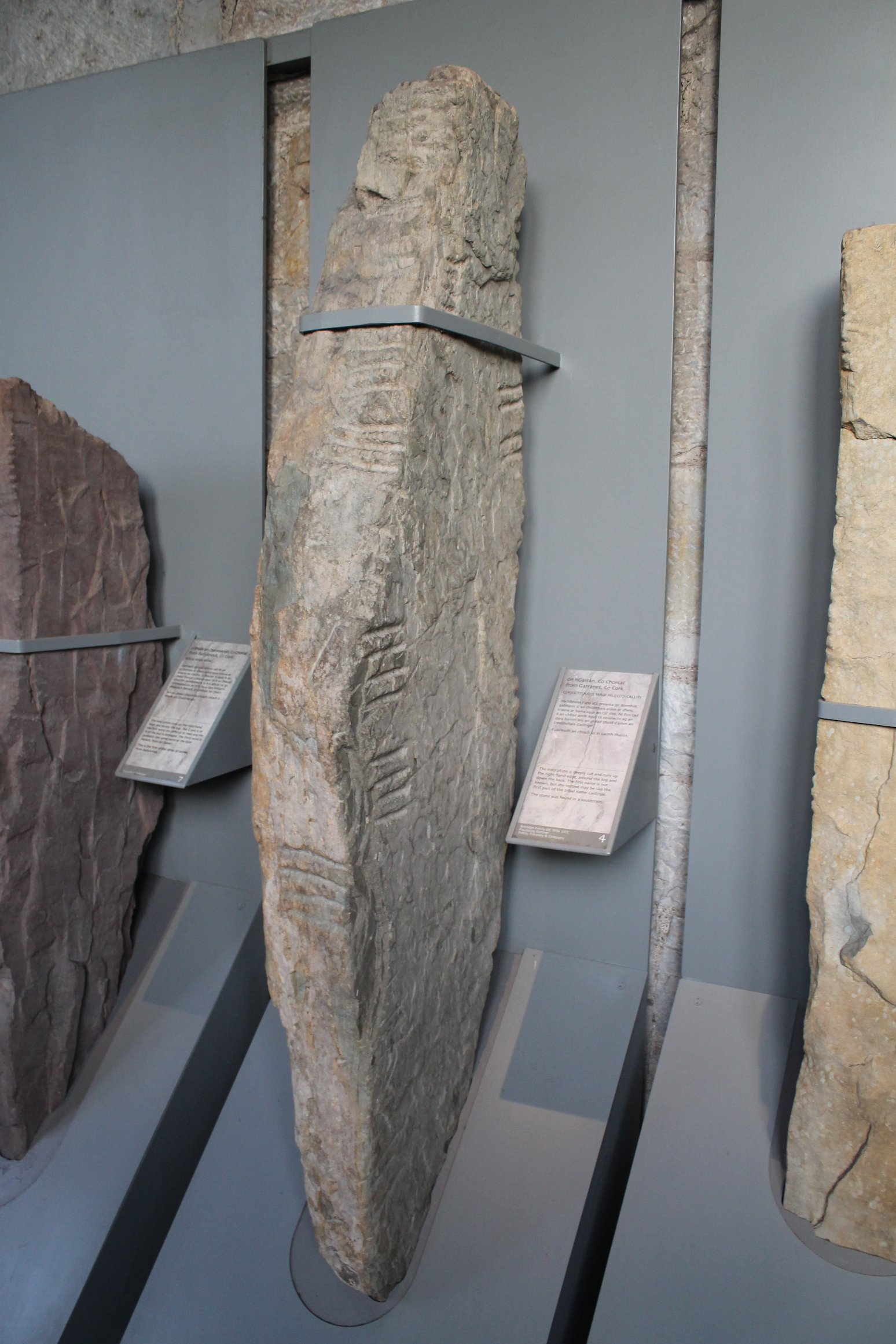
Last recorded location(s): Now on permanent display in the Stone Corridor (‘Rúin na gCloch / Stories in Stone’ exhibition), University College Cork, where it was examined and photographed for the OG(H)AM project in May 2024.
Support
National Monuments Service SMR ID: CO084-090003-
Object type: Pillar
Material: Sandstone
Dimensions: H 1.75 × W 0.50 × D 0.20 m
Condition: An irregularly-shaped pillar, seemingly reused in a souterrain and damaged in places, particularly the vulnerable edges. According to Macalister (1945, 84), the height of the stone was 1.75m (5 ft. 9 in.) but only 1.57m (5ft. 1.8in.) are currently accessible. All of the ogham stones in the UCC collection underwent conservation in 2006. The stones are currently in display cases and held in position by brackets.
Inscription
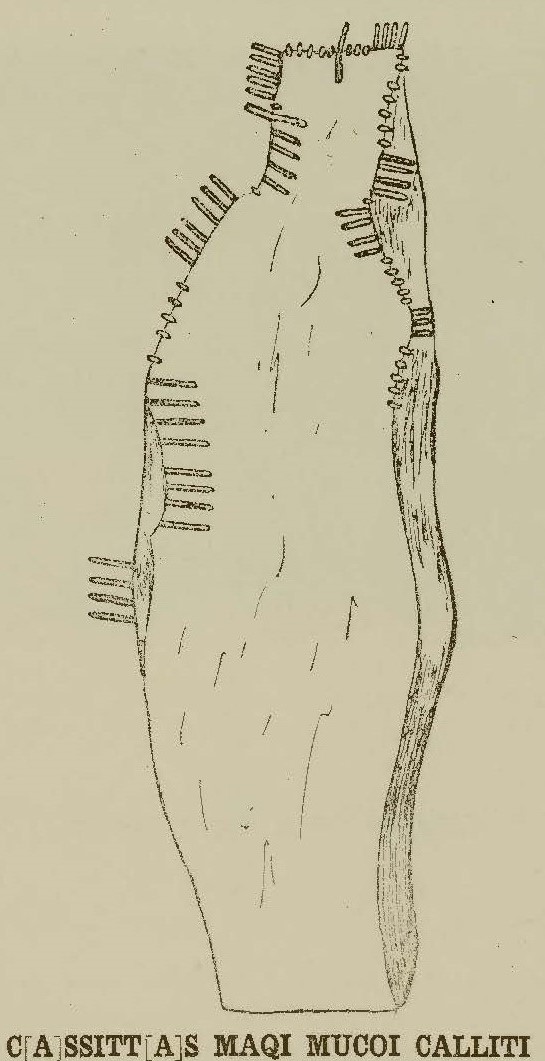
Text field: The inscription begins at roughly 0.75m from the bottom of one angle, runs over the top, and ends approximately 0.90m from the bottom of the adjacent angle.
Letters: The inscription is pocked and rubbed in bold, deep strokes. The vowel notches are quite large, especially towards the end of the inscription.
Edition
Ogham text: ᚉ[ᚐ]ᚄᚄᚔᚈᚈ[ᚐ]ᚄ ᚋᚐᚊᚔ ᚋᚒᚉᚑ
Transcription: C[A]SSITT[A]S MAQI MUCOI CALLITI
Critical apparatus:
- Although the M is damaged and only 3 or 4 of the I-strokes of MAQI survive, the reading is not really in doubt. Likewise, regarding the final I of MUCOI where only 4 vowel notches survive. In the same word, the uncommented CO of Macalister’s reading is no longer evident.
Commentary
McManus (2004, 15, no. 4) is generally in agreement with Macalister’s reading of the inscription but notes that the first name could end in -AS or -OS. He also suggests that the kin group name (MUCOI CALLITI) may correspond to the first element in the kin group Cailtrige.
O’Brien (2021, 212) notes that ‘Edel Bhreathnach (2013, 163) identifies the MUCOI CALLITI here with Clann Laoghaire, additionally known, according to the Book of Leinster, the Book of Ballymote and the Book of Lecan, as Ceinéal Caollaidhe (O’Brien 1976, 218), a sept of Eoghanachta, who descended from Caoillaidhe mac Conaill. This Caoillaidhe mac Conaill is reputed to have been the grandson of Nadfroích, a progenitor of many of Eoghanachta dynasties, and supposed brother of Cas, from whom Uí Eachach Mumhan derive (O’Brien 1976, 195-6)’.
References
- Brash 1869, 260-264
- Macalister 1945, 83-84, no. 81
- McManus 2004, 11, 15, no. 4
- O’Brien and Hogan 2021, 47-49, 212
- Power 1932, 25
- Power, Byrne, Egan, Lane, and Sleeman 1992, 125, no. 1037