Provenance
Discovery: Discovered in the NW quadrant of a large rath or ringfort (CO055-007001-) at Castle farm (also site of Ballyknock castle CO055-007004-). According to Barry (1891, 522), this roofing flag was ‘fourth south of the NW angle’ of the souterrain (CO055-007003-) where fourteen other ogham stones were also found (I-COR-031 - I-COR-045), all but one (I-COR-031) acting as lintels. A high percentage of ogham stones in Ireland are found reused in souterrains, particularly in Co. Cork but this is the highest number from a single souterrain.
Findspot: Ballyknock North (Baile an Chamhaicigh Thuaidh), Co. Cork, Ireland (ITM Coordinates: 594327, 586954)
Current repository: Ireland University College Cork (inv. no. 18)
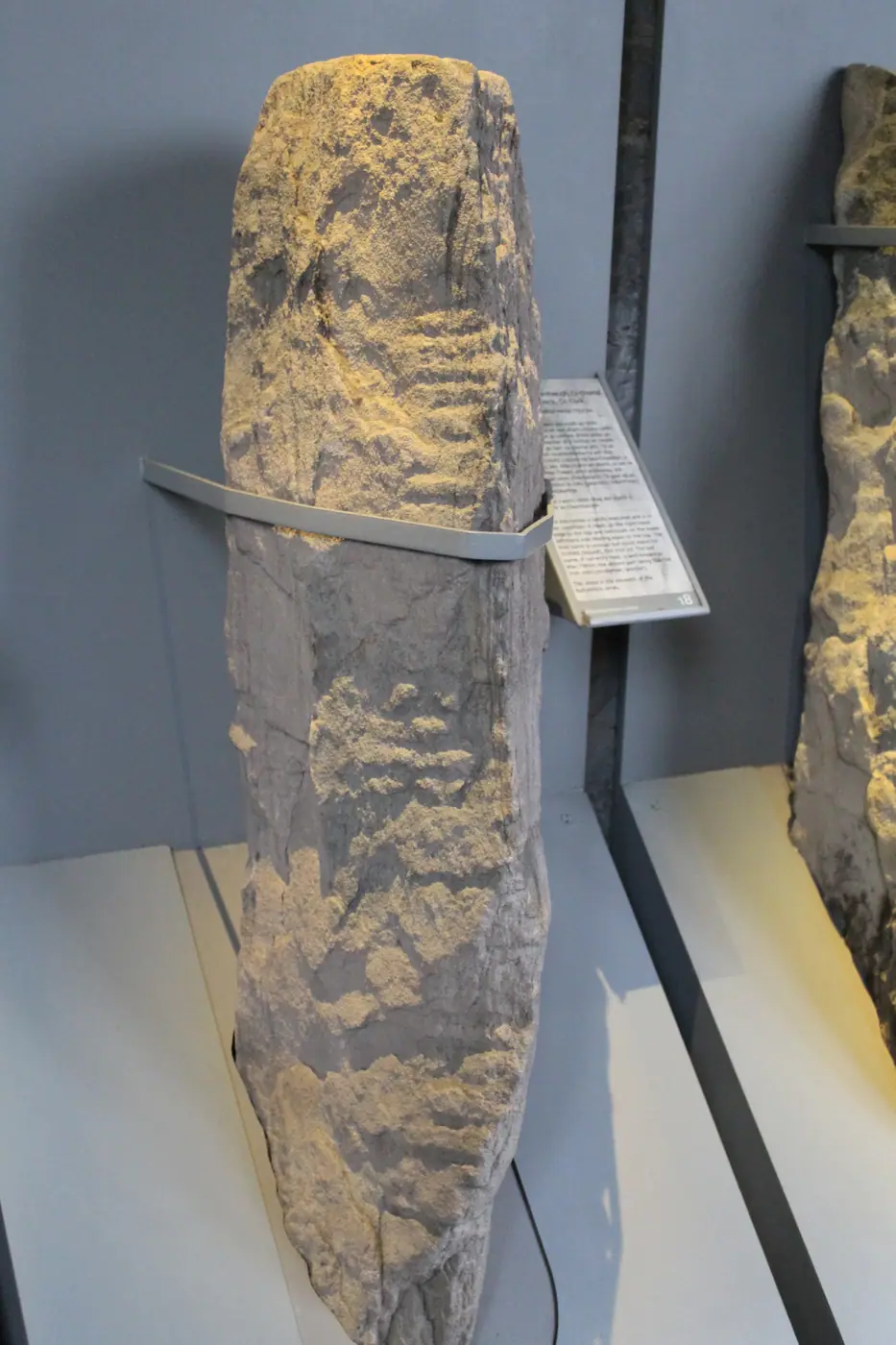
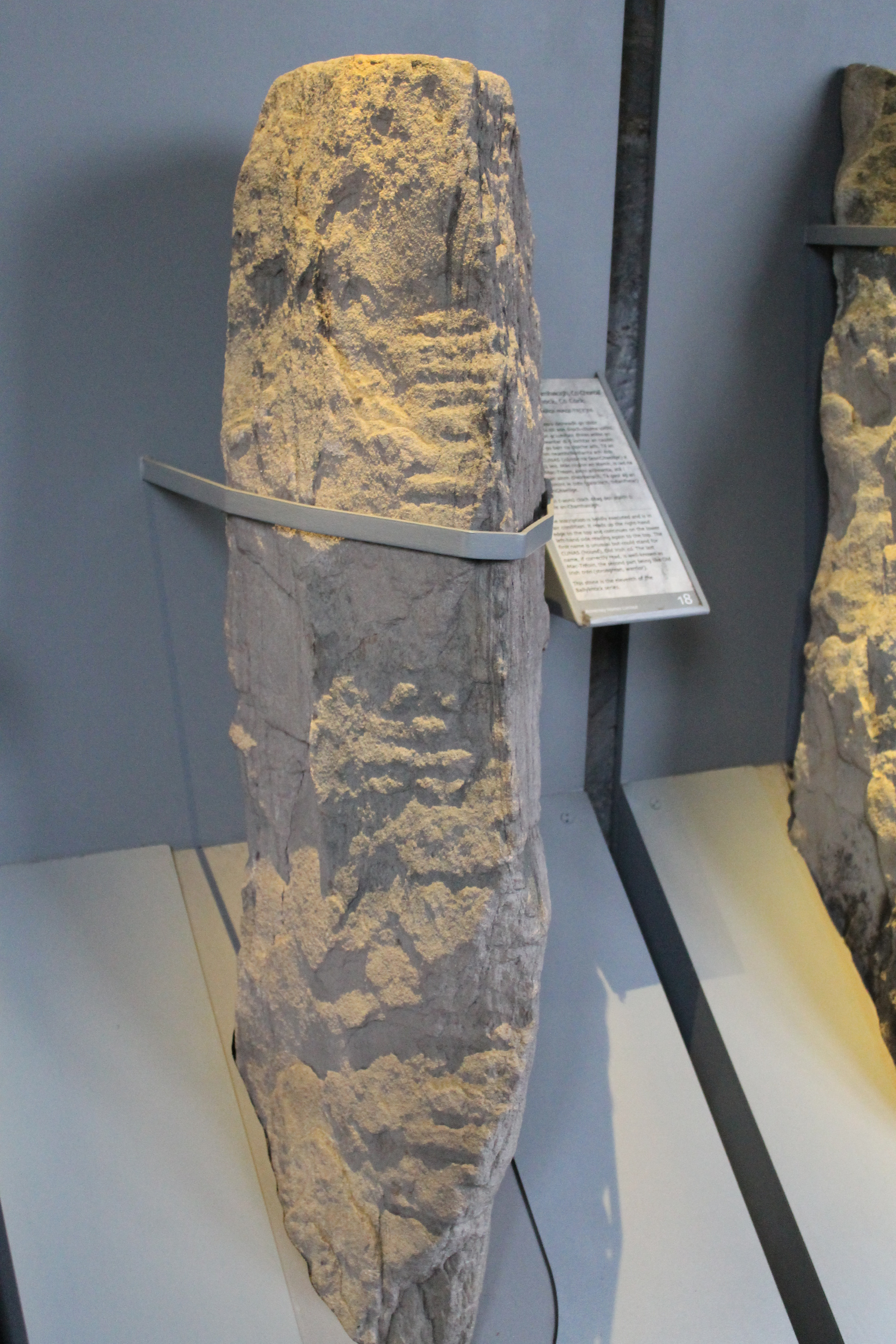
Last recorded location(s): The stone is currently on permanent display in the Stone Corridor (‘Rúin na gCloch / Stories in Stone’ exhibition), University College Cork, where it was examined and photographed for the OG(H)AM project in May 2024.
Support
National Monuments Service SMR ID: CO055-007008-
Object type: Pillar
Material: Sandstone
Dimensions: H 1.35 × W 0.34 × D 0.23 m
Condition: Reused in a souterrain and ‘chipped here and there, but in fair condition’ (Macalister 1945, 86). Barry (1891, 522) noted that the stone was 1.35m (53 in.) in height, tapering in width from top to bottom. All of the ogham stones in the UCC collection underwent conservation in 2006. The stones are currently in display cases and held in position by brackets. The current visible extent above the display case is 1.09m (3ft. 7in.).
Inscription
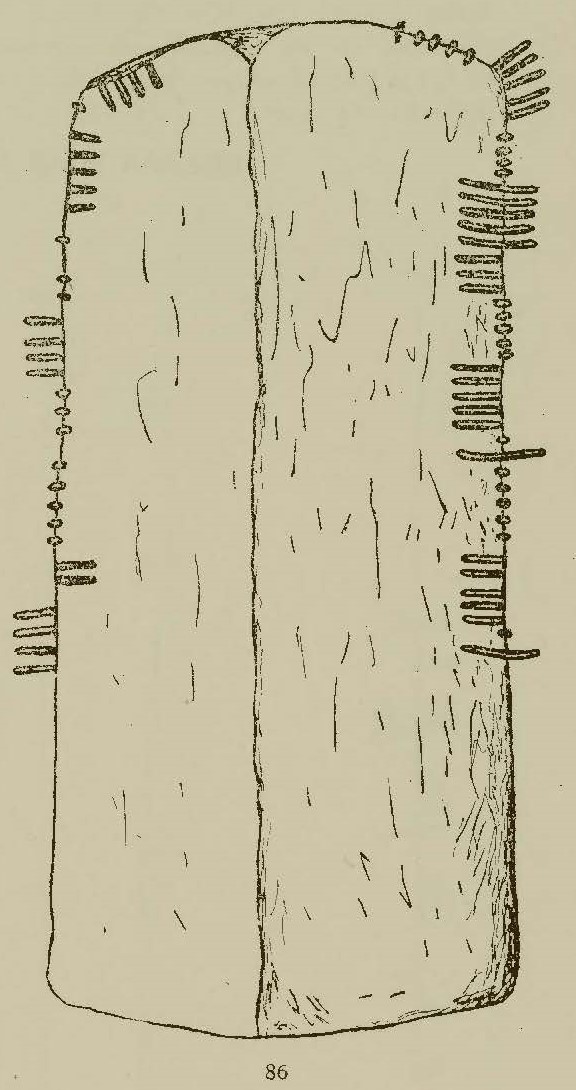
Text field: The inscription is on two angles (up-up), not adjacent, but diametrically opposite. The first begins 0.43m (17in.) from the bottom and ends 0.06m (2.5in.) from the top. The second begins 0.41m (16in.) from the bottom and turns to the left at the top for the final vowel (Barry 1891, 522).
Letters: The inscription is pocked in bold strokes. The first M is quite straight rather than sloped.
Edition
Ogham text: ᚉ
Transcription: CLIUCOANAS MAQI MAQITRẸṆ[I]
Critical apparatus:
- As suggested by McManus (2004, 19), the OA of the first name should perhaps be read as U, giving -CUNAS, the familiar gen. sg. of the word for ‘hound’ (OIr. cú, gen. con). 2. Macalister (1945, 86) stated: ‘The last word is not so clear as the rest, as its notches are lost in the rather wide cleavage planes of the stratification’.
Translation
of C son of Mac-Thréuin
Commentary
With regard to the first name, Ziegler (1994, 149-150) suggested a first element clíu. This word has been used as a territorial name (e.g. Clíu, a large area encompassing much of south-west Tipperary and into east Limerick, attested in the population group names Araid Cliach and Airthir Cliach and in an old name for the Galtee mountains Crotta Cliach, ‘the harps of Cliú’ (Hogan 1910, 248–249; O’Brien 1962, 208–209).
The compound name MAQAS-TRENI is attested elsewhere in the ogham corpus (in I-COR-007 Ballynabortagh 3, Co. Cork and in Wales: W-BRE-006 Llywell and W-PEM-004 Cillgerran). The word TREN- (Old Irish trén ‘strong’) is also found in other names, for example NETTA-TTRENALUGOS (I-COR-071) from Montaggart, Co. Cork and TRENAGUSU (W-PEM-004) from Cilgerran in Pembrokeshire. As noted by Moore (Ronan 2009, 152), the single-element name Trén ‘occurs in the Eôganacht, UÍ Liathǽin and Corco Loígde genealogies of Munster and it is interesting to speculate that the ogham evidence may indicate a link between Wales and Cork in the 5th-6th centuries’ AD.
References
- Barry 1891, 514-535
- Macalister 1945, 86, no. 86
- Power and et al. 1994, no. 4219
- Ziegler 1994, 149-150, 238-239
- McManus 2004, 19, no. 18