Provenance
Discovery: Discovered in 1846 by Cork antiquarians Windele, Abell, and Hawkes in a souterrain (CO085-067002-) in the SW quadrant of a ringfort (CO085-067001-), with five other ogham stones: I-COR-046, I-COR-048, I-COR-049, I-COR-050 and I-COR-051. In 1849 Windele removed five of the stones, including this one, to his own residence (Blair’s Castle, Cork) but they were later moved to the museum of the Royal Irish Academy (Brash 1879, 140; Macalister 1945, 92-93).
Findspot: Ballyhank (Baile Sheanc), Co. Cork, Ireland (ITM Coordinates: 557971, 564534)
Current repository: Ireland National Museum of Ireland (inv. no. 1872.25)
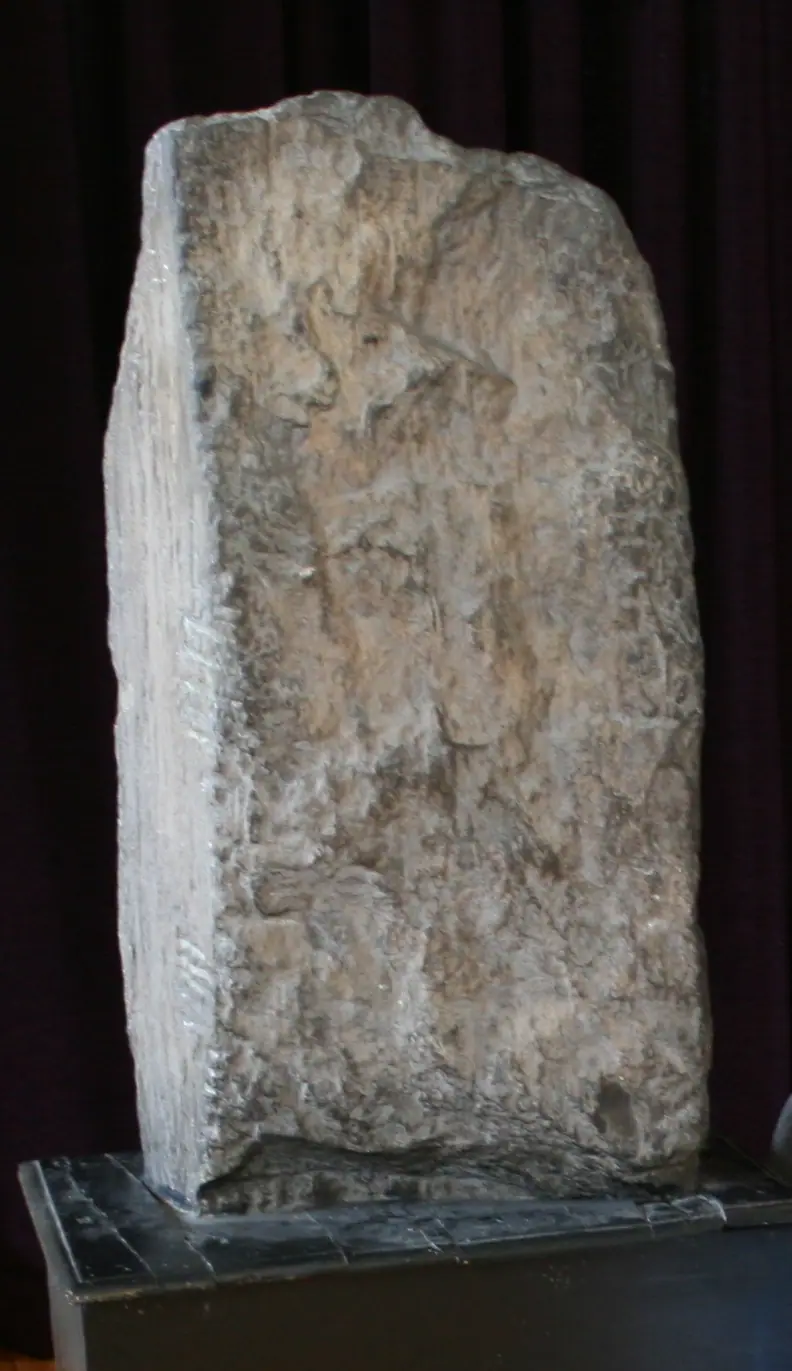
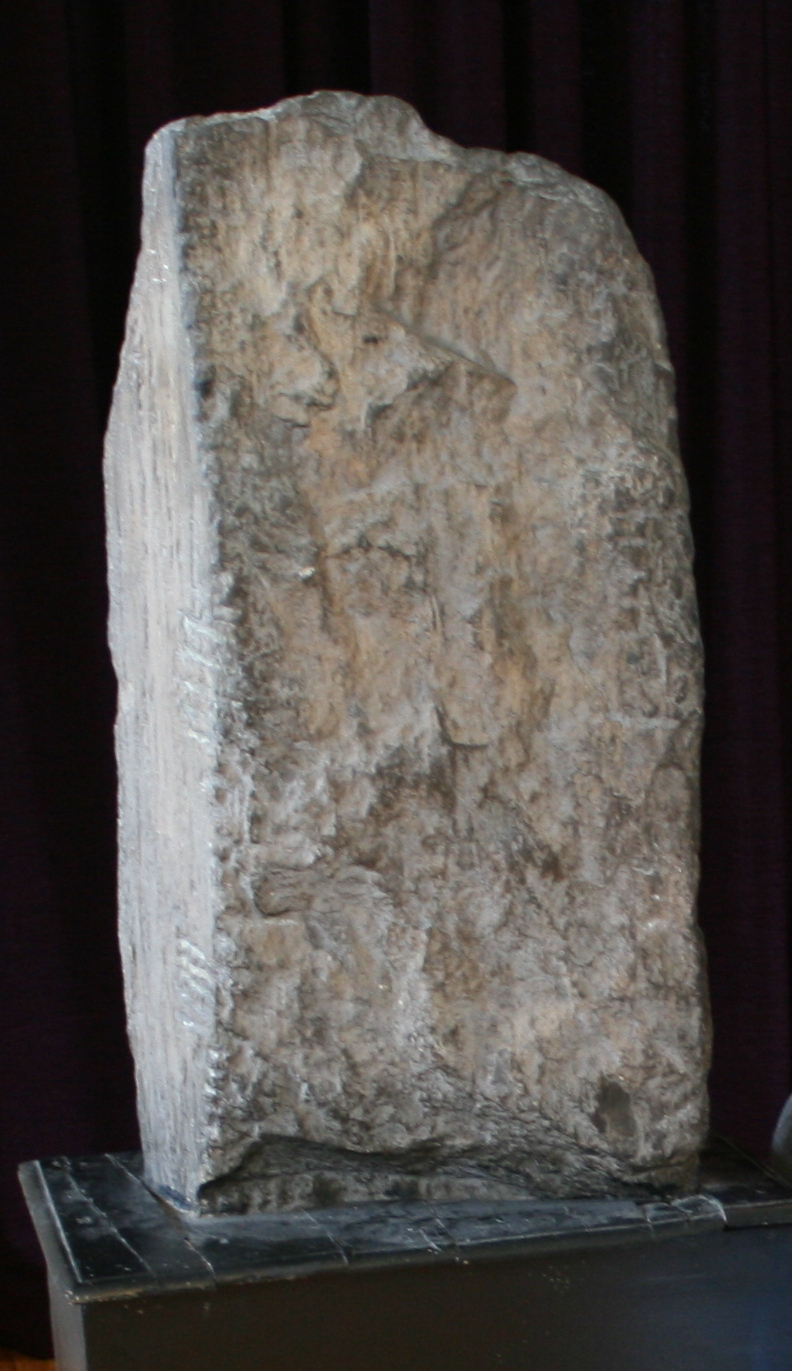
Last recorded location(s): All six stones from Ballyhank are now in the collection of the National Museum of Ireland. This stone is on loan to Músaem Chorca Dhuibhne in Ballyferriter, Co. Kerry, where it was recorded in 3d in collaboration with the Discovery Programme in 2013 as part of the Ogham in 3D project.
Support
National Monuments Service SMR ID: CO085-067004-
Object type: Pillar
Material: Sandstone
Dimensions: H 0.90 × W 0.40 × D 0.20 m
Condition: Reused as a lintel in a souterrain, this fine-grained sandstone pillar is quite broken and damaged, especially the inscribed edges. According to Brash (1879, 142) it was a ‘rough unshapely slab’ of 1.33m in length (4 ft. 4.5 in) when he saw it at Windele’s residence. Macalister (1945, 96) recorded the height as 1.22m (4 ft.) but the current extent above the display stand is 0.90m (3ft. 5in.).
Inscription
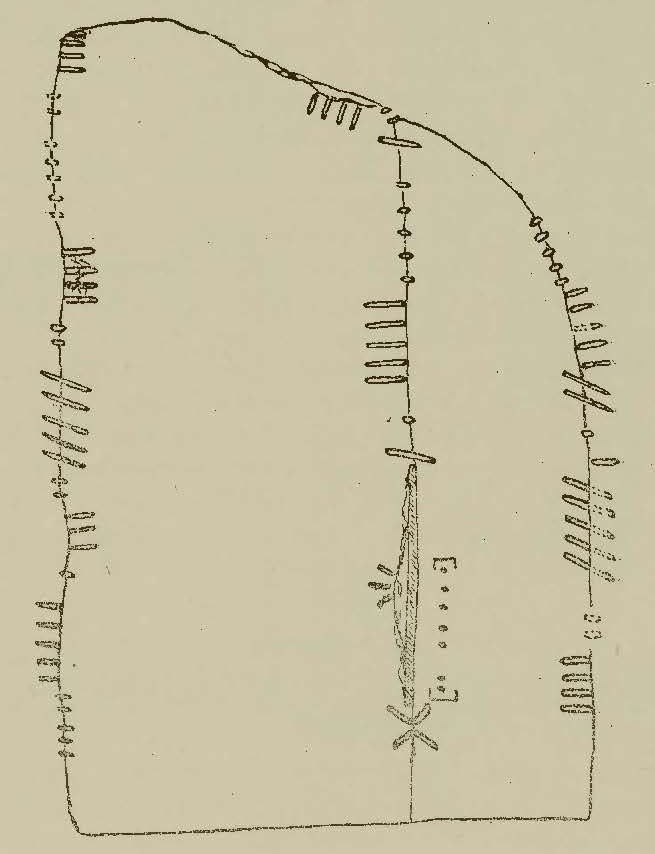
Text field: The inscription is on three angles of the stone (up-up-down), apparantly starting on the right edge of one of the faces and, as described by Macalister (1945, 95), running ‘round the circumference of the stone clockwise, not counter-clockwise, which is more usual’.
Letters: The inscription is coarsely pocked in bold strokes. Macalister (1945, 95) noted regarding the second line that ‘about the middle of the spalled surface there appear the distal ends of three scores, diverging outward, cut in fine lines’. These are not at all evident on the stone or 3d model. The X-forfid is used, probably with its consonantal value in the formula word KOI ‘here’.
Edition
Ogham text: ᚉᚑ̣ᚏᚁᚐᚌᚅᚔ̣ ᚕ
Transcription: CỌRBAGNỊ K[OI] M[A]Q[I] MỌC̣C̣OI C̣OROṬANI
Critical apparatus:
- Although some vowels are damaged in the intial name, there isn’t really any doubt as to what was intended. Three of the final I strokes survive at the top of the stone. 2. There is more extensive damage to the second angle but there is enough space after the K for OI.
Translation
of Corbán here, a son of …?
Commentary
The personal name CORBAGNI (later Corbán, corbbaid ‘defiles’) is also attested on I-KER-116 Rockfield IV, Co. Kerry.
The fact that the endings (-AGNI, -I) are intact in both personal names would suggest a possible pre-6th century date (McManus 1991, 97).
References
- Brash 1879, 140,142-143
- Macalister 1945, 92-93, 94-96
- McManus 1991, 66, 97
- Power, Byrne, Egan, Lane, and Sleeman 1997, no. 7949