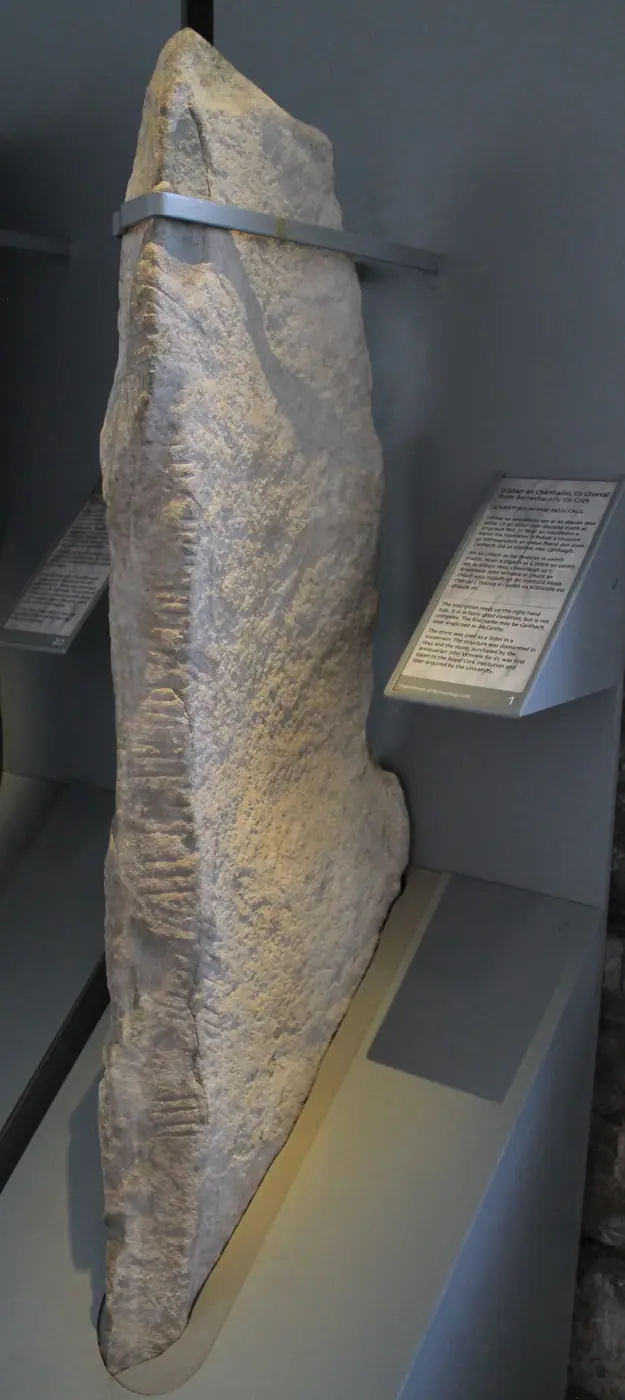
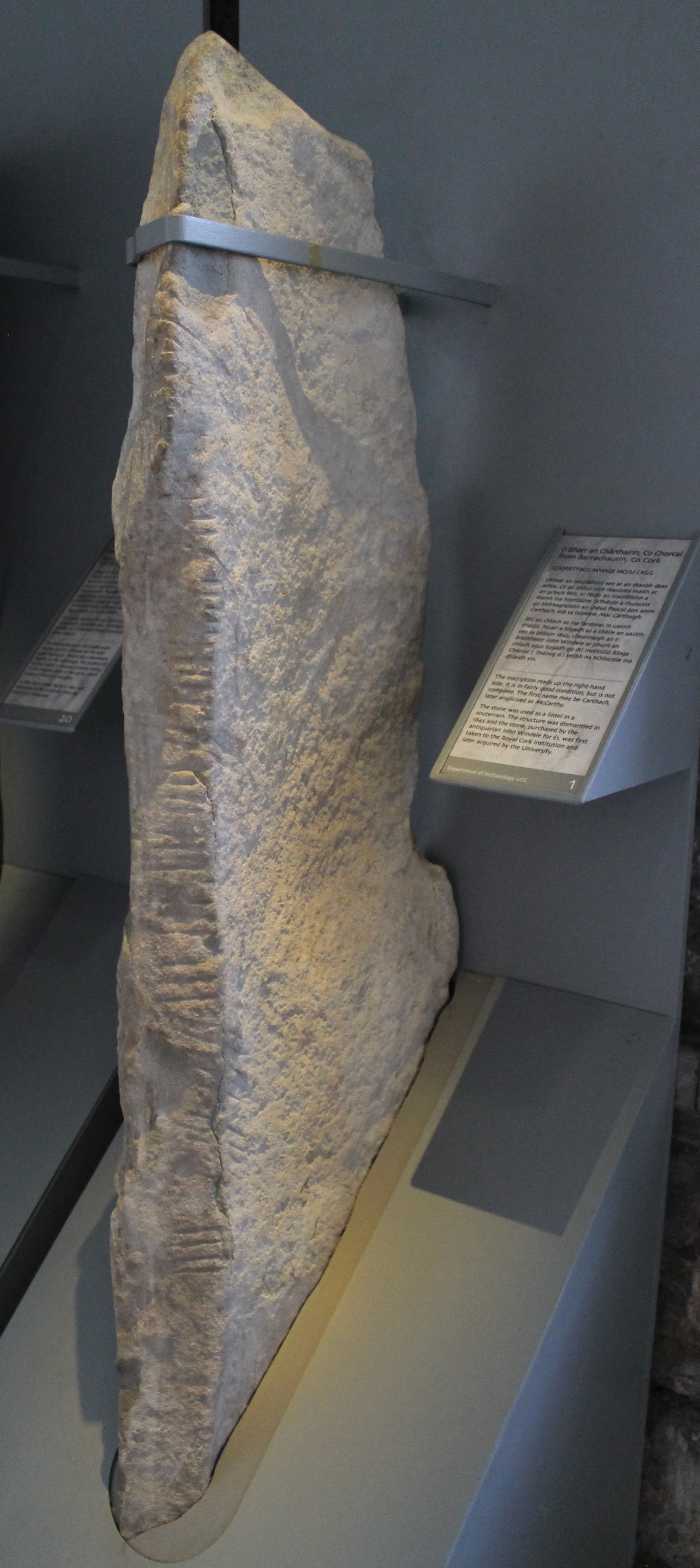
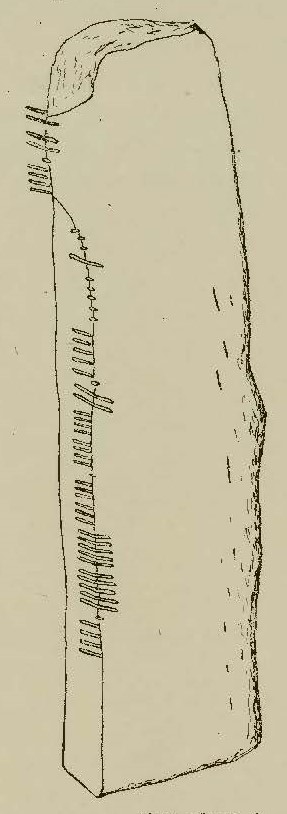
Provenance
Discovery: Discovered when a souterrain (CO050-045002-) was uncovered in a ringfort (CO050-045001-). The souterrain was dismantled in 1845 (during the Great Famine in Ireland) when the ringfort it was in was cultivated as a cabbage-garden; apparently a number of lintels were raised and ‘laid on the rampart of the fort for subsequent disposal’, however one bearing an ogham inscription was carried off by night and sold to the antiquarian John Windele for £1 (Macalister 1945, 102-103).
Findspot: Barrahaurin (Barr an Chárthainn), Co. Cork, Ireland (ITM Coordinates: 544112, 583414)
Current repository: Ireland University College Cork (inv. no. 1)
Last recorded location(s): Now on permanent display in the Stone Corridor (‘Rúin na gCloch / Stories in Stone’ exhibition), University College Cork, where it was examined for the OG(H)AM project in May 2024.
Support
National Monuments Service SMR ID: CO050-045003-
Object type: Pillar
Material: Sandstone
Dimensions: H 1.30 × W 0.42 × D 0.12 m
Condition: Reused as a lintel in a souterrain. Macalister (1945, 103) noted damage to the end of the inscription. According to Macalister (1945, 102), the height of the stone was 1.42m (4ft. 8in.) but only 1.30m is currently accessible. All of the ogham stones in the UCC collection underwent conservation in 2006. The stones are currently in display cases and held in position by brackets.
Inscription
Text field: The inscription commences 0.38m (15in.) from the base and runs up one angle of the stone (Macalister 1945, 102).
Letters: The inscription is comprised of ‘finely cut’ strokes (Macalister 1945, 102).
Edition
Ogham text: ᚉ[ᚐ]ᚏᚏᚈᚈᚐᚉᚉ ᚋᚋᚐᚊᚔ ᚋᚒ vac.
Transcription: C[A]RRTTACC MMAQI MU vac. CAGG[I(?)---]
Critical apparatus:
- Macalister (1945, 102) read: CARRTTACC GAQI MU CAGG[I] but the second word was rightly read as MMAQI by McManus (2004, 14). 2. Macalister (1945, 102) commented that the third U stroke is slightly larger than the first two, ‘but not sufficiently so to make it into a consonant’ stroke (H). He also noted that ‘between MU and CAGGI there is a blank space of 2 inches’ (approx. 6cm), although this could be due to an uneven arris at this point.
Translation
of Carthach son of ?
Commentary
The inscription appears to commemorate an individual named Carthach (anglicised in the surname (Mc)Carthy). It is unclear here if MU is short for the formula word MUCOI ‘descendant/offspring’ or the possessive (mo) ‘my’, which is later quite commonly used with personal names in a hypocoristic form or pet name (especially clerical names, e.g. Mo Chuta, hypocoristic form of Carthach). CAGG[I], which may be incomplete, appears to be the same element found in NETA-CAGI ‘champion of C?’ from Casteltimon in Co. Wicklow (I-WIC-001), but has not been identified in the later manuscript tradition (McManus 2004, 14). This inscription is a good example of the doubling of consonants sometimes found in ogham (see Harvey 1987), although the doubling of the initial M of MAQI may be unique, or at least very rare.
References
- Harvey 1987, 45-71
- Macalister 1945, 102-103, no. 103
- McManus 1991, 65
- McManus 2004, 14-15, no. 1
- Power and et al. 1994, no. 7954