Provenance
Discovery: In the first half of the 19th century, this ogham-inscribed slab was found below ground-level near St Mary’s Church but outside the graveyard. It was taken first to Gardie House in Bressay, and thence to a churchyard about a mile to the south of Gardie House. In 1852 it was sent to Newcastle for exhibition, returned to Bressay and in 1864 presented to National Museum of Antiquities of Scotland (Allen and Anderson 1903, 5-6). The ogham was first published by Dr Charles Graves (1853, 248-249) in 1853.
Findspot: Bressay, Shetland, Scotland (National Grid Reference: HU 521 423)
Current repository: Scotland National Museums of Scotland (inv. no. IB109)
Last recorded location(s): Now in the National Museums of Scotland. Recorded by OG(H)AM in November 2021 and supplementary photos in June 2022.
Support
Trove 1279
Object type: Cross-slab
Material: Chlorite schist
Dimensions: H 1.22 × W 0.27 × D 0.06 m
Decoration: The Bressay slab is sculpted on its broad faces with low and false relief decoration. Both sides of the Bressay slab are highly decorated and exhibit crosses. The side of the slab considered as the ‘front’ features a larger cross, a single lion and a single horseman.
Condition: The slab is complete and in good condition. The ogham inscription is intact, clear, and well-preserved (Forsyth 1996, 119).
Inscription
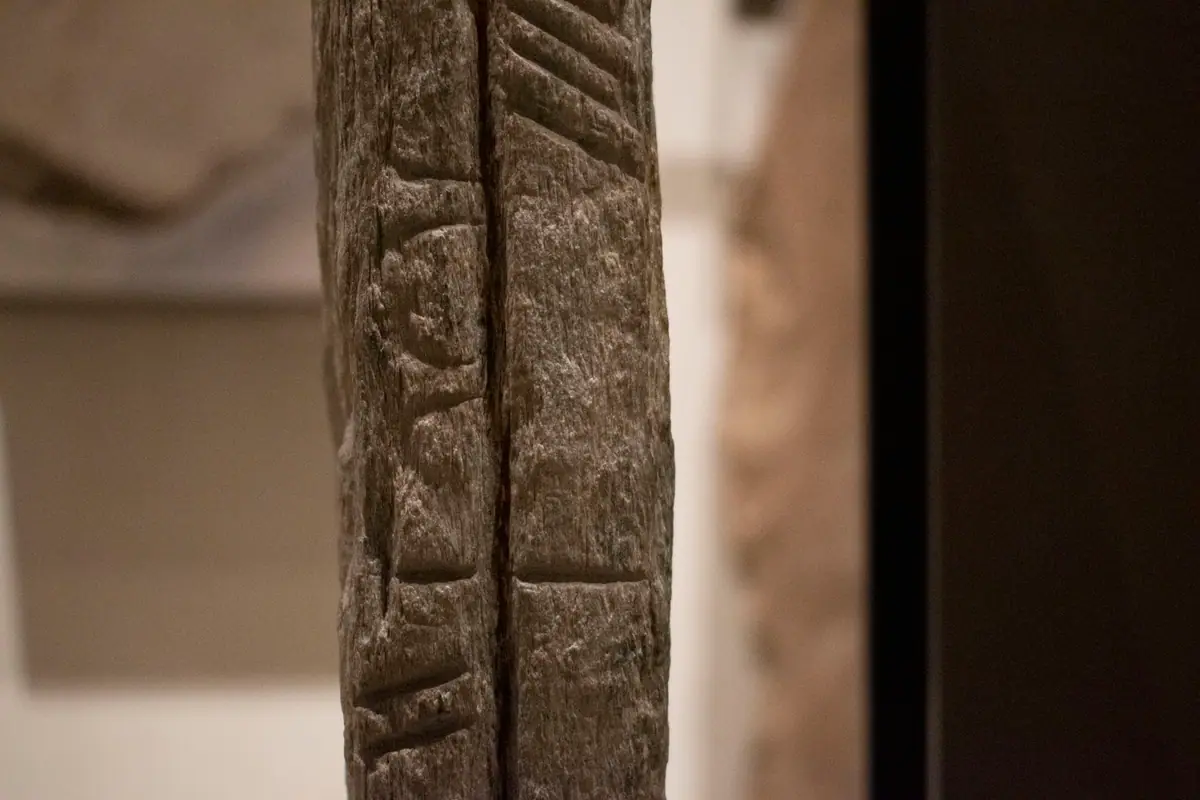
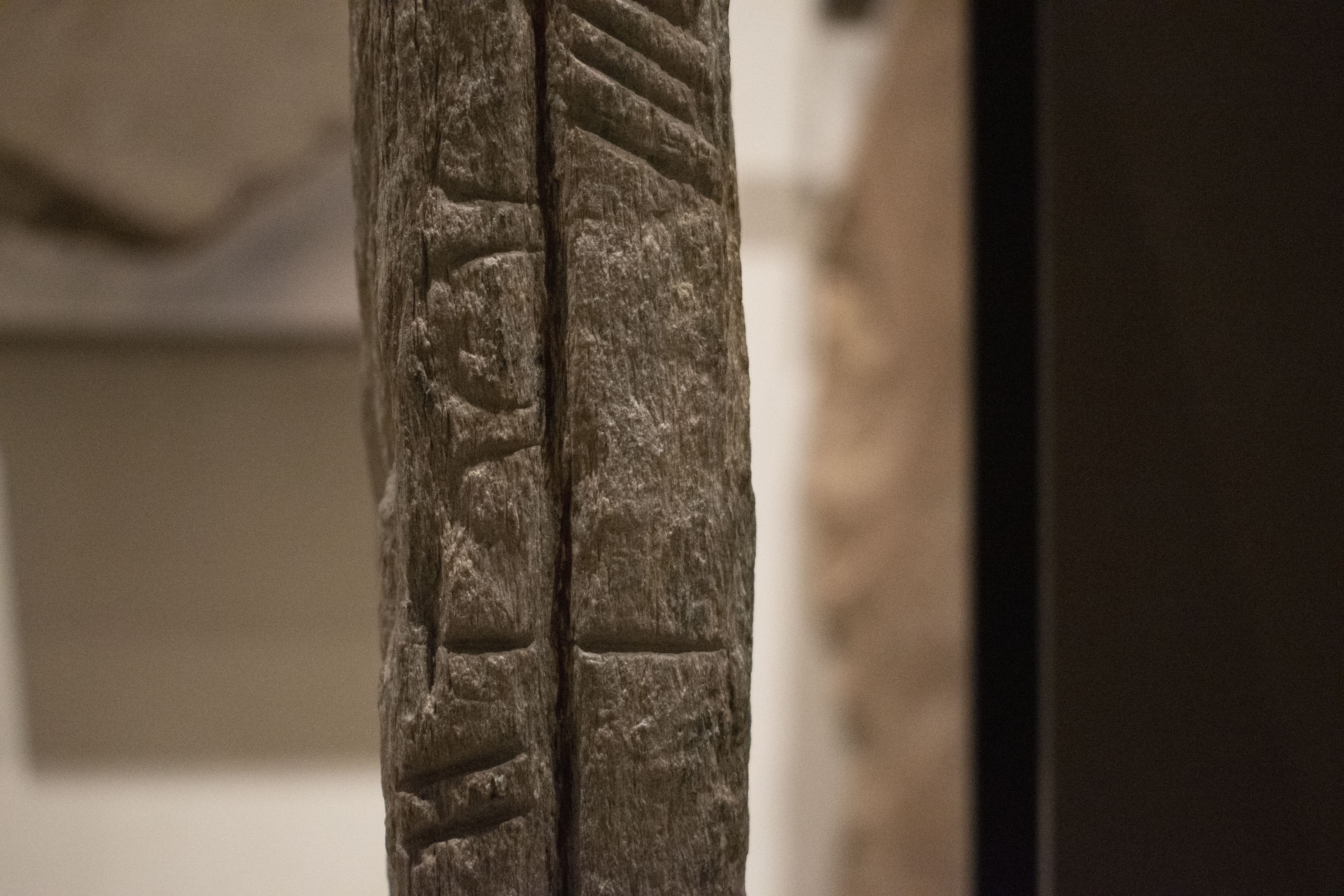
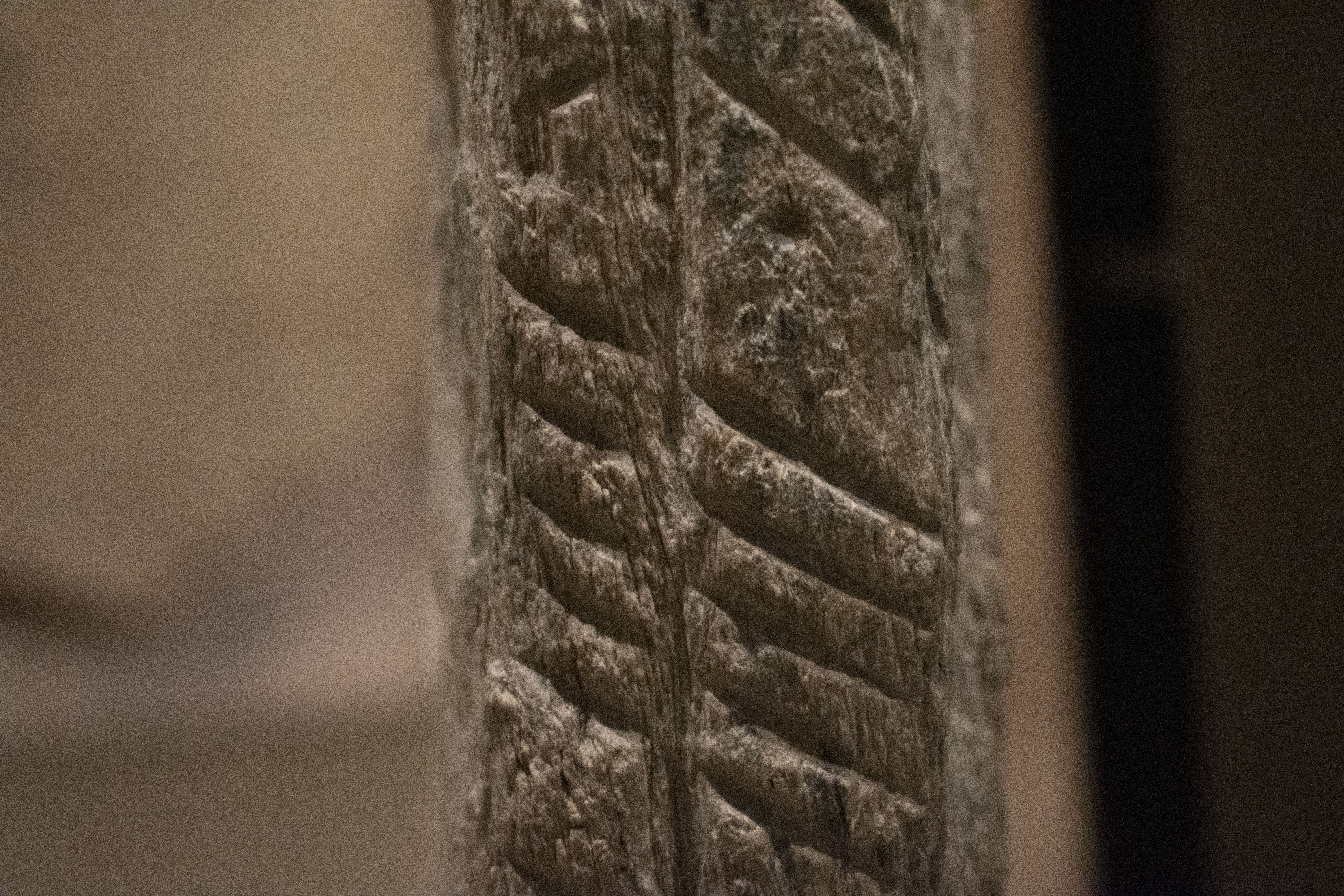
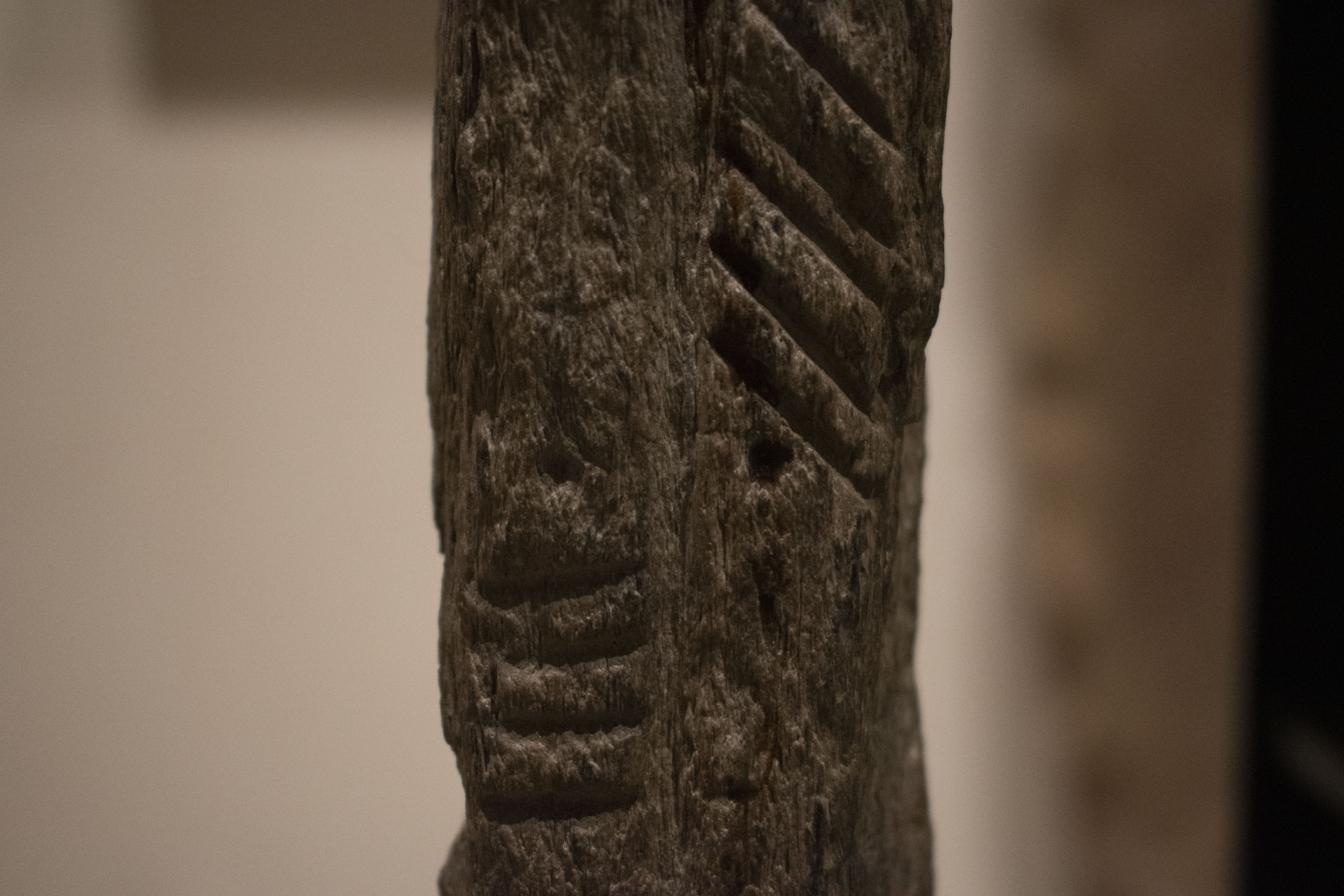
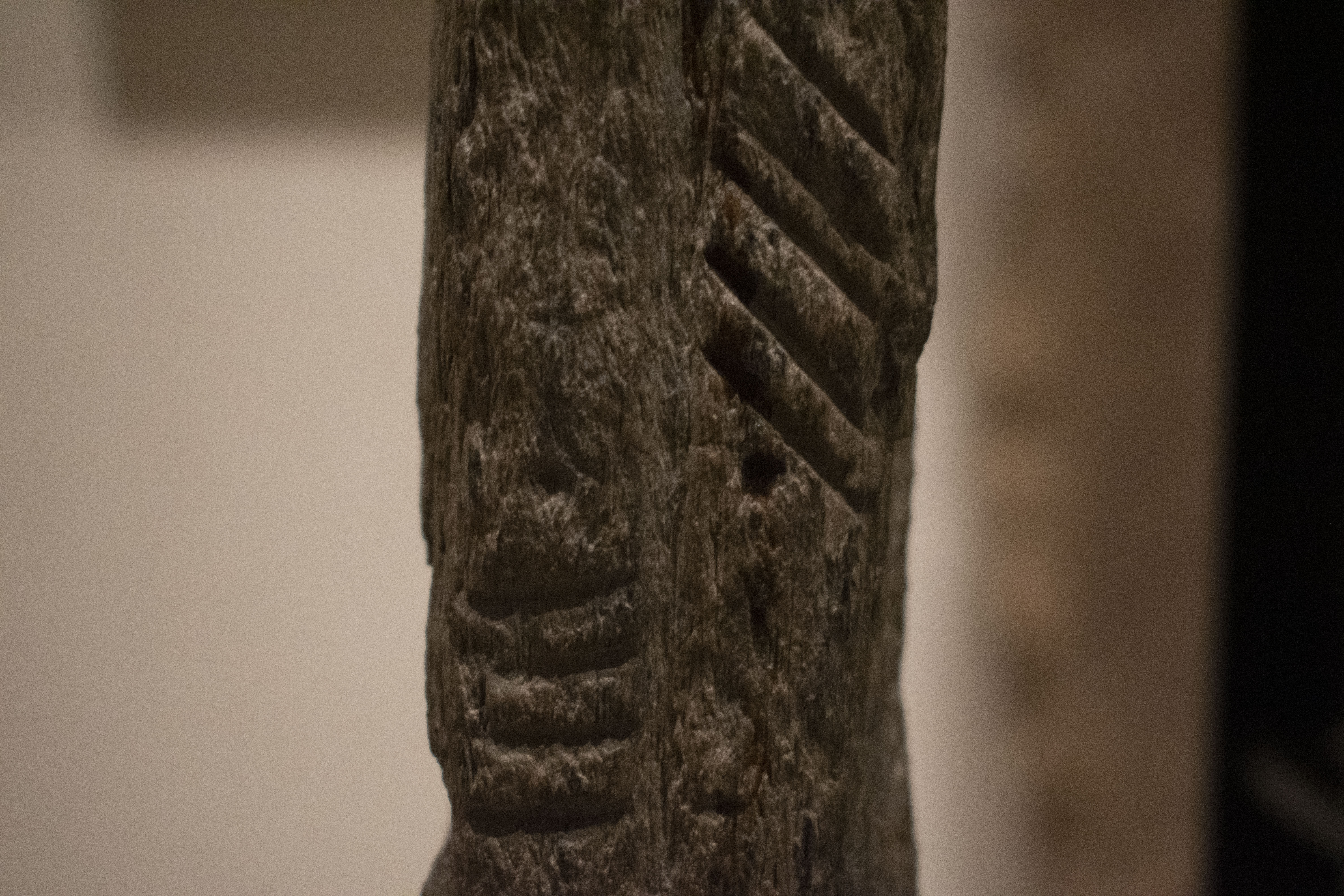
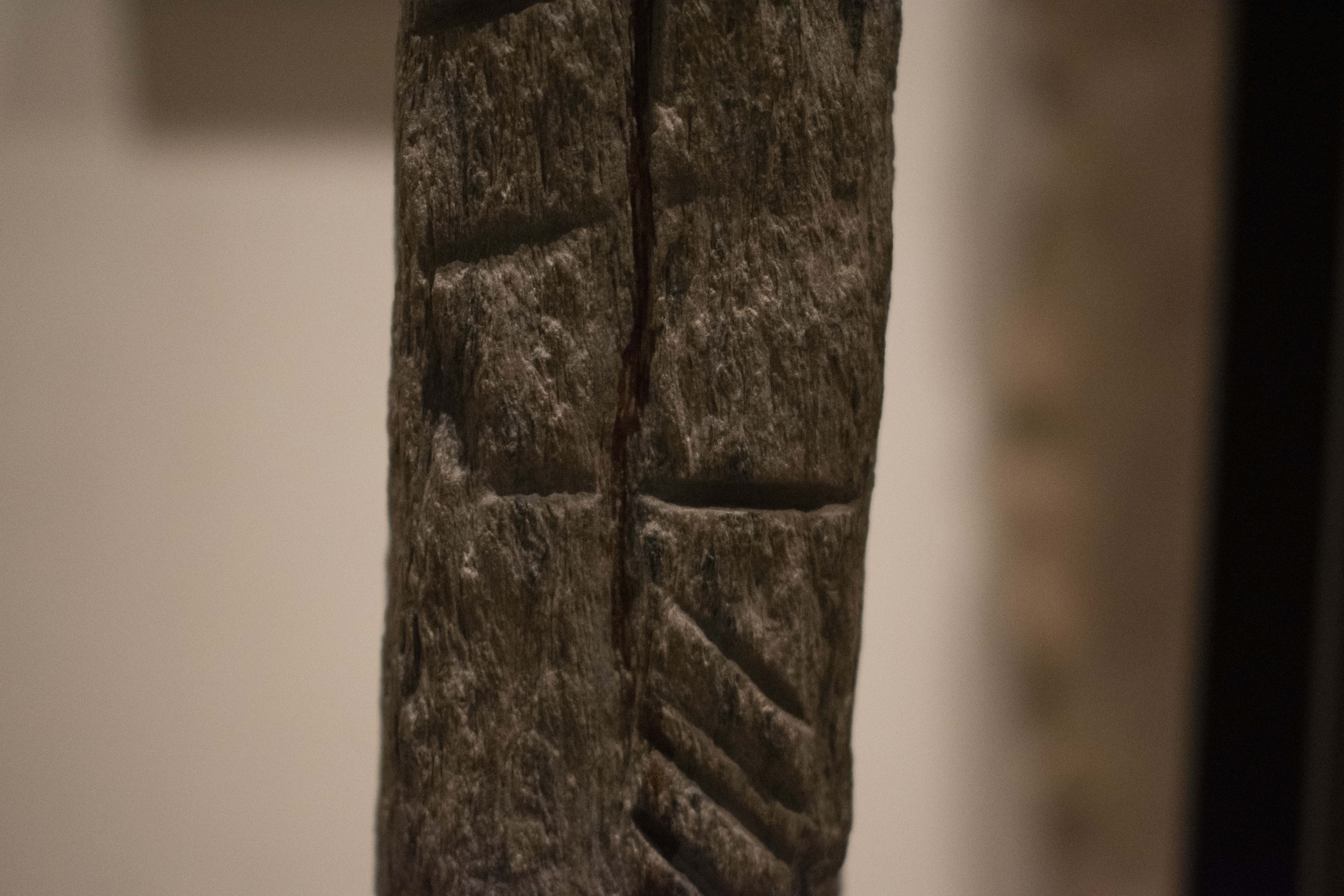
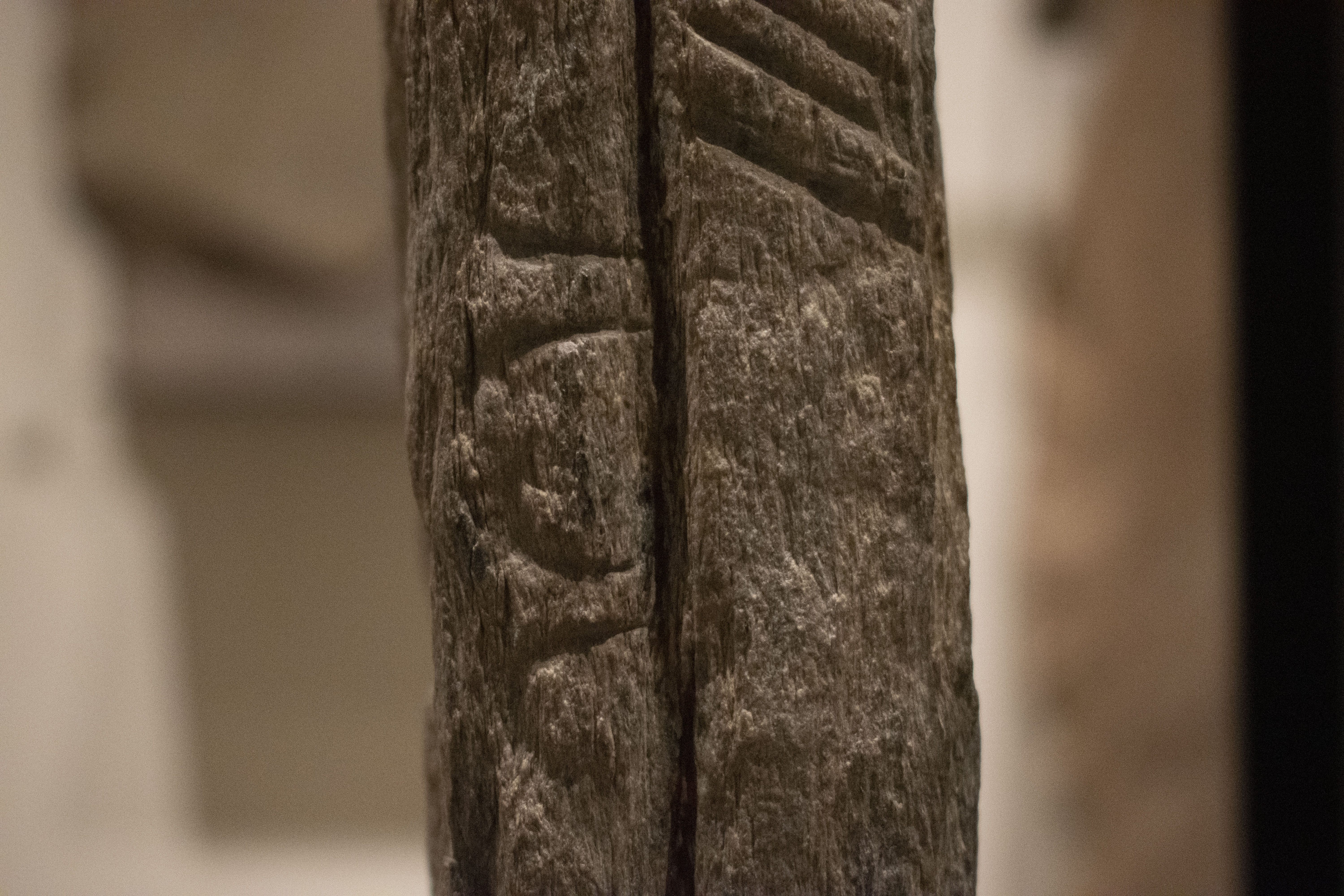
Text field: The slab is incised up the length of both flat narrow faces with ogham letters. The two lines of ogham occupy almost the full length of the narrow edges of the slab. There is no evidence of any lettering along the shaped upper surface. The longer of the two lines, the right-hand side, consists of twenty-nine letters and starts parallel with the feet of the lion. The shorter side, to the left and comprising nineteen letters, begins a little higher, level with the mouth of the lion, and ends a little lower. For both inscriptions on the right and left edge, the stem is visible before the first letter so we can be sure the beginning of the text is intact. Also, all the b- and h-aicme letters slope, to a greater or lesser degree, in the direction of reading, so there can be no doubt that the ogham inscriptions read from the bottom up as expected.
Letters: The Bressay text is described by Forsyth (1996, 119) as ‘a well-carved monumental text’. All the strokes are sharp, narrow, V-section, chisel-cut scores. Some are quite deep, all are well-preserved with only a very few letters being badly worn. The stem has been re-cut after the cross-strokes and is deeper and broader than them. Occasionally strokes cross the stem slightly, but never far or deeply, and these over-shoots are clearly just a slip of the blade (Forsyth 1996, 122). The letter-strokes take up the whole width of the narrow edge, i.e. the ogham-band stretches from edge to edge. All letters are clearly spaced and are evenly arranged along the entire length of the text, without bunching towards the end, indicating a degree of planning. In addition to exhibiting word division dots, rabbit-eared Ds, an angled A, a cross-hatched R, and an angular diamond shaped OI forfid, the Bressay text also features an unique character: the fifth character of the inscription on the right edge consists of five undulating strokes sloping backwards across the stem. Forsyth (1996, 127) maintains that this character is presumably a vowel and that we may take it as some form of I, perhaps an s-shaped I.
Date: Ninth- or early tenth-century A.D.
Edition
Ogham text: ᚉᚏᚏᚑ̣ᚄ
Transcription: CRRỌSCC᛬ NAHHTVVDDADDS᛬ DATTRR᛬ ANN BENNISES MEQQ DDROANN
Critical apparatus:
- The interpretation of the Bressay text remains uncertain, especially in regards to the order in which the two sides of the slab ought to be read, ‘if indeed they are meant to be taken sequentially’ (Forsyth 1996, 129). Forsyth (1996, 127) suggests that one possible reading is to ‘take the longer line first’, however, ‘it could be that the two are separate sense units and it does not matter which goes first, certainly no indication is given on the inscription itself’. The interpretation of the longer text on the right edge is aided by the presence of word-divison dots.
Translation
There are two possible translations for the inscription: 1) the cross of Nectudad, daughter of An (in memory of her husband) Benises son of Droan 2) the cross of Nectudad’s daughter An, (daughter of) Benises son of Droan
Commentary
All have recognised the first word of the right edge inscription, CRROSCC, as meaning ‘cross’. The linguisitic significance of this particular form is that it is virtually identical with the crosg an attested variant of the more common Modern Scottish Gaelic crasg, genitive croisg (as opposed to the Old Irish cross, Modern Irish cros. The second word, NEHHTVVDDAD̎D̎S, is most likely a Pictish personal name, Nectudad, and judging by the ogham spellings may be related to other Pictish names such as Nechtan/Naiton, NEHT-, NEHHT-, NETU. The third word, DATTRR, has previously been understood as a form of the Old Norse dottir ‘daughter’. Although the spelling is some way from dottir, it might reflect a Gaelic-speaker’s attempt to render a word which had been heard but not seen written (Forsyth 1996, 131). The final word, ANN, has been interpreted as the female personal name Anna. If this is a Gaelic name, it is perhaps more plausibly linked to Anu the name of a female Irish deity and saint, or the more popular Áine. It is equally possible that the name was a Norse male personal name, Án(n), gen, Áns, which is mentioned in Landnámabók.
The left line of ogham contains MEQQ in the middle which immediately suggests the familiar ‘X son of Y’ formula. MEQQ is reminiscent of the formula word MAQ(I) ‘son of’ (cf. Old Irish maic) on Irish ogham stones. The first word of the left edge inscription, BENISES, could be the personal name Beinir which means ‘to straighten out’ and appears in Scaldic poetry meaning ‘helper, giver’. Alternatively, it is possible that the initial BEN should be understood separately as the Old Irish ben ‘woman’, ‘wife’. The inscription would therefore read as ‘the wife of Ises son of Droan’, but what BEN-ISES could mean is unclear. The final name could be Drón, genitive Dróin, a well attested Irish male personal name related to the noun dron ‘solic, firm, substantial, vigorous’.
According to Forsyth (1996, 137), ‘Bressay affords an insight into ninth- or early tenth-century Shetland society, commemorating a family of Christians created by inter-marriage between Norse and Celtic-speakers’.
References
- Allen and Anderson 1903, 5-6
- Forsyth 1996, 117-137
- Graves 1853, 248-249
- West 2013-06-08