Provenance
Discovery: Discovered on Good Friday 2000 by Noel O’Neill, Gerry Bracken, and others during archaeological fieldwork. The find was subsequently published in Archaeology Ireland (Moore 2001, 33). Kilgarvan (Cill na nGarbhán, meaning ‘Church of the Garbháns’ or ‘Church of Garvan’) is said to have been founded by St Féichéine of Fore (Fobar), a Connacht man, in the seventh century. Garvan is thought to have been the local patron saint, and the placename preserves his memory.
Findspot: Kilgarvan (Cill na nGarbhán), Co. Mayo, Ireland (ITM Coordinates: 532776, 816140)
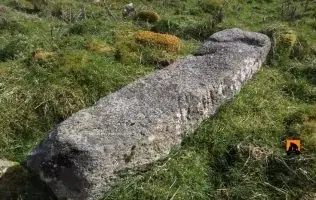
Last recorded location(s): The pillar was observed (May 2022) lying flat on the ground orientated N-S in the graveyard of Kilgarvan. 3D recorded as part of the Mayo Ogham project, funded by The Heritage Council and Mayo County Council.
Support
National Monuments Service SMR ID: MA040-031004-
Object type: Pillar
Material: Granite
Dimensions: H 1.35 × W 0.30 × D 0.20 m
Condition: The surface of the stone is moderately blotched with lichens and moss, with denser growth on the W face. The start of the ogham inscription has been spalled away which may have removed a couple of scores (Archaeological Survey of Ireland, Field Report 2017).
Inscription
Text field: The ogham inscription runs up along an upper angle of the pillar (left side of the broad face) extending from roughly mid-way along its length to the top of the stone.
Letters: The broad, evenly-spaced strokes appear to have been pocked and rubbed.
Edition
Ogham text: ᚇᚑᚈᚐᚌᚅᚔ
Transcription: DOTAGNI
Critical apparatus:
The reasonably clear ogham inscription has been read as DOTAGNI. However, a possible original COTAGNI was noted by Moore (2001, 33), as the spall at the start of the inscription may have removed a couple of scores.
Translation
of Dothán
Commentary
A later version of DOTAGNI would be something like Dothán, but no such name appears to be attested in the later sources. The name may consist of the word doth ‘bearing, bringing forth, hatching (of animals)’ or, if COTHAGNI, possibly coth ‘food, sustenance’.
Dating
Moore (2001, 33) dated the stone to approximately 400–599 AD on linguistic grounds, placing it in the earlier phase of Ogham stone carving in Ireland. The inscription DOTAGNI preserves a single personal name in the standard Ogham commemorative formula, suggesting the stone likely served as a burial marker for a local individual of some standing, possibly a chieftain or person of note in the early Christian community associated with the site.
References
- Moore 2001, 33