Provenance
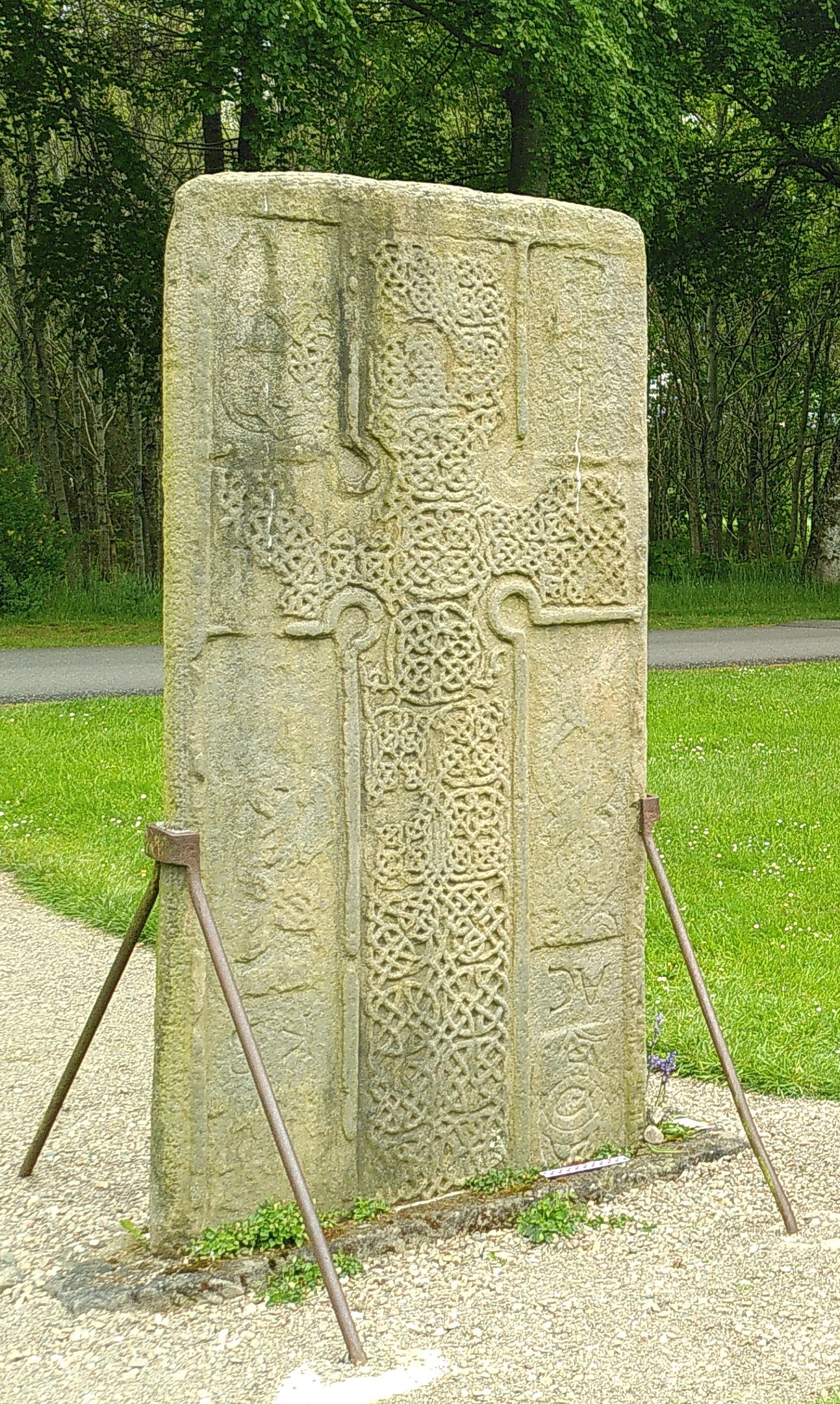
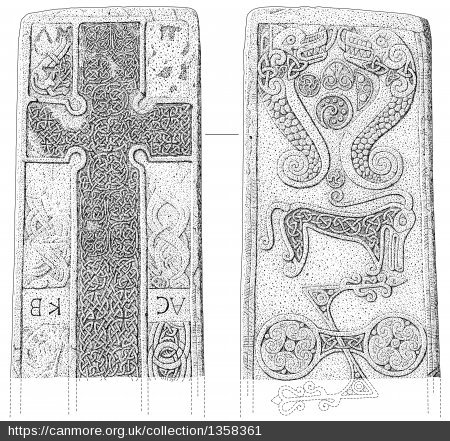
Discovery: The ogham inscription was first noted by Lord Southesk in 1885 (Southesk 1886, 14). Also known as ‘Rodney’s Stone’, the sculptured cross-slab was discovered in 1781 in the old churchyard during digging for the foundations of a new parish church at Dyke (Forsyth 1996, 139). It was set up first in Dyke village and sometime before 1842 it was moved to the grounds of Brodie Castle (Forsyth 1996, 139). It had been re-used as a recumbent grave-slab, probably in the early eighteenth century; ‘on the front face two recessed panels were cut into the interlace designs either side of the cross-shaft, and two pairs of initials incised’ (Forsyth 1996, 140).
Findspot: Dyke and Moy, Moray, Scotland (National Grid Reference: NH 9842 5766)
Last recorded location(s): Recorded on Brodie Castle grounds on May 24th 2023.
Support
Trove 15529
Object type: Cross-slab
Material: Sandstone
Dimensions: H 1.875-1.905 × W 0.95-1.05 × D 0.1 m
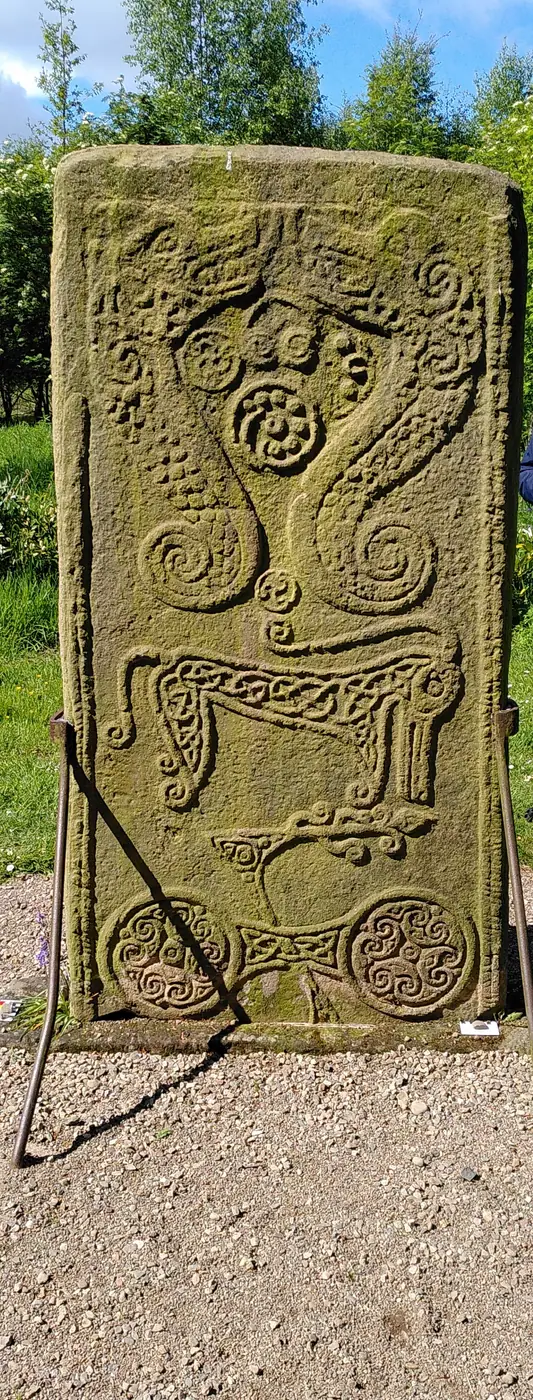
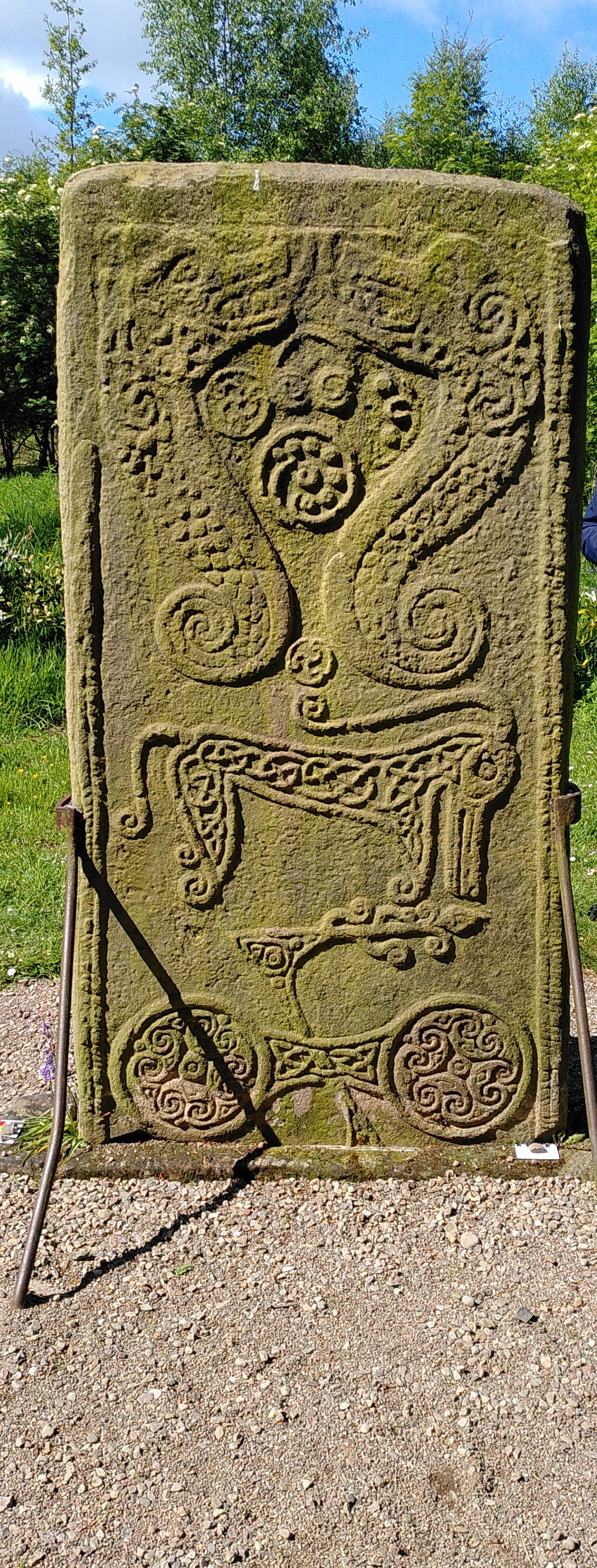
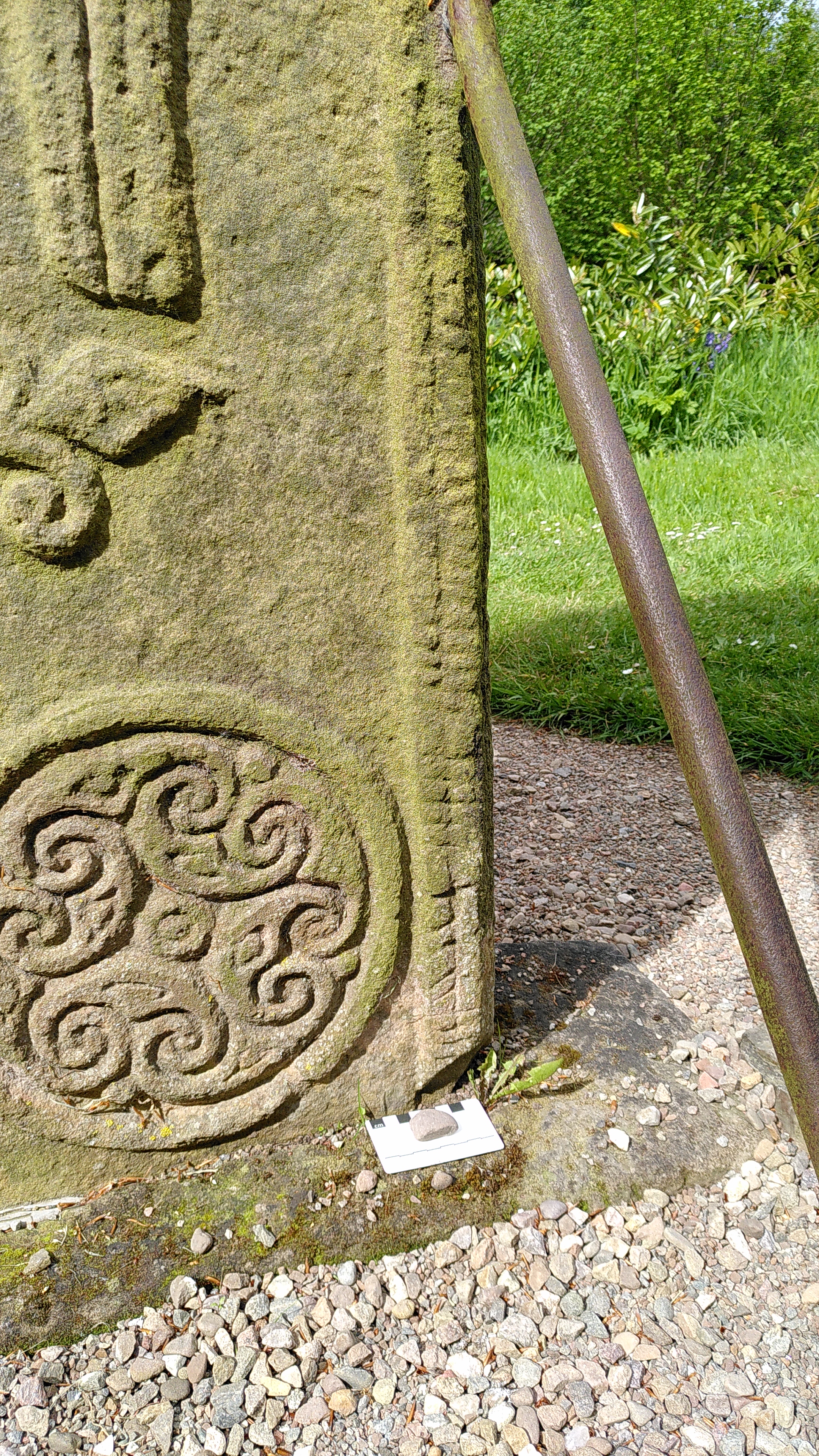
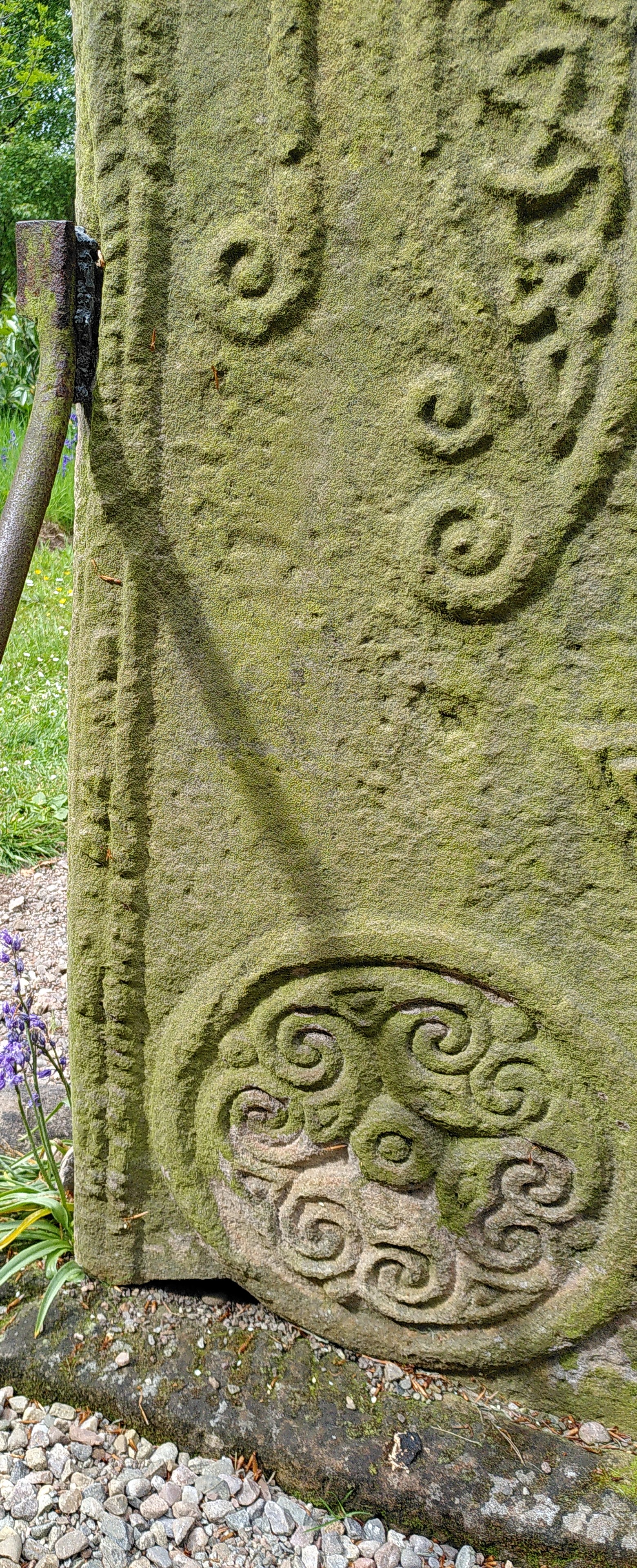
Decoration: The entire front face is carved with a cross with small rounded hollows at its armpits (Forsyth 1996, 142). The cross is outlined in a thick roll-moulding and it is decorated with complex interlace (Forsyth 1996, 143). Each of the background quadrants created by the arms includes interlaced beasts (Forsyth 1996, 143). Towards the bottom of the two lower panels inverted initials AC (right) and KD (left) are incised (Forsyth 1996, 143). The back is dominated by a large pair of sea monsters occupying the full width of the slab and almost half its length (ibid). Below are two large symbols, a Pictish beast and a double-disc and Z-rod symbol (Forsyth 1996, 143). The space between the pair of sea monsters is carved with curvilinear motifs, including a large spiral disc decorated with pellets in the centre, a penanular brooch with expanded terminals above, a crescent with pellets to the right, a circular disc decorated with triskele to the left and another smaller disc decorated with triskele at the bottom (Forsyth 1996, 143).
Condition: The ogham inscriptions are severely damaged with only short sections being legible (Forsyth 1996, 142). A broad recessed band cut along the top edge carries away the end of both lines of ogham on the back face. Traces of ogham letters are visible along the entire extant length of the right margin of the reverse face, however, on the left margin letters are only visible as far as the curl of the monster’s tail. Thereafter the surface is too worn to tell and the final quarter of its length has flaked away entirely. On the front of the slab ogham is visible on the right margin only. The front face is badly weathered, the carving on the reverse is in good condition (Forsyth 1996, 142). The lower edge of the slab is broken with a portion missing from the back (Forsyth 1996, 142).
Inscription
Text field: The three ogham inscriptions occupy the entire length of the right edge (front and back) and the left edge (back only) of the slab on a raised band approximately 5cm wide. An incised stem-line runs up the centre of each band (Forsyth 1996, 145). The direction of the angled vowels and the slope of the b- and h- aicme consonants indicate that the three inscriptions are to be read vertically upwards.
Letters: The inscription was likely pocked. The strokes are of no more than medium length and the vowel strokes are long, occupying the entire width of the raised band (Forsyth 1996, 155). There are occasional angled-vowels with one case of what appears to be a mix of straight and angled strokes (Forsyth 1996, 155). Individual letters are carefully spaced and component strokes are parallel and evenly-spaced (Forsyth 1996, 155).
Date: 850
Edition
Transcription: [---]RRṂỌQQ̣DIṬTOSSS[---] [---]EDDARRNON Ṿ[---]THIHAL[---]IRR[---]UIBUẒ[---] ṢONṢẸLCCO[---]
Critical apparatus:
- Forsyth (1996, 146) asserts that the raised bands on the slab were intended to bear the ogham and that all three inscriptions were part of the original design since the left-hand edge without ogham is only decorated with a narrower moulding similar to that outlining the cross. 2. The three inscriptions may be part of one continuous text, or represent independent sense units. The order in which the inscriptions should be read remains unclear due to the poor condition of the carving (Forsyth 1996, 146).It is apparent though that all three oghams were carved in the same hand (Forsyth 1996, 155). 3. Despite the length of the ogham inscriptions, ‘Brodie appears to lack both the x-forfid and the hammerhead A, the two most common forfeda in Scotland’ (Forsyth 1996, 156).
Translation
Due to the poor condition of the inscription, neither the language nor a full translation can be determined (Forsyth 1996, 156).
Commentary
The Brodie ogham is by far the longest ogham inscription from Scotland, originally consisting of up to seventy or eighty characters, and represents a substantial commitment to ogham literacy (Forsyth 1996, 157-158).
Given the length of the inscription combined with the fact that the typical ‘MAQQ’ does not seem to appear at any point, it is likely the original text incorporated more than proper nouns (Forsyth 1996, 157-158). Only one section, the EDDARRNONN on the back left representing the male personal name Etheman/ldamon, can be established with certainty (ibid). Though the name is Brittonic, the spelling could be Irish or Pictish (Forsyth 1996, 157-158).
The fact that the Brodie Stone has been carefully dressed and all its carvings, apart from the ogham inscription, are in relatively high relief suggests a date later in the Pictish period (Forsyth 1996, 142).
References
- Allen and Anderson 1903, 132-135
- Forsyth 1996, 139-159
- Southesk 1886, 14-22