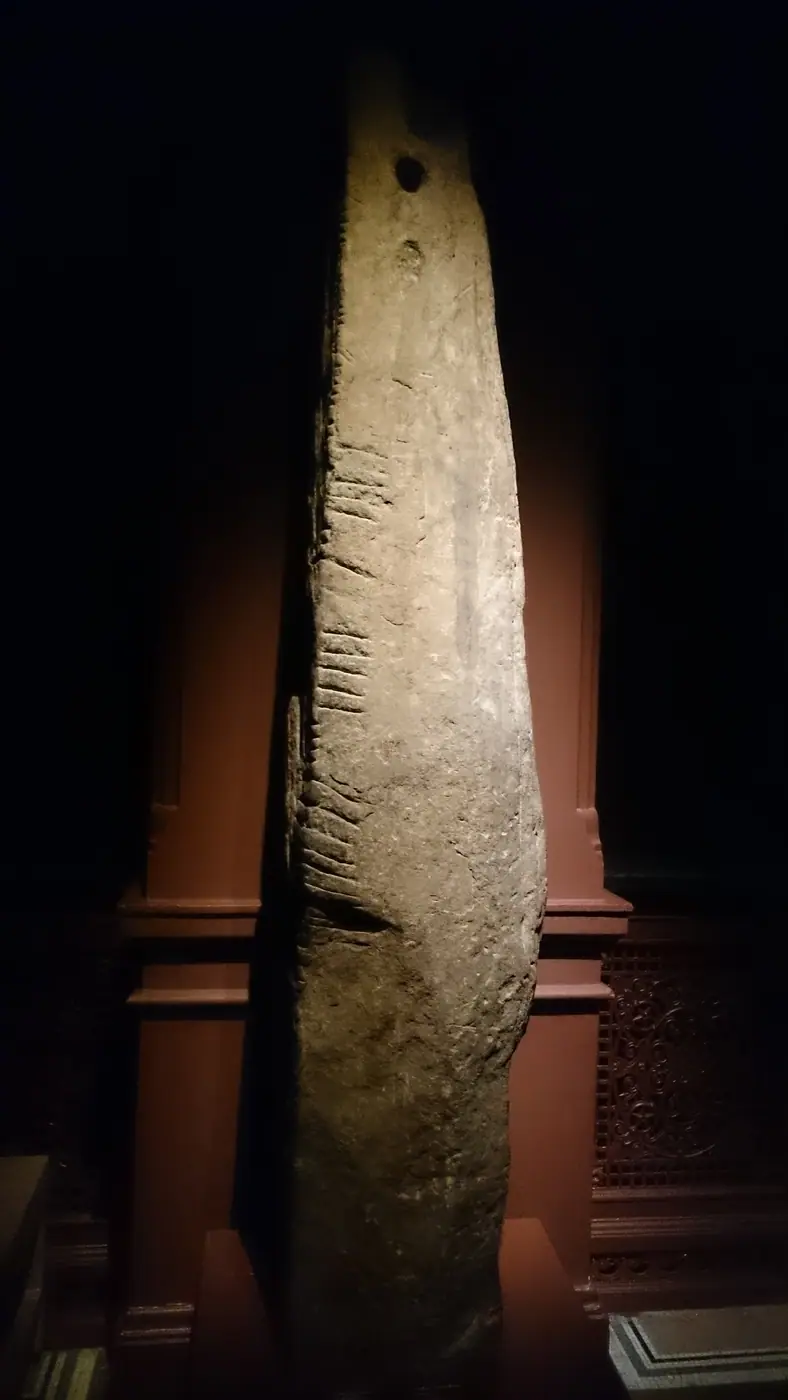
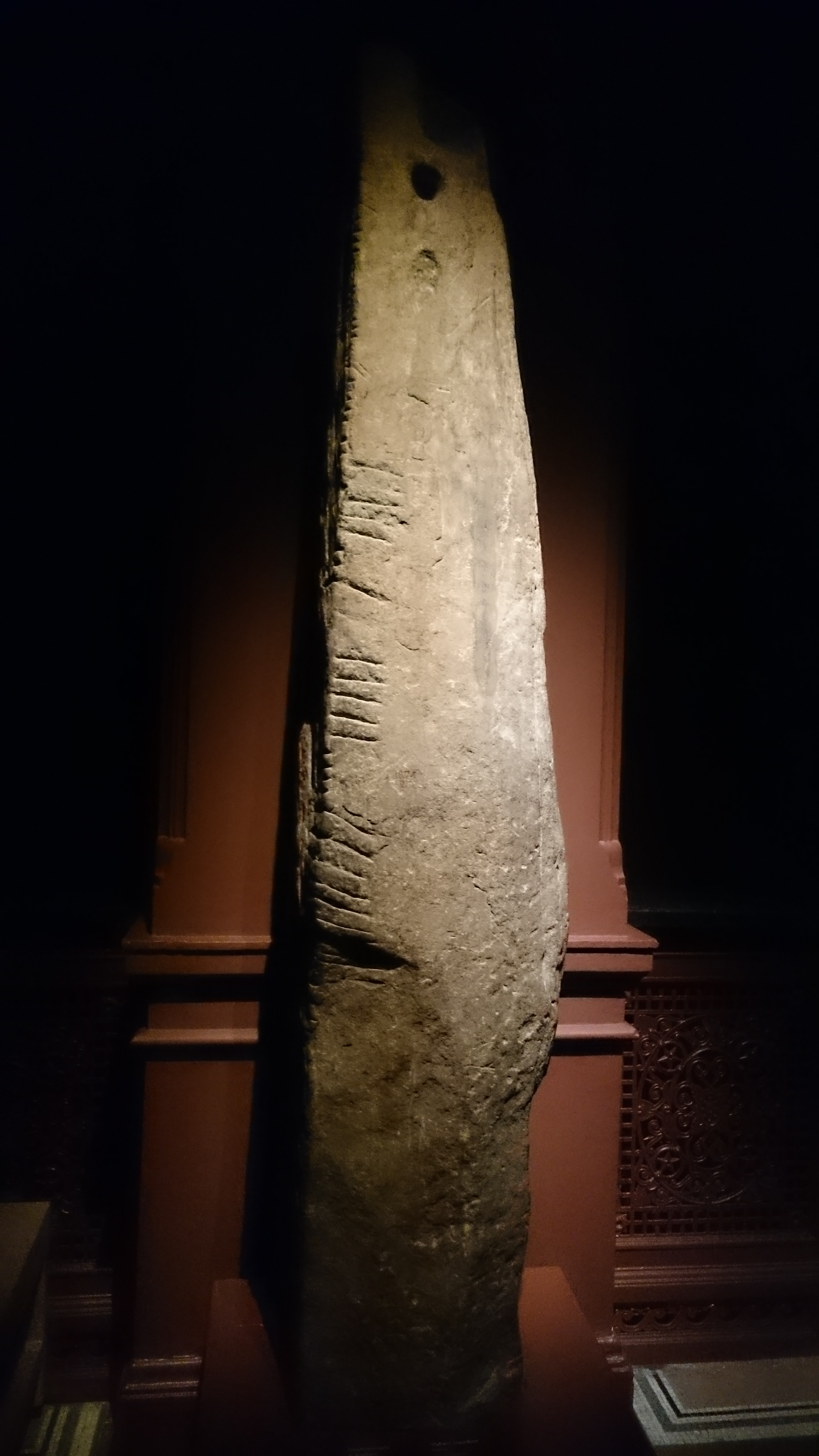
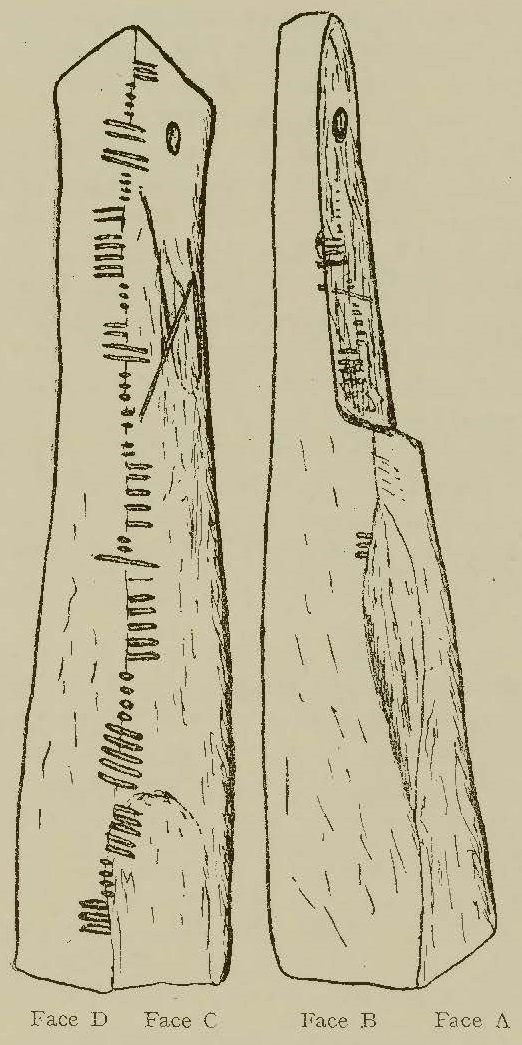
Provenance
Discovery: Discovered by a farmer while ploughing a field in 1872, this large stone was removed and appropriated by him as a gate post. It was in this usage that the ogham inscription was identified by Brash in 1873 (Brash 1879, 160-161). According to Brash (1879, 160-161), who was shown the find site, the stone formed a lintel in a possible long cist grave (about 1.5m (5ft.) long). However, Quarry (1896, 382) later revisited to purchase the stone and asked the landowner to dig on the site again in the hope of finding more ogham stones. This uncovered a stone-lined underground construction about 5.49m (18ft.) in length, suggesting a souterrain. Brash’s cist grave may have actually been a section of this souterrain. Two further ogham stones (I-COR-070 and I-COR-071) were found used as upright supports in the construction. Subsequently, a fourth ogham stone (I-COR-072) was discovered (Brash 1879, 162) but it remains on the farm.
Findspot: Monataggart (Móin an tSagairt), Co. Cork, Ireland (ITM Coordinates: 545879, 580808)
Current repository: Ireland National Museum of Ireland (inv. no. 1874:91)
Last recorded location(s): Purchased along with two others from the same site by the Royal Irish Academy (Quarry 1896, 382) and now part of the collection of the National Museum of Ireland. This stone is on display in the Museum of Archaeology (Kildare Street, Dublin). The stone was recorded in 3D (using an Artec Leo structured light scanner) in collaboration with the Discovery Programme in February 2022 as part of the OG(H)AM project.
Support
National Monuments Service SMR ID: CO061-022002-
Object type: Pillar
Material: Sandstone
Dimensions: H 2.61 × W 0.42 × D 0.30 m
Condition: Describing the stone as a tall, rough and irregularly-shaped, tapering monolith, Brash (1879, 162) gave the length as ‘8ft. 7in.’ (2.61m, but it is currently 2.22m above the display stand). Macalister (1945, 116) remarked that its size ‘suggests that it was originally a bronze-age megalith, adapted…for an ogham monument’. After being reused as building material in an underground chamber (probably a souterrain CO061-022001-), it was later reused again as a gate post. There is a hole at the top of the stone, which was made for this purpose. The top half of the back of the stone is also broken away. Macalister (1945, 116-117) noted that an older inscription on the dexter angle of the opposite face was removed, and that traces of a couple of letters can still be seen on the lower half of this angle, but this is quite doubtful. He also claimed that a Chi-Rho (☧) symbol was removed from the face to the right of the surviving inscription. Russell Ó Riagáin examined the stone as part of a study on Chi-Rho and Tau-Rho symbols and identified what may be a Tau-Rho or Staurogram (⳨) (presented in his paper at the Internation Insular Art Conference, Cork 2025).
Inscription
Text field: The inscription begins 0.91m (3ft., according to Brash 1879, 162) from the bottom and runs up the dexter angle of one of the faces, finishing near the top. Although there are other marks and scratches on the stone, none can be clearly identified as the remains of an earlier inscription as suggested by Macalister (1945, 116-117)
Letters: The inscription is both v-cut and pocked. There is unusual variation in the size of the consonant strokes in this inscription, the vowel strokes by comparison are relatively uniform and wedge-shaped. The first couple of consonants are v-cut and quite tightly spaced. From the R of the first word to the beginning of the final word, the strokes are broader, deeper and more widely spaced. They also appear to have been pocked. For most of the final word, the carving technique appears to revert back to more tightly spaced and finer v-cuts. However, the final three strokes once again appear to have been pocked. It is also striking that the carver has confused the aicmi, carving T for V, N for Q, and vice versa. Finally, there is quite a bit of space (1.1m/3ft. 7in.) left between the initial personal name and the rest of the inscription. Although this is rare in the ogham corpus, there are a few other examples and it appears to be a late feature.
Date: Early seventh century AD (linguistic)
Edition
Ogham text: ⸢ᚃ⸣ᚓ⸢ᚊ⸣ᚏᚓ⸢ᚊ⸣ vac.
Transcription: ⸢V⸣E⸢Q⸣RE ⸢Q⸣ vac. MO⸢Q⸣OI G⸢L⸣U⸢N⸣⸢L⸣EGGE⸢T⸣
Critical apparatus:
- The inscription (with the B and H aicmi confused) reads: TENREN (vac.) MONOI GDUQDEGGEV 2. Although there are traces of what looks like a faint stroke between the final character of the first name and the M of the following word (closer to the M), it does not seem to be part of the inscription.
Translation
of Fíachrai from the kin group Glúnleced (?)
Commentary
The personal name VEQREQ is probably a compound of *veiko ‘energetic, hostile’ and rí ‘king’ (-RIGAS > REG > REC). McManus (1986, pp 30-31), following Ferguson (1879, 207-210), suggests a possible reading -CH (4 scores for C and 1 for H) /x/ rather than -Q (5 scores). GLUNLEGGET is presumably an unidentified kin-group name consisting of glún ‘knee’ and an unknown second element.
This inscription is linguistically quite late, possibly early seventh century. For example, syncope (dropping of internal vowels) is apparent in both names (indicated by asterisk: VEQREQ, GLUNLEGGET) (McManus 1991, 97) and the same character (Q) is used for both guttural sounds (VEQREQ for earlier VECREG) showing that these sounds had already fallen together (McManus 1991, 116, 122). In an early ogham inscription, we would rather expect *VECRIG. Lowering of *i > e and the spelling *g by Q (= ch) looks even almost like 8th century Old Irish. Note that MUCOI has also been written with a Q and that this formula word appears here without a preceding MAQI, whereas MAQI MUCOI is more common in earlier ogham inscriptions. Interestingly, Monataggart 2 and 3 (I-COR-070 and I-COR-071) are linguistically much earlier (with final syllables still intact), possibly early or middle fifth century.
References
- Brash 1879, 160-162
- Macalister 1945, 116-117
- McManus 1986, 2-4, 30-31
- McManus 1991, 97, 116, 122
- Power, Byrne, Egan, Lane, and Sleeman 1997, 169, no. 7978
- Quarry 1896, 382