
Provenance
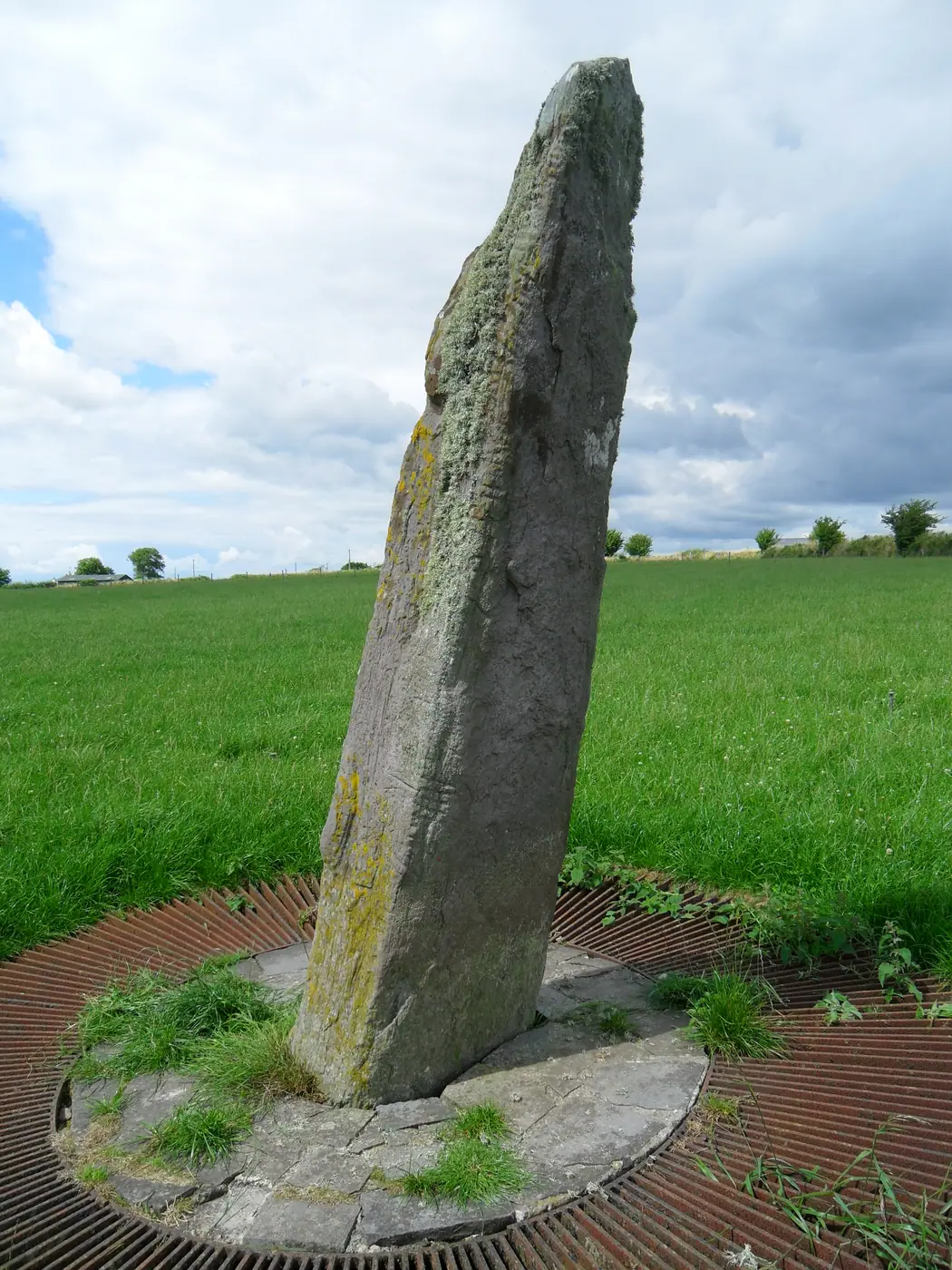
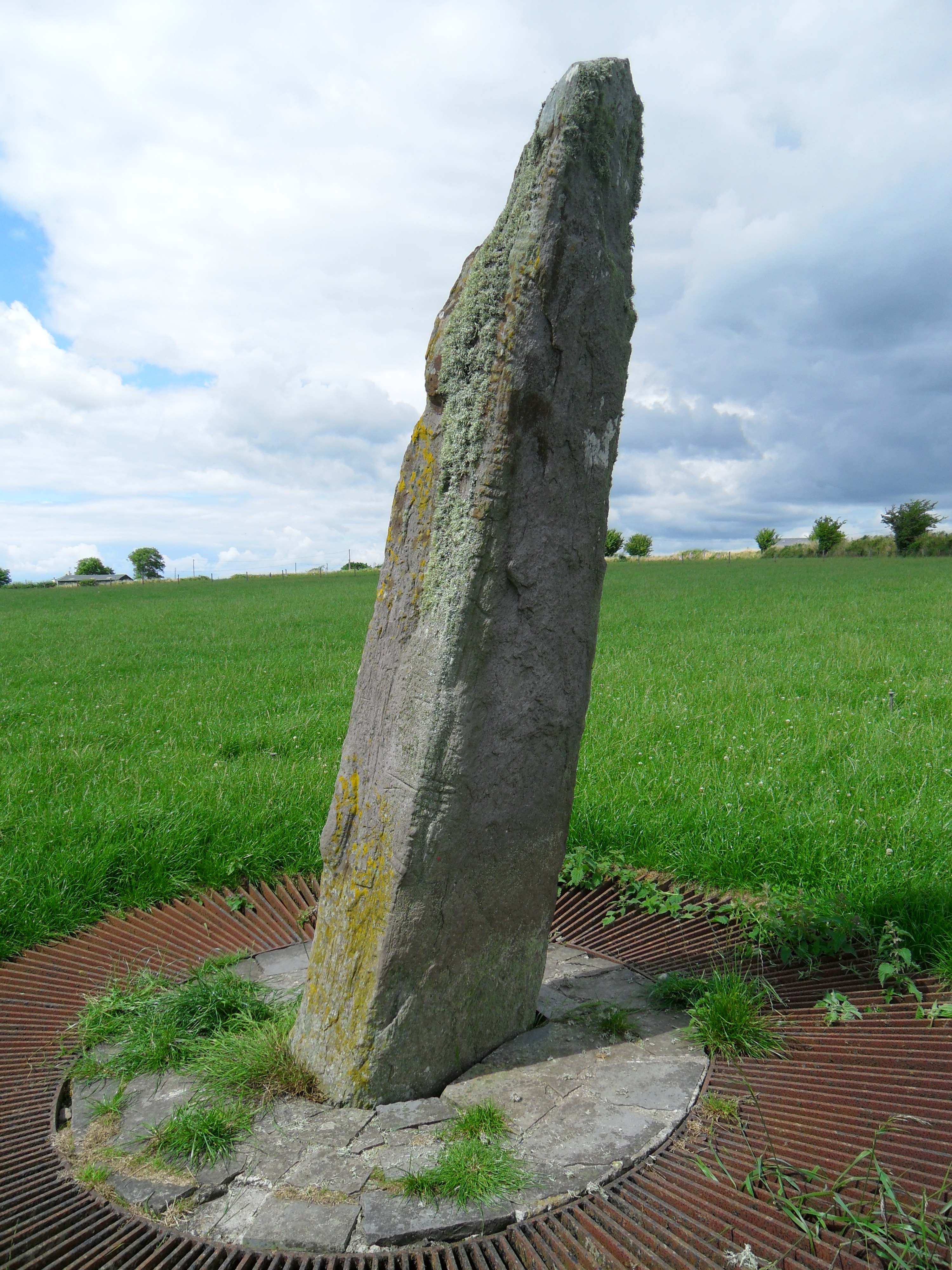
Discovery: First published by Brash (1879, 137) as having been reported to Windele by one of his ‘ogam scouts’. The stone was found in ‘an open field’ in the townland. A circular cattlegrid was installed around the stone in 1985 by OPW; an excavation of the ground under the circular strip limited to 1m wide with its inner edge and 1m from the centre of the stone revealed nothing except N-S cultivation furrows and ploughmarks (Manning 2000, 107). A second ogham stone (I-COR-004) lies c. 40m to the N in the next field and Burnfort ogham stone (I-COR-002) is found c. 900m to SE (Power et al. 1997, no. 7965).
Findspot: Greenhill (Plácas), Co. Cork, Ireland (ITM Coordinates: 558399, 591925)
Last recorded location(s): On find site at Greenhill where it was visited and 3D recorded for the Ogham in 3D project in August 2013.
Support
National Monuments Service SMR ID: CO042-049002-
Object type: Pillar
Material: Clay slate
Dimensions: H 2.50 × W 0.60 × D 0.30 m
Condition: This large pillar tapers to a point at the top and is leaning to the E. Described by Brash (1879, 137) as the ‘usual hard clay-slate of the district’, it is heavily covered in places with lichen and the inscription is weathered and worn by cattle rubbing. The stone also displays other markings, such as V-shaped ‘hone scores’ (at least two, of differing lengths and orientation, to the left of the N of TREN) found on other ogham stones and carved stones more generally. Other examples from the ogham corpus include Greenhill 1 (I-COR-003) and Ratass ogham stone, Co. Kerry (I-KER-139). Macalister (1945, 62) reported that the inscription was vandalised, rendering its interpretation difficult ‘for anyone who had not previously been familiar with it’.
Inscription
Text field: The inscription runs upwards along the SE edge starting 0.45m from ground to near full height of the stone.
Letters: The ogham strokes appear to have been pocked and possibly also (later?) v-cut with a flat chisel.
Date: First half of the sixth century (linguistic)
Edition
Ogham text: ᚈᚏ̣ᚓᚅᚒ̣ [ᚋᚐ]ᚊᚔ̣ ᚋᚒᚉᚑᚔ ᚊᚏᚔᚈᚈᚔ
Transcription: TṚENỤ [MA]QỊ MUCOI QRITTI
Critical apparatus:
- Some of the ogham strokes and notches are lost (MA of MAQI) or unclear (I of MAQI, R and U of TRENU) due to wear, lichen and damage. For example, the B-side of the first three R strokes have been lost, which led Brash (1979, 138) to read this as TTGENU. It is also impossible to be sure of the intended final vowel in TRENU, as the inscription is very worn at this point. Two notches seem fairly certain, three likely (space enough) but nothing legible after this until the Q of a possible MAQI.
Translation
of Trén/Trian son of the descendant of Creth
Commentary
A genitive TRENI (Old Irish o-stem Trén ‘strong’) might be expected here, as in MAQI-TRENI (I-COR-007 Ballynabortagh 3; I-COR-035 / CIIC 86. Ballyknock V, although also uncertain, and in Wales: W-BRE-006 / CIIC 341. Llywell and W-PEM-004 / CIIC 428. Cillgerran). However, McManus (1991, 179, note 35) notes that ‘MacNeill (1909, 361) compares the MS gen. Tréno, Tréna and suggests reading TRENO, which is possible’.
The name QRITTI may be the word creth ‘craftmanship, skilled work, poet’. This single-element name is possibly attested later as Crithe (CGH S. 571, Ziegler 1994, 223) and is also found at Reask (Ballineanig), Co. Kerry (I-KER-013: LUGUQRIT MA[QI] QRITT[I]) and Stradbally More, Co. Waterford (I-WAT-009: QRIT[—]I MAQ[I LO]BACONA AVI NEAGRACOLINEA). Here it follows the formula word MUCOI and so is part of a kin-group name, though probably not related to the Crothrige (McManus 1991, 111). The retention of the -I in QRITTI would suggest dating this inscription to the first half of the sixth century.
References
- Brash 1879, 137-140
- Macalister 1945, 62
- Manning 2000, 107–112
- McManus 1991, 121-179
- Power, Byrne, Egan, Lane, and Sleeman 1997, no. 7965
- Ziegler 1994, 223