Provenance
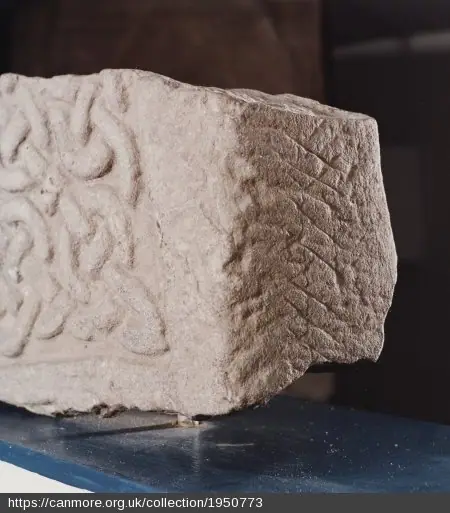
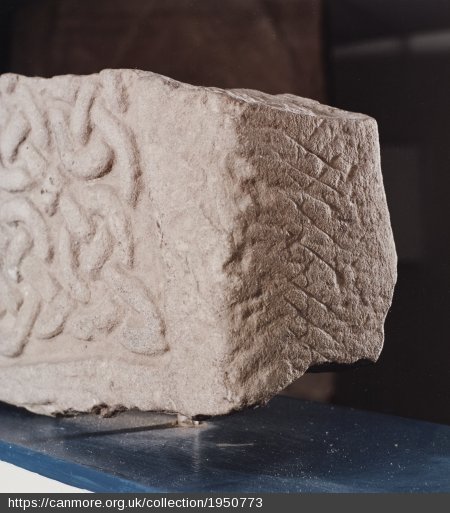
Discovery: Also known as St Vigean’s 6, the possibility of an ogham inscription on the fragment was originally suggested by Duke in 1887-1888. The first recording of the ogham inscription is a photo from the Records of the Royal Commission on the Ancient and Historical Monuments of Scotland collection taken in 2000 and published online on Canmore. The fragment of the cross-slab was found during grave-digging in 1888 and was taken into the church (Geddes 2017, 183). In 1960, it was removed from the church and taken to St Vigeans Museum (Geddes 2017, 184).
Findspot: Arbroath, St Vigeans, Angus, Scotland (National Grid Reference: NO 6384 4289)
Current repository: Scotland St Vigeans Museum (inv. no. )
Last recorded location(s): Recorded in St Vigeans Museum (HES).
Support
Trove 35586
Object type: Cross-slab
Material: Sandstone
Dimensions: H 11 × W 26 × D 60 cm
Decoration: The front face is decorated with a panel of interlace, and the back face contains a double-disc and Z-rod symbol (Allen 1903, 242).
Condition: A small fragment of a free-standing cross-slab, most likely the terminal of the upper arm of a cross. The fragment bears lines which resemble ogham. However, the ogham stokes have been described as so defaced they were unintelligible (Geddes 2017, 184).
Inscription
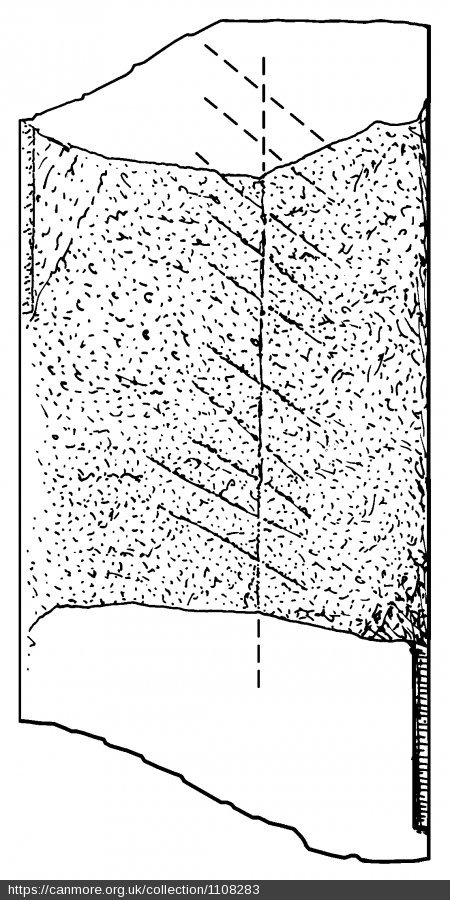
Text field: The left face of the fragment is incised with short parallel lines which may be ogham letters. In 1903, Allen read the marks on the left face of the fragment as a T-pattern (Geddes 2017, 184). In 2005, Borland recognised the T-pattern but discerned two ogham letters ‘RR’ with a drawn stem-line (Geddes 2017, 184). However, Forsyth noted that the stem-line was ‘hard to detect’.
Letters: Forsyth determined that the strength of the purported ogham strokes seem to be very similar to the other cuts on the face (Geddes 2017, 184).
Date: Eighth or ninth century
Edition
Transcription: [---]ṚR[---]
Critical apparatus:
- Given the quality of the carving on the other faces of the fragment and the T pattern on face A, Forsyth suggested that the purported ogham strokes ‘might be a light sketch for a fret pattern’, though, it could be interpreted as a fragment of an ogham lightly carved (Geddes 2017, 184).
Translation
An exact translation of the inscription cannot be provided.
Commentary
There is doubt over whether this is ogham or not. Due to this uncertainty and the brevity of the surviving portion, its language (if indeed it is linguistic) cannot be readily determined.
References
- Allen and Anderson 1903, 241-242
- Cruden 1964, 25
- Fraser 2008, 58-59
- Geddes and Borland 2017, 183-184