The oldest surviving line of ogham text in any manuscript isn’t Irish. It’s English, copied out around 1100 by a scribe working in or near Oxford, and it isn’t recording anyone’s name for a gravestone. Byrhtferth’s ogham signature, as scholars have come to call it, sits buried inside a diagram of the universe drawn by an Anglo-Saxon monk who, as far as anyone knows, never set foot in Ireland.
A monk obsessed with diagrams
Byrhtferth of Ramsey (c. 970 - c. 1020) was a monk at Ramsey Abbey in Huntingdonshire, trained by Abbo of Fleury during the two years Abbo spent teaching there from 985 to 987. In 1011 Byrhtferth finished his Enchiridion, a handbook meant to teach young monks computus, the medieval science of calculating the date of Easter, though he wandered freely into astronomy, numerology, and rhetoric along the way. He had a habit of turning complicated ideas into elaborate diagrams, and one of them survives on folio 7v of Oxford, St John’s College MS 17, an early twelfth-century copy made roughly a century after Byrhtferth’s death.
The wheel at the centre
The diagram is called De concordia mensium atque elementorum, “On the concord of the months and the elements.” In Byrhtferth’s own words, translated by Peter Baker, it “contains the twelve signs and the two solstices and the two equinoxes and the twice two seasons of the year,” along with the names of the elements, the twelve winds, and the four ages of man, plus “the twice two letters of the name of the first man, Adam.”
At the very centre is a wheel-shaped figure with eight spokes. Just above it sits a horizontal cartouche crowded with abbreviations, small pictograms, and, at the far right, a single line of ogham letters running along a stemline exactly as they would on a standing stone in Munster, except this one was drawn in ink by a scribe who almost certainly never saw one carved.
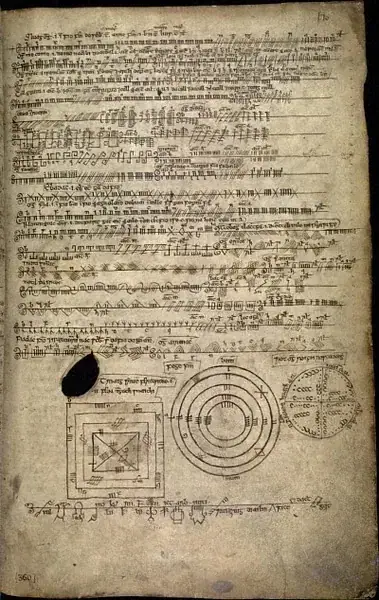 A medieval manuscript page combining ogham text with the kind of wheel diagrams and cryptic alphabets found around Byrhtferth’s own ogham signature.
A signature nobody can quite read
What the ogham actually says is still argued over. In a 1994 paper titled “Byrhtferth’s Ogam Signature,” Patrick Sims-Williams read the strokes as MEGFDLU and proposed that the last five letters had been shifted by one place in the alphabet, a simple substitution cipher that turns them into the Latin me fecit, “made me.” Paired with a rebus he saw in the pictograms beside it, a comet over the earth for Old English beorht, “bright,” next to a figure for ferhð, “mind” or “spirit”, the whole thing spells out Byrhtferth me fecit: “Byrhtferth made me.”
Not everyone agrees on the letters, let alone the translation. The runologist behind the BabelStone blog reread the strokes as MMMMOFDLU and argued that some of Sims-Williams’s letterforms don’t match how ogham was actually written in manuscripts of the period. There’s a competing theory about the wheel itself, too: read its tripled spokes correctly and it may spell ABBA, repeated six times, the Aramaic word for “father” used three times in the New Testament to address God. On a diagram whose cartouche also carries the abbreviation for Christ, an invocation might fit the centre of a monk’s universe better than his own name would.
How ogham reached Ramsey without any Irish stones
Byrhtferth’s ogham almost certainly didn’t come from direct contact with Ireland. The same manuscript, on folio 5v, carries tables of runic futhorcs and cryptic cipher alphabets, the kind of material a scholar interested in exotic scripts for their own sake would collect. Ogham, runes, and invented ciphers all sat on the same page as curiosities, filtered through Latin grammatical texts and the wider insular monastic fascination with unusual alphabets rather than through anyone who’d actually watched a stone being cut.
That’s a very different route into England than the one ogham took roughly six centuries earlier, when Irish settlers carried the script there in person. At Silchester in Hampshire, an ogham-inscribed Roman column was found upside down at the bottom of a well, radiocarbon evidence from the site pointing to around 350-425. It reads, in part, “of Tebicatos, son of the descendant of…” Whoever carved it was almost certainly an Irish immigrant marking ownership of a Roman house, using ogham for exactly what it was invented for. Byrhtferth’s monastery, six hundred years later, had no such community living nearby. He inherited the script as an idea, not a lived practice. More of ogham’s history in England shows where its actual Irish-speaking carvers settled, and our history and origins of ogham page traces that fuller journey from Ireland outward.
An unfinished puzzle
Nobody has cracked Byrhtferth’s ogham signature to everyone’s satisfaction, and it’s entirely possible nobody ever will. What’s clear is that by the early eleventh century, ogham had already become something else in places like Ramsey: not a way to mark a grave, but a piece of exotic learning, useful mainly for making a diagram look more mysterious than it already was. That a script born to carve personal names on Irish hillsides ended up as a puzzle in the margins of an English monk’s calendar says something about how far, and how strangely, ideas travelled in the early medieval world. The full ogham stone map has hundreds of inscriptions to compare it against, and none of them look quite like this one.
Further Reading
- Sims-Williams, Patrick. “Byrhtferth’s Ogam Signature.” In Essays and Poems Presented to Daniel Huws, 283-291. Aberystwyth, 1994.
- Parsons, David. “Byrhtferth and the Runes of Oxford, St John’s College, Manuscript 17.” In Runeninschriften als Quellen interdisziplinärer Forschung, 439-445. 1995.
- BabelStone Blog. “Byrhtferth’s Ogham Enigma.” 25 December 2008.
- Hayden, Deborah. “‘Byrhtferth’s Ogam Signature’ and Oxford, St John’s College MS 17.” OG(H)AM project blog, University of Glasgow, 18 January 2023.
- Baker, Peter S., and Michael Lapidge, eds. Byrhtferth’s Enchiridion. Early English Text Society, 1995.