Ogham Tattoo Placement
Ogham Spine Tattoos
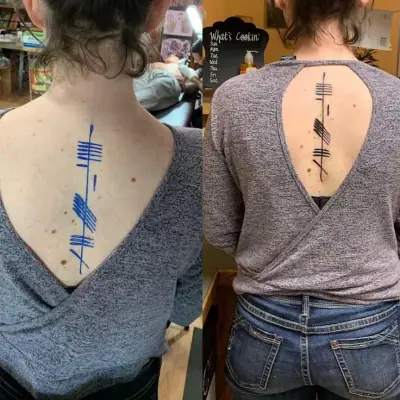
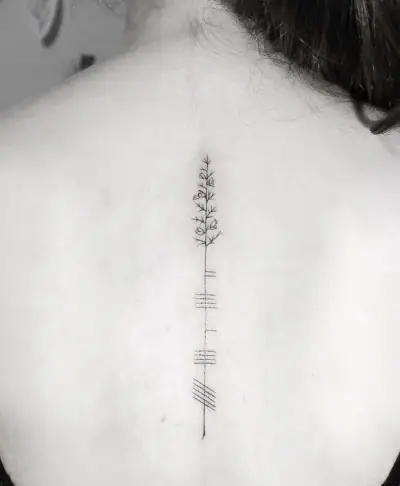
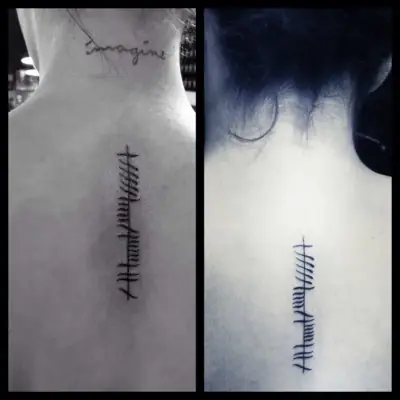
The spine is Ogham's most dramatic canvas. A long inscription running the full length of the back creates one of the most striking Celtic tattoos possible — and the vertical format is completely natural.
Why Ogham and the Spine Are a Perfect Match
Ogham was designed to be read vertically. On standing stones, the inscription runs from the base of the stone to the tip — a distance of anywhere from 30 cm to over a metre. The spine offers exactly that kind of vertical canvas, making it the closest thing to a standing stone that a tattoo can achieve.
A full spine inscription can accommodate 15 to 25 characters, which is enough for a full name, a meaningful phrase in Irish, or a sentence. This is the placement for people who want to commit fully to the script — it cannot be hidden or made small.
Design Tips for Spine Ogham
- Start at the neck, read downward — or start at the lower back and read upward. Both conventions exist; upward reading is more historically accurate.
- Keep the stem line centred on the spine — the natural vertebral line serves as a visual axis for the tattoo.
- Use a heavier stem than strokes — on a long inscription, visual hierarchy between stem and strokes prevents the piece from looking uniform and flat.
- Consider spacing — Ogham characters are spaced evenly along the stem. Generous spacing across a full spine reads better than compressed characters.
- One inscription, no line breaks — Ogham is a single continuous line. Do not attempt to break a phrase across multiple parallel stems, as this has no historical precedent.
Inscription Ideas for Spine Placement
᚛ᚔᚅᚔᚑᚅ᚜
Daughter of Ireland
Iníon na hÉireann
~17+ characters
᚛ᚑᚈᚆᚔᚏ᚜
From the land of saints
Ó thír na naomh
~14+ characters
᚛ᚈᚐᚋᚔᚄ᚜
The heart is brave
Tá misneach sa chroí
~18+ characters
᚛ᚋᚐᚔᚏᚓ᚜
A full name (3 parts)
e.g. Máire Ní Bhriain
~15–22 characters
For complex Irish phrases, verify spelling at teanglann.ie before generating your Ogham. Then use our translator to produce the inscription.