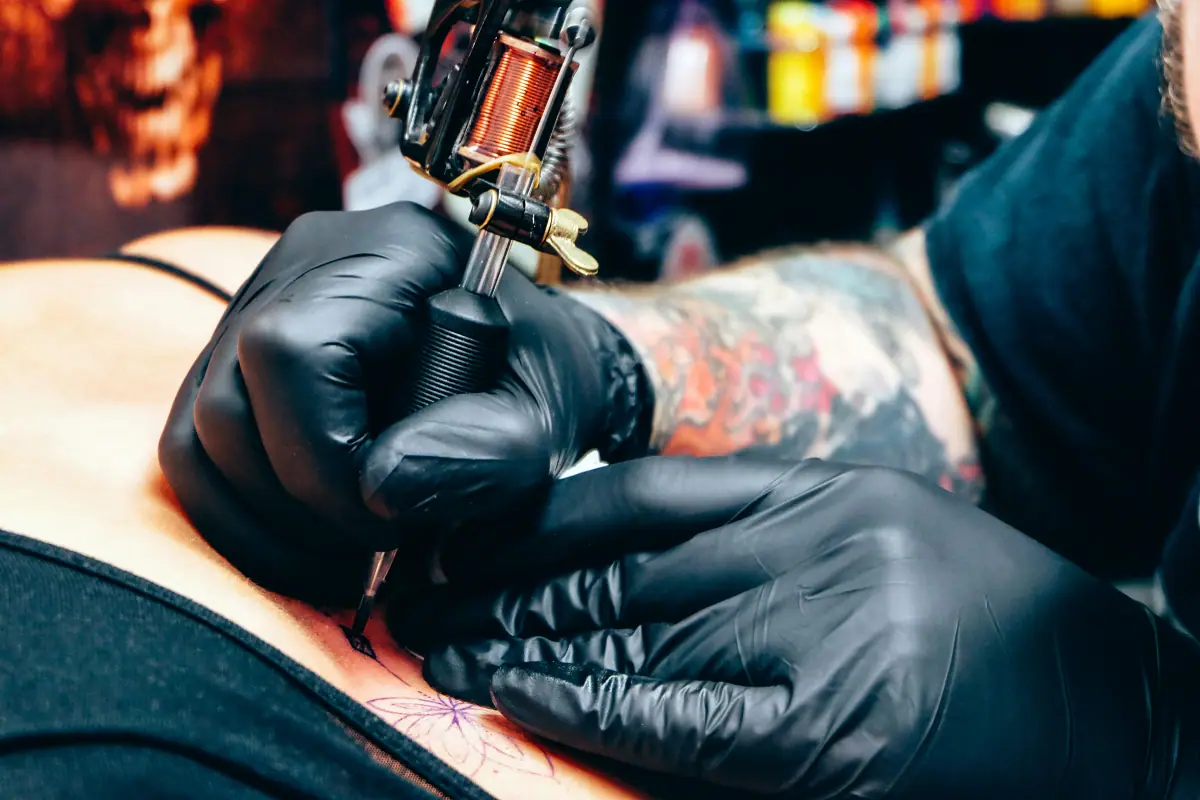
An Ogham tattoo is one of the most distinctive pieces you can get. It’s visually clean, rooted in 1,600 years of history, and genuinely legible to anyone who knows the script. Which also means it can be genuinely, permanently wrong — in a way that anyone who knows the script will immediately spot.
These are the mistakes that come up most often, and what to do instead.
1. Getting the direction backwards
Traditional Ogham reads bottom to top on vertical inscriptions. On a stone, the inscription starts at the base and climbs upward. For a spine or forearm tattoo, that means the first character of your name or word sits closest to the ground.
This is the single most common error. Some artists mirror their reference image. Some generators produce it top-to-bottom. Some people simply assume it reads the same direction as English.
How to avoid it: Before your appointment, use our Ogham translator, which labels each character individually so you can confirm the sequence. Show your artist the numbered breakdown, not just the finished rendering.
2. Using characters from unreliable sources
The classical Ogham alphabet — the Beith-Luis-Nion — is well documented and consistent across reputable sources. A small number of characters in widespread internet use are either misdrawn, invented by modern designers, or taken from damaged or misread stone inscriptions.
If you copy an inscription from an image on Pinterest or a tattoo inspiration board, you have no way of knowing whether the original generator used historically accurate characters.
How to avoid it: Generate your inscription from a source that cites its character set. Our translator uses the standard Unicode Ogham block (U+1680–U+169F), which maps directly to the historically attested characters in the Auraicept na n-Éces and related medieval sources.
3. Transliterating when you meant to translate — or the reverse
There are two ways to put a word into Ogham:
- Transliterate: map the letters of the word directly into Ogham characters. “LOVE” in English becomes ᚂᚑᚃᚓ.
- Translate: find the Irish equivalent and write that in Ogham. “Love” in Irish is grá, which becomes ᚌᚏᚐ.
Neither is wrong, but they produce completely different inscriptions — and they have different implications. Transliterating English into Ogham is a modern convention; Ogham was designed for Old Irish, so a translated Irish inscription is closer to historical use. But the transliteration is more legible to people who know your language.
How to avoid it: Decide which approach you want before you generate anything. Our translator offers both options. If in doubt, Irish single words like grá, neart, saoirse or dóchas tend to make more striking tattoos than their English transliterations.
4. A spelling mistake in the source word
Ogham maps characters faithfully to the input it’s given. Feed in a typo, get a typo in ancient script — permanently.
This is especially common with Irish language words. Síocháin (peace) and Siochain (a phonetic mangling of peace) produce different inscriptions. Oidhreacht (heritage) has a silent dh that trips up even native speakers.
How to avoid it: For Irish language words, verify the spelling in a reputable dictionary (teanglann.ie is authoritative) before you generate anything. For names, check whether the Irish spelling or the anglicised spelling is what you want — they are not interchangeable.
5. Removing the stem line
Ogham characters are defined by their relationship to a central stem. Strokes go left, right, across, or diagonally through the line — without the stem, the characters lose their reference point and become ambiguous.
Some tattoo designs strip the stem for a cleaner, more minimal look. The result is technically unreadable — the marks no longer function as letters.
How to avoid it: Keep the stem. If you want a minimal look, reduce the width of the strokes rather than removing the structure. The stem line is the script.
6. Making it too small to read
Ogham depends on the number and position of strokes relative to the stem. At small scale, the difference between B (one stroke left) and L (two strokes left) is a few millimetres. Fade and line spread make this worse over time.
A wrist piece with six characters at 4cm is already pushing the lower limit. At 3cm, the fine detail will blur within a few years.
How to avoid it: Use our 3D tattoo designer to preview the inscription at scale on the body before committing. If the characters start to blur at your intended size, use a larger placement or shorten the inscription.
7. Trusting the artist to look it up themselves
Ogham is not in the standard training set for tattoo artists. That is not a criticism — it’s simply not a common enough script for most artists to have encountered it. The problem arises when an artist is asked to “do Ogham” and searches for reference images themselves. The quality of those reference images is unpredictable.
How to avoid it: Bring a printed reference to your appointment. Print the inscription large enough to see the individual strokes clearly. Mark the direction explicitly (arrow pointing from first character to last). Ask the artist to trace a stencil before applying it, and check the stencil against your reference before the needle starts.
8. Choosing a word that looks right but means something else
This one is specific to Irish language tattoos. Irish spelling is phonetic but uses vowel combinations that look unusual to English speakers. Bua (victory) is pronounced “BOO-ah”. Aoife (a name) is “EE-fah”. Caomh (gentle, kind) is “KEEV”.
Someone who doesn’t speak Irish might look at the Ogham rendering of bua and assume it means something else, or pick a word that sounds right but transliterates to a different meaning.
How to avoid it: Before finalising your word, check both the meaning and the pronunciation. If you’re getting a word in Irish because of its meaning, spend five minutes confirming that the word you’ve found actually means what the source says it means.
The short version
- Direction: bottom to top on vertical inscriptions
- Use a reliable generator — our translator uses historically accurate characters
- Decide upfront: transliteration or Irish translation
- Spell-check before you generate, especially for Irish words
- Keep the stem line
- Don’t go too small — Ogham needs room to breathe
- Bring your own printed reference to the artist
- Verify meaning and pronunciation for Irish language words
An Ogham tattoo done right is one of the cleanest, most meaningful pieces you can get. The verification takes twenty minutes. The tattoo lasts a lifetime.
Want to design yours first? Use our free Ogham Tattoo Designer to preview your inscription on a 3D body model before you book the studio.