On 15 July 2026, at Purcell Auctioneers’ summer book sale, a small octavo manuscript in a worn half-leather binding came up as one lot among roughly 580. The estimate was €2,000.
The hammer fell at €20,000.
The Book
The manuscript is titled Irish tales collected from the Best authors now extant — 226 pages of flowing Gaelic script, compiled in 1835 by a man named Matthew Moore Graham (Mata Mórdha in Irish) of Dundalk, County Louth.
Graham was not a monk, not a professional scribe, not a university scholar. He was an engineer — assistant to the county surveyor — who spent his spare hours translating Irish poetry and copying out the old tales before they slipped away. In 1833 he published The Giantess, from the Irish of Oisin; and the Wars of Donomore in Belfast. Two years later, he produced this manuscript.
And here is the detail that made us sit up: Graham decorated his opening letters in imitation of the ancient Irish manuscripts — the insular style you know from the Book of Kells — and one illustrated page features a landscape, an Irish warrior, a shamrock design, and Ogham writing.
In 1835. Centuries after the last Ogham stone was carved, a surveyor’s assistant in Dundalk was still reaching for the old script when he wanted to say: this is ours, and it is old, and it matters.
The Kilnasaggart Connection
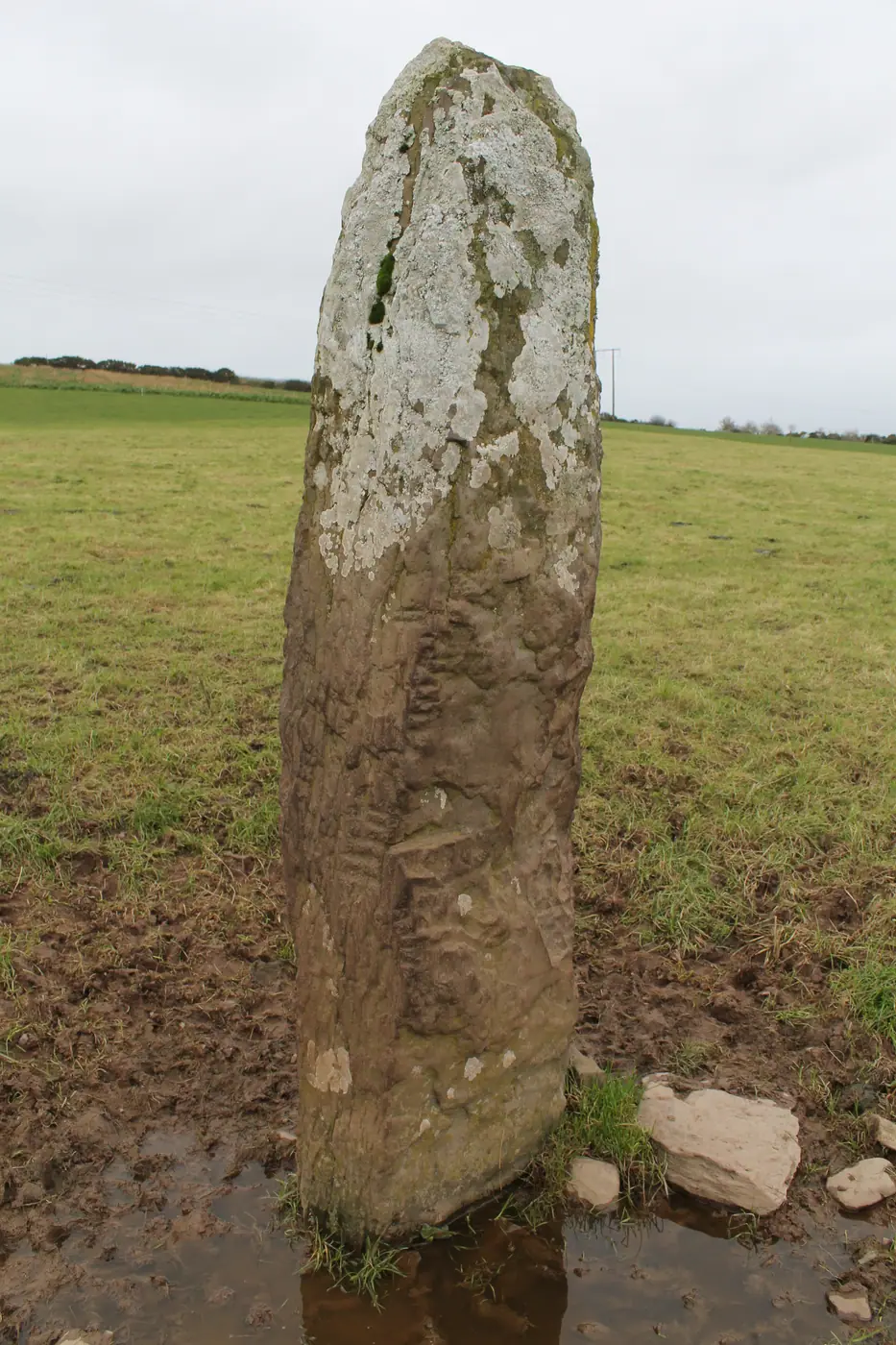
Tucked into the manuscript is a study of the inscriptions on the Kilnasaggart Stone — the granite pillar in south Armagh that is one of the earliest datable inscribed stones in Ireland, raised around 700 AD. Graham was examining and recording ancient Irish inscriptions decades before R.A.S. Macalister was even born.
It’s a good reminder that the antiquarian tradition — ordinary people walking out to old stones, puzzling over worn letters, writing down what they found — is much older than the academic discipline that grew out of it. Graham belongs to the same lineage as every person who has ever stood in a field squinting at the edge of an Ogham stone.
The Maid and the Fire
The survival of this book is closer to miracle than plan.
After Graham’s death, his manuscripts were kept by his daughter, who ran a guesthouse near Dundalk. At some point, a maid — needing to get a fire going — used a stack of the old papers as fuel. By the time the scholar Énrí Ó Muirgheasa (Henry Morris) came looking for Graham’s work in the early twentieth century, only about a dozen manuscripts survived.
Every page of Irish tales that exists today exists because it happened not to be on top of the pile on a cold morning. If that doesn’t make you want to digitise everything immediately, nothing will.
Why Ten Times the Estimate?
Manuscripts in Irish rarely come to market — most are already locked away in institutional collections. When one surfaces, especially one with named authorship, decorated pages, and this kind of provenance story, collectors and (hopefully) institutions compete hard.
The buyer hasn’t been named. Professor Pádraig Ó Macháin of University College Cork voiced the hope shared by many: that the manuscript stays in Ireland and remains accessible to scholars, rather than disappearing into a private collection — a quieter version of the maid’s fire, in its own way.
(The same sale had one more delight: a Gaelic typewriter, made in Cork, estimated at €100. It went for €1,500. Apparently 2026 is the year of the Irish-language sleeper hit.)
The Long Thread
What we love about this story is the thread it draws. An Ogham carver in the 5th century. A stonecutter at Kilnasaggart around 700. Monks illuminating manuscripts at Kells. An engineer in Dundalk in 1835, copying tales by lamplight and decorating them with Ogham because the old letters still meant something. A scholar in 1910 rescuing what the fire spared. And a saleroom in 2026 where people bid five figures to hold that thread in their hands.
The script survives because, in every century, somebody decided it was worth the trouble.
Browse the Ogham stone database to see the inscriptions that started the whole tradition, or write your own name in Ogham — no lamplight required.